Introduction: The Silent Sentinel of Global Trade
The global economy is anchored by the maritime industry, a complex web of shipping lanes that facilitates over 80% of world trade. Yet, beneath the veneer of routine logistics lies a persistent and evolving threat: maritime piracy and armed robbery. For over three decades, the International Maritime Bureau (IMB) Piracy Reporting Centre (PRC) has stood as the primary bulwark against this menace. Operating as a 24-hour nerve center, the PRC is more than just a reporting agency; it is a critical intelligence hub that saves lives, secures cargo, and informs the global policy response to piracy.
As modern piracy shifts from rudimentary boarding attempts to sophisticated, coordinated attacks, the role of the IMB PRC has never been more vital. By centralizing data and facilitating rapid response, the Centre acts as the "first responder" of the high seas, bridging the gap between distressed vessels and the international naval and law enforcement assets tasked with their protection.
Main Facts: The Mission of the IMB PRC
Founded in 1991, the IMB Piracy Reporting Centre was established in response to a surge in maritime violence that threatened the stability of international shipping routes. Based in London, the organization serves as a singular, global contact point for masters and shipowners to report incidents of piracy and armed robbery.
Core Objectives:
- Immediate Response: The PRC maintains a constant vigil, 24 hours a day, 365 days a year. Upon receiving a distress signal, the Centre immediately alerts relevant coastal authorities, naval task forces, and law enforcement agencies.
- Information Dissemination: Through a sophisticated network of warning broadcasts and email alerts, the PRC ensures that vessels in high-risk zones are kept abreast of real-time threats. This proactive intelligence allows masters to adjust routes or increase security measures before an attack occurs.
- Data Intelligence: By collating granular data on every incident—from location and time to the methodology of the attackers—the IMB provides the maritime industry and governmental bodies with the insights necessary to identify emerging trends and hotspots.
The IMB’s philosophy is built on the premise that you cannot solve a problem you cannot measure. By encouraging shipmasters to report even minor incidents of armed robbery, the PRC builds a comprehensive picture of maritime threats, which is essential for lobbying for increased naval patrols and law enforcement resource allocation in volatile regions.
Chronology: A Legacy of Maritime Protection
The evolution of the IMB PRC mirrors the changing face of maritime crime. Since its inception, the Centre has adapted its tactics to address distinct waves of piracy that have threatened global commerce.
- 1991: The Foundation: Following a spike in incidents in the Southeast Asian waters, the International Chamber of Commerce (ICC) established the PRC. The initial goal was to centralize incident reporting, which was previously fragmented and often ignored by local jurisdictions.
- 1990s–2000s: The Rise of Southeast Asian Piracy: The PRC played a pivotal role in exposing the systemic nature of piracy in the Malacca Strait. Its reports provided the leverage needed to encourage littoral states to cooperate in joint maritime patrols.
- 2008–2012: The Somali Crisis: This period marked the most intense challenge for the PRC. As piracy off the coast of Somalia threatened global energy supplies, the IMB acted as the primary conduit between the shipping industry and the international naval coalitions (such as EUNAVFOR). The PRC’s real-time monitoring was instrumental in the implementation of "Best Management Practices" (BMP), which significantly reduced successful hijackings.
- 2015–Present: Diversification of Threats: In recent years, the center has tracked a shift in piracy from the Gulf of Aden to the Gulf of Guinea and, more recently, a resurgence in incidents within the Singapore Strait and the Caribbean. The PRC has evolved to monitor not only physical hijacking but also the kidnapping of crew for ransom and cyber-enabled piracy tactics.
Supporting Data: Understanding Modern Piracy
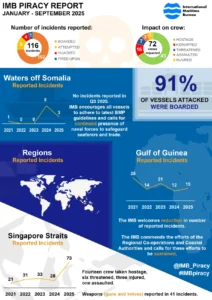
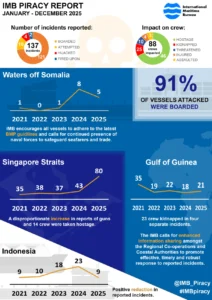
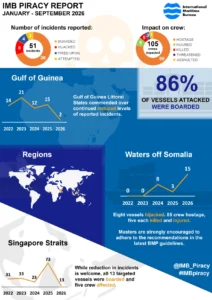
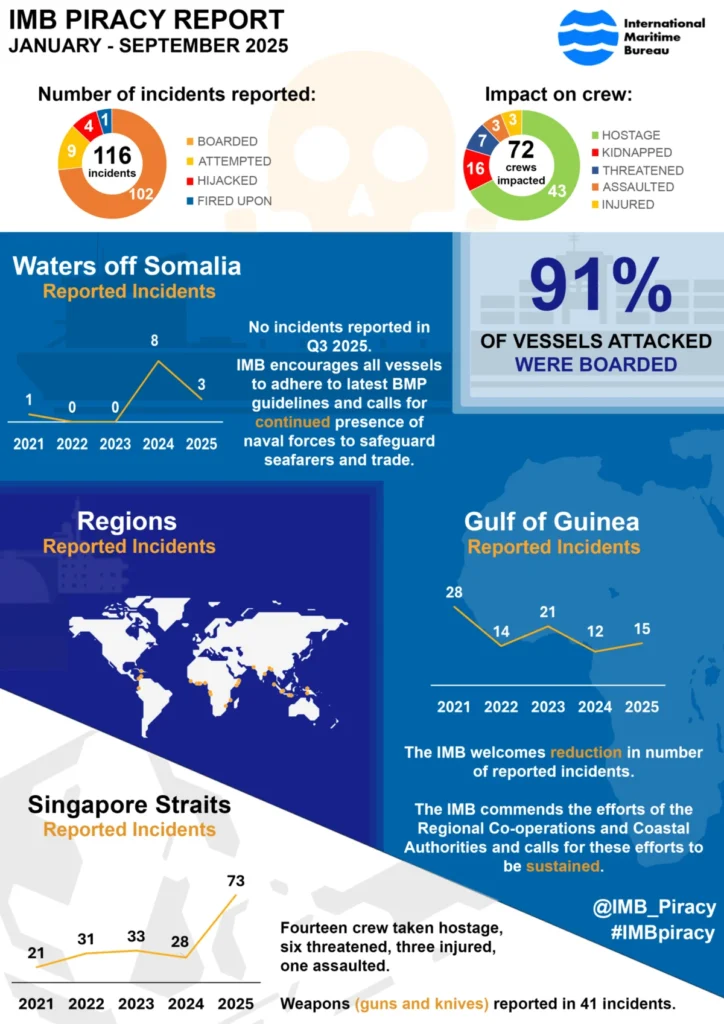
The latest data from the January to September 2025 Piracy and Armed Robbery Against Ships report highlights a nuanced landscape of threats. While the era of large-scale, long-term vessel hijackings has been dampened by increased security, the frequency of armed robberies in ports and anchorages remains a persistent nuisance that costs the industry billions in delays, increased insurance premiums, and security upgrades.
The Anatomy of an Attack
The 2025 report underscores several critical trends:
- Opportunistic Robbery: The majority of reported incidents involve low-level, opportunistic robberies where perpetrators board vessels at anchor, often under the cover of darkness, to steal ship stores or personal effects.
- The "Hotspot" Shift: Data indicates a concentration of incidents in specific regional corridors. The PRC’s ability to map these hotspots allows for the "dynamic routing" of commercial vessels, essentially steering them away from danger zones before they enter the reach of pirate skiffs.
- The Power of Reporting: A core finding in the 2025 analysis is that regions with higher rates of reporting tend to see a faster response from local authorities. When the IMB PRC facilitates the reporting process, it creates a "paper trail" that forces accountability upon the coastal states responsible for those territorial waters.
The full report is an essential read for shipowners and insurers alike, serving as a roadmap for risk assessment and the allocation of physical security resources, such as hardened bridge citadels and armed security details.
Official Responses: The Institutional Consensus
The IMB PRC does not operate in a vacuum. Its legitimacy is drawn from its partnership with international organizations, including the International Maritime Organization (IMO) and various regional maritime security centers.
The Director’s Perspective
Michael Howlett, Director of the ICC International Maritime Bureau, has frequently emphasized that maritime security is a collective responsibility. According to Howlett, the greatest enemy of safety is complacency. He stresses that "the IMB PRC acts as the eyes and ears of the industry. However, those eyes can only see as far as the reports provided by the masters at sea."
Howlett’s office works tirelessly to ensure that shipowners understand the legal and safety benefits of reporting incidents. In many instances, the data compiled by the IMB is the primary evidence used by international courts to prosecute pirates. By maintaining a meticulous chain of custody for incident reports, the IMB ensures that justice is not just a concept, but a tangible outcome of maritime policing.
The Role of Regulatory Bodies
The IMO recognizes the IMB PRC as a critical reporting node. Many flag states now mandate that their vessels report all suspicious activity to the PRC as part of their Safety Management System (SMS). This institutional recognition has elevated the PRC from a private initiative to an indispensable component of the global maritime architecture.
Implications: The Future of Maritime Security
Looking ahead, the implications of the IMB PRC’s work are profound. As the global shipping industry transitions toward autonomous and semi-autonomous vessels, the nature of piracy will inevitably evolve to target the digital and remote-operation systems of these ships.
Technological Adaptation
The future of the IMB PRC involves integrating satellite surveillance, AI-driven pattern recognition, and real-time cyber-incident reporting. As ships become more "connected," the line between physical piracy and cyber-piracy will blur. The PRC is already positioning itself to be at the forefront of this, ensuring that the same spirit of cooperation used to fight pirates with skiffs is applied to those fighting with code.
Economic and Humanitarian Impacts
The implications of the IMB’s work are not merely economic. Every ship that avoids a pirate attack represents a crew that remains safe, a supply chain that remains unbroken, and a delivery that reaches its destination. The humanitarian aspect—preventing the trauma of kidnapping and the violence associated with armed robbery—is perhaps the most significant, yet often overlooked, achievement of the Centre.
A Call to Action
The IMB encourages all stakeholders—from individual shipmasters to multi-national logistics corporations—to view the IMB PRC not as an administrative burden, but as a strategic partner. Reporting an incident is a contribution to the global commons; it helps ensure that limited naval resources are deployed where they are most needed and that international pressure is applied to states failing to secure their waters.
Conclusion: Securing the Blue Economy
The IMB Piracy Reporting Centre remains the sentinel of the high seas. In an era of geopolitical uncertainty and supply chain fragility, the work conducted by Michael Howlett and his team at the ICC International Maritime Bureau is more critical than ever. By providing the data, the alerts, and the coordination necessary to navigate a dangerous world, the PRC ensures that the lifeblood of the global economy—shipping—continues to flow.
As the industry moves through 2025 and beyond, the message from the IMB is clear: vigilance is the price of security. For those operating on the water, the PRC is the first number to call in a crisis and the first partner in the long-term quest for a safer, more secure maritime environment.
For further inquiries, detailed incident analysis, or to request access to the latest security briefings, please contact:
Michael Howlett
Director, ICC International Maritime Bureau
Tel: +44 207 423 6960
Email: [email protected]
Download the latest report on Piracy and Armed Robbery Against Ships (January–September 2025) at the official ICC-CCS portal.