Introduction: The Sentinel of Global Trade
In an era where over 80% of global trade is transported by sea, the safety of maritime corridors is not merely a logistical concern—it is a cornerstone of global economic stability. Since its inception in 1991, the International Maritime Bureau (IMB) Piracy Reporting Centre (PRC) has functioned as the world’s foremost shield against the scourge of maritime crime. Operating as a 24-hour, single-point-of-contact nexus, the IMB PRC serves as a critical bridge between vulnerable vessels on the high seas and the regional authorities capable of intercepting criminal activities.
As the complexities of maritime threats evolve—moving from traditional piracy to sophisticated armed robbery, kidnapping for ransom, and cyber-enabled maritime crime—the role of the IMB PRC has become increasingly indispensable. This report examines the operational framework of the IMB, the historical context of its interventions, and the vital importance of real-time reporting in maintaining the integrity of global shipping lanes.
The Operational Mandate: A 24/7 Guardian
The IMB Piracy Reporting Centre was established by the International Chamber of Commerce (ICC) with a singular, urgent mission: to provide a centralized hub for reporting piracy and armed robbery incidents. Before the center’s existence, shipmasters often faced a fragmented response system, with no clear channel for alerting global authorities to ongoing threats.
Core Functions and Response Mechanisms
The PRC’s operational model is built on three pillars: Reporting, Coordination, and Intelligence.
- Immediate Response: When a ship reports an attack, the IMB acts as a force multiplier. It immediately relays critical information to local coastal agencies, navies, and law enforcement. This rapid dissemination is often the difference between a successful hijack and a thwarted attempt.
- Warning Systems: Utilizing its global network, the IMB issues immediate broadcasts and email alerts to vessels navigating through high-risk areas. These warnings provide shipmasters with the situational awareness required to implement "hardened" security measures, such as the Best Management Practices (BMP).
- Data Synthesis: Beyond emergency response, the PRC serves as the world’s leading repository for maritime crime statistics. By meticulously tracking the location, method, and outcome of every reported incident, the IMB provides policymakers with the data necessary to allocate naval assets effectively.
Chronology: Thirty-Four Years of Combatting Maritime Crime
To understand the significance of the IMB’s work, one must look at the evolution of piracy over the last three decades.
1990s: The Foundation
When the PRC was launched in 1991, piracy was often viewed as a regional nuisance. However, the surge in attacks in Southeast Asian waters and the Malacca Strait necessitated a professionalized response. The IMB’s early years focused on establishing communication protocols that transcended national borders.
2000s: The Rise of Somali Piracy
The early 2000s saw a paradigm shift. The collapse of civil order in Somalia led to a massive spike in high-seas hijacking. The IMB played a foundational role in coordinating the international response, which eventually involved the deployment of multi-national naval task forces. The PRC’s logs from this period provide a harrowing look at the risks faced by merchant mariners, including long-term hostage-taking and the use of "mother ships" to extend the range of pirate attacks.
2010s to Present: Diversification of Threats
In the last decade, the theater of conflict shifted to the Gulf of Guinea and back toward the Sulu and Celebes Seas. Modern threats now include "opportunistic" armed robbery, where perpetrators board vessels at anchor to steal cargo or ship stores, as well as sophisticated kidnapping operations. The IMB has continuously updated its protocols to address these evolving tactical trends, emphasizing the necessity of early detection.
Supporting Data: The 2025 Landscape
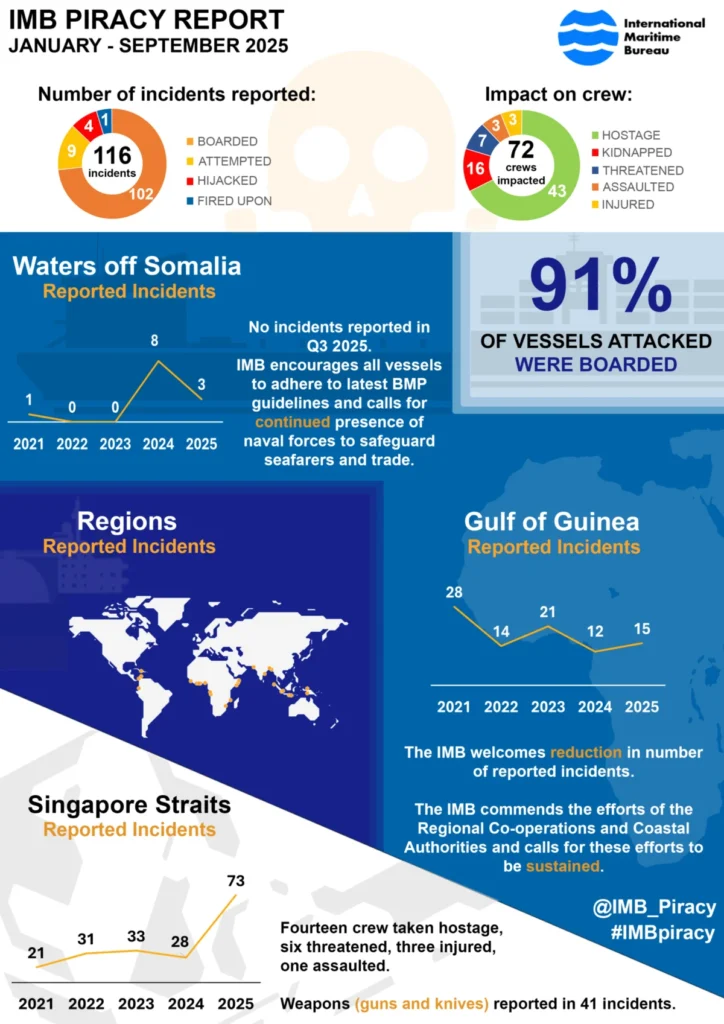
The recently released Piracy and Armed Robbery Against Ships report (covering January to September 2025) highlights that while international naval cooperation has dampened the success rate of attacks, the frequency of incidents remains a persistent challenge to global supply chains.
Key Data Insights
- Incident Density: The data reveals that a significant percentage of incidents occur while ships are at anchor or in port. This indicates that current security challenges are not limited to the open ocean but are heavily influenced by port security infrastructure.
- The "Reporting Gap": The IMB emphasizes that the data is only as good as the reporting. Under-reporting remains a significant hurdle. When shipowners fail to report "near misses" or minor boardings, authorities are unable to identify emerging "hot spots," allowing criminals to operate with impunity in those zones.
- Impact of Hardening: Vessels that implement the IMB’s recommended hardening measures—such as increased watch keeping, citadel implementation, and the use of razor wire—report significantly lower success rates for pirates.
The full report for 2025, available via the ICC-CCS website, provides a granular breakdown of these trends, serving as an essential tool for Chief Security Officers (CSOs) and ship operators worldwide.
Official Responses and Industry Collaboration
The IMB does not operate in a vacuum. Its effectiveness is predicated on its collaboration with the International Maritime Organization (IMO), regional coast guards, and private industry stakeholders.
A Call for Industry Accountability
Michael Howlett, Director of the ICC International Maritime Bureau, has consistently advocated for a culture of transparency. In official statements, Howlett has urged shipmasters and owners to view the IMB PRC not as a bureaucratic hurdle, but as a critical ally.
"The reporting of every incident, no matter how small, is a vital first step in ensuring that authorities allocate resources to the right areas," Howlett noted. "Without accurate, real-time data, maritime security becomes reactive rather than proactive. By reporting, owners are not just protecting their own crews, but contributing to the safety of the entire shipping community."
Government and Navy Coordination
The IMB provides the intelligence that allows governments to justify the cost of naval patrols. In regions where piracy has been successfully suppressed, it is almost always due to the synergy between the intelligence provided by the IMB and the operational deployment of state security forces.
Implications: The Future of Maritime Security
As we look toward the remainder of 2025 and beyond, several implications arise from the current state of maritime security.
1. The Technology-Security Nexus
Modern piracy is increasingly aided by technology. Perpetrators use AIS (Automatic Identification System) tracking to identify slow-moving vessels or those with lower freeboards. The IMB is actively working to ensure that the maritime industry understands the risks of digital exposure, advocating for better cybersecurity practices alongside physical security.
2. Economic Consequences
The cost of piracy is not just the value of stolen goods or ransom payments. It includes increased insurance premiums, the necessity of hiring armed security guards, and the diversion of vessels, which adds days to transit times and increases fuel consumption. The work of the IMB PRC acts as a direct stabilizer for these costs, helping to keep global shipping rates competitive.
3. Crew Welfare
At the heart of the IMB’s mission is the human element. Piracy is a traumatic experience for crews. The PRC’s commitment to providing 24/7 support is a testament to the industry’s responsibility toward the men and women who keep the global economy moving.
Conclusion: A Collective Responsibility
The IMB Piracy Reporting Centre remains the bedrock of maritime safety. Its 34-year history demonstrates that piracy is a challenge that can be managed, but only through collective action. By providing the intelligence, coordination, and advocacy necessary to combat these threats, the IMB ensures that the high seas remain a viable corridor for trade.
For shipowners, operators, and masters, the message is clear: Report, document, and cooperate. The IMB PRC is ready to assist at any hour of the day or night. In the fight against maritime crime, every report is a victory for safety and a deterrent against those who seek to disrupt the flow of global commerce.
For more information, please contact:
Michael Howlett,
Director, ICC International Maritime Bureau
Tel: +44 207 423 6960
Email: [email protected]
To access the latest insights and security trends, download the January to September 2025 Piracy and Armed Robbery Against Ships report via the official ICC-CCS portal.