
LONDON – The global maritime landscape faced a challenging year in 2025, marked by a palpable uptick in piracy and armed robbery against commercial shipping vessels. According to the latest Annual Piracy and Armed Robbery Report released by the ICC International Maritime Bureau (IMB), the year saw a concerning reversal of recent trends, with the frequency of attacks climbing to levels not seen in the previous two years.
As maritime trade remains the lifeblood of the global economy, the surge in incidents—ranging from opportunistic boarding to calculated hijackings—has sent ripples of concern through the shipping industry. While the containment of Somali-based piracy efforts stands as a rare success story, the focus of global maritime authorities has shifted toward the Singapore Straits and other high-traffic corridors where the threat to crew safety and economic stability has intensified.
The State of Global Maritime Security: Key Facts and Figures
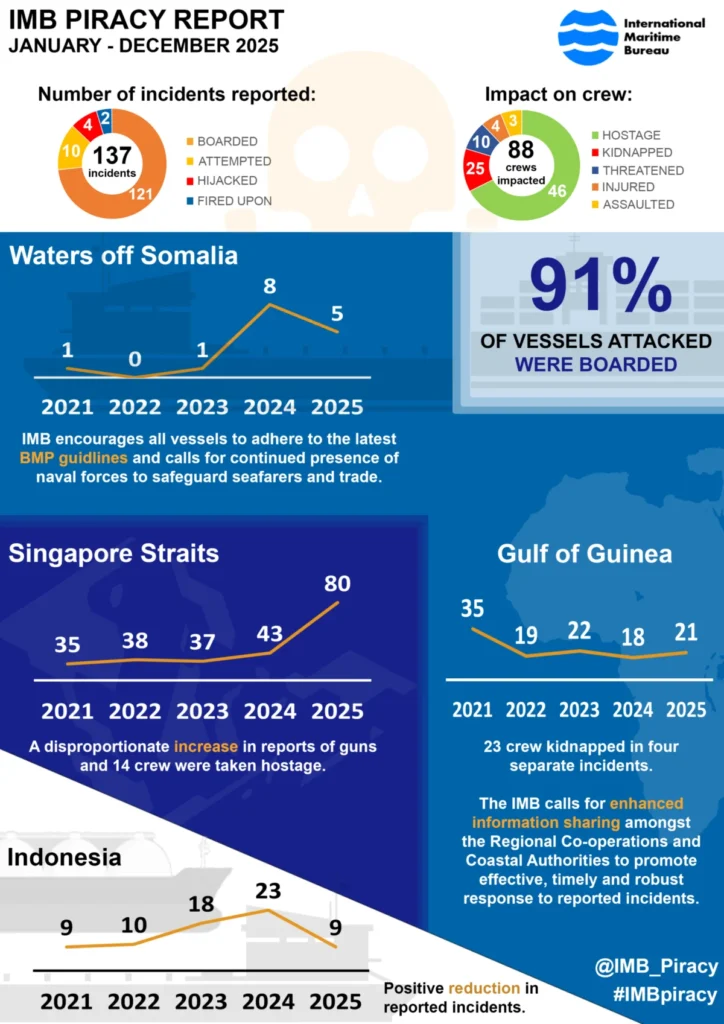
The IMB’s 2025 data paints a sobering picture for the maritime industry. A total of 137 incidents of piracy and armed robbery against ships were officially recorded throughout the year. This represents a significant increase from the 116 incidents reported in 2024 and the 120 recorded in 2023.
Breakdown of Reported Hostilities
The nature of these attacks reflects an evolving strategy among perpetrators. The 2025 report categorizes the incidents as follows:
- Boardings: 121 vessels were successfully boarded by perpetrators.
- Hijackings: Four vessels were seized, indicating a high level of coordination and intent.
- Armed Assaults: Two vessels were fired upon, representing a escalation in the level of violence used.
- Attempted Attacks: 10 incidents were classified as failed attempts, often thwarted by crew vigilance or physical vessel hardening.
While the majority of these events are classified by the IMB as "low-level" incidents—often involving theft of ship stores or petty larceny—the human cost remains disproportionately high. The psychological and physical toll on seafarers is a recurring theme in the report, which highlights that 46 crew members were taken hostage in 2025. While this figure is a decrease from the 126 hostages taken in 2024, the spike in kidnappings tells a different story.
The Rise of Kidnapping and Weaponry
Perhaps the most alarming statistic in the 2025 report is the increase in kidnapping for ransom. Twenty-five crew members were reported kidnapped in 2025, nearly doubling the 12 cases reported in 2024 and significantly higher than the 14 reported in 2023. This trend suggests that criminal syndicates are increasingly viewing crew members as high-value commodities rather than collateral damage.
Furthermore, the escalation in the lethality of equipment used by attackers is notable. The use of firearms was reported in 42 incidents in 2025, a dramatic increase from the 26 incidents recorded in 2024. Conversely, the use of knives—typically associated with opportunistic, low-level robbery—dipped slightly, appearing in 33 incidents compared to 39 in the previous year. This shift toward firearms suggests that attackers are becoming more brazen, better equipped, and more willing to engage in lethal force to achieve their objectives.
A Chronological Overview: Tracking the 2025 Trendline
The progression of maritime security throughout 2025 was not uniform. The first quarter of the year began with a steady stream of reports from Southeast Asian waters, particularly the Singapore Straits, which consistently ranked as the primary hotspot for maritime crime.
- Q1 2025: The year opened with a focus on the Singapore Straits. Increased traffic density, combined with the low-profile nature of local criminal groups, led to a cluster of boarding incidents reported in the early months.
- Q2 2025: As seasonal weather patterns shifted, maritime security forces observed a tactical evolution in the Gulf of Guinea and Southeast Asia. The IMB noted a move toward more coordinated attacks on anchored vessels.
- Q3 2025: The mid-year period saw a stabilization of the Somali piracy threat. Due to a sustained and robust naval presence—a combination of international coalition patrols and private security initiatives—the once-prolific pirate networks off the Horn of Africa were largely contained, preventing a resurgence of the large-scale hijackings that plagued the region in previous decades.
- Q4 2025: The final quarter saw a surge in incidents in high-traffic trade lanes, coinciding with the peak shipping season. The concentration of vessels during this period provided, in the eyes of the IMB, "fertile ground" for perpetrators looking to exploit gaps in surveillance.
The Singapore Straits: A Global Hotspot
The Singapore Straits have become the focal point of the IMB’s concern. Due to the narrowness of the waterway and the volume of vessels passing through the world’s busiest shipping lanes, the straits offer an ideal environment for armed robbers to board slow-moving or anchored ships. In 2025, the number of incidents here surpassed all other global maritime regions.
The modus operandi in this region is typically to board under the cover of darkness, steal whatever is immediately accessible—such as engine parts, paint, or electronics—and flee before the crew can raise a coordinated alarm. While these acts are "low-level," they disrupt the flow of trade and create an atmosphere of persistent insecurity for crews.
Official Responses and Strategic Imperatives
The release of the 2025 report has prompted calls for a renewed commitment to maritime safety from international governing bodies. ICC Secretary General John W.H. Denton AO emphasized that the safety of seafarers is inextricably linked to the stability of the global economy.
"Maritime trade remains a cornerstone of real economic activity and growth," Denton noted. "The rise in reported maritime incidents highlights the importance of protecting seafarers and securing key shipping routes, not only for crew safety but for the stability of global supply chains and the economies that depend on them."
The Call for Multilateral Cooperation
Denton’s sentiments echo a growing consensus among shipping lines and insurers: maritime security cannot be solved by individual flag states alone. The IMB advocates for:
- Enhanced Information Sharing: Creating real-time intelligence loops between commercial vessels and regional naval authorities.
- Increased Patrols: Maintaining a visible naval presence in high-risk transit areas to act as a deterrent.
- Vessel Hardening: Encouraging ship operators to adhere strictly to Best Management Practices (BMP), which include the use of razor wire, water cannons, and the maintenance of a "citadel" (a safe room) to protect crew during an active boarding.
- Legislative Reform: Urging littoral states to prosecute apprehended pirates and robbers, ensuring that the legal consequences for these crimes act as a genuine deterrent.
Implications for Global Supply Chains and Insurance
The rise in maritime crime has direct and indirect consequences for the global economy. For the shipping industry, every boarding incident results in insurance premiums rising, which are eventually passed down to the consumer. Furthermore, the threat of violence forces shipping companies to invest heavily in security measures, including the hiring of Private Maritime Security Companies (PMSCs) and the implementation of expensive, non-standard transit routes that increase fuel consumption and delivery times.
The Human Cost
Beyond the balance sheets, the human cost is immeasurable. The 2025 figures show that 10 crew members were threatened, four were injured, and three were assaulted. These incidents result in significant psychological trauma, leading to high turnover rates in an industry already facing a chronic shortage of qualified seafarers. The "fear factor" associated with transiting high-risk areas makes recruitment more difficult and undermines the dignity of the profession.
Economic Stability
As the world continues to recover from the logistical disruptions of the early 2020s, the maritime industry remains the backbone of global commerce, moving over 80% of all traded goods. When piracy threatens these routes, it creates a systemic risk. A single successful hijacking of a critical cargo ship can lead to supply chain bottlenecks, inflationary pressures on essential goods, and a loss of confidence in maritime logistics.
Conclusion: Looking Toward 2026
As the maritime industry enters 2026, the IMB’s report serves as a wake-up call. The containment of Somali piracy proves that when the international community prioritizes maritime security, it can effectively suppress criminal activity. However, the shifting nature of threats in the Singapore Straits and the rise in kidnappings elsewhere indicate that maritime criminals are adapting to modern security measures.
Ensuring safe passage at sea will require a sustained, multi-layered approach. It demands that governments and private sector stakeholders move beyond reactive measures and invest in proactive, intelligence-led strategies. Without a coordinated global response, the 2026 maritime landscape risks becoming even more hazardous, threatening the integrity of the very trade routes that sustain our modern world. The message from the IMB is clear: the safety of those at sea is not just a maritime issue; it is a global economic imperative that requires immediate, collective, and unwavering attention.