In the complex, interconnected web of global commerce, the maritime industry serves as the circulatory system of the modern economy. With over 80% of the world’s trade volume transported by sea, the safety and security of shipping lanes are not merely industry concerns; they are fundamental requirements for global economic stability. At the heart of this security architecture stands the International Maritime Bureau (IMB) Piracy Reporting Centre (PRC), an organization that has become the definitive frontline defense against maritime crime.
As the geopolitical landscape shifts and criminal syndicates employ increasingly sophisticated tactics, the IMB PRC’s role as a 24-hour, single point of contact has never been more critical. By providing real-time support to vessels under threat and disseminating transparent, reliable data to governments and international authorities, the PRC acts as a lighthouse in the often-murky waters of maritime security.
The Genesis and Evolution of the IMB Piracy Reporting Centre
To understand the current state of maritime security, one must look at the historical trajectory of piracy and armed robbery against ships. The IMB Piracy Reporting Centre was established in 1992, a time when piracy was transitioning from localized nuisances into a transnational security threat.
Chronology of Intervention
- 1992: The IMB Piracy Reporting Centre is formally inaugurated in Kuala Lumpur, Malaysia, to act as a global clearinghouse for reports of piracy and armed robbery.
- The 2000s (The Somali Crisis): The PRC becomes the primary source of actionable intelligence during the height of the Somali piracy epidemic, helping coalition naval forces coordinate patrols and protect shipping lanes.
- The 2010s (Shift to West Africa): As Somali piracy declined due to international naval intervention and the widespread adoption of Best Management Practices (BMP), the PRC shifted its focus to the rising tide of attacks in the Gulf of Guinea.
- The 2020s (Digital Integration): The PRC modernizes its reporting infrastructure, integrating real-time satellite tracking and automated alert systems to provide instantaneous warnings to ships operating in high-risk zones.
Today, the PRC operates as a 24/7 hub. Its mandate is clear: to minimize the loss of life, injury, and cargo by serving as a bridge between distressed vessels and the international naval assets capable of providing assistance.
Supporting Data: Why Transparency Matters
The credibility of the IMB PRC rests upon its rigorous data collection methods. Unlike other reporting agencies that may be influenced by political considerations, the PRC maintains a strictly neutral and evidence-based reporting standard.
The Power of Reliable Statistics
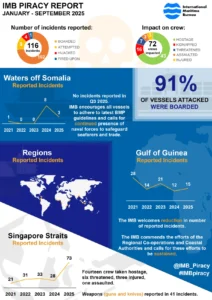
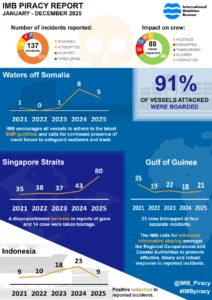
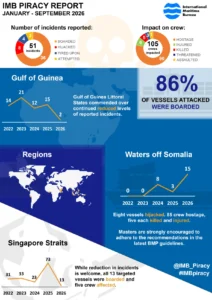
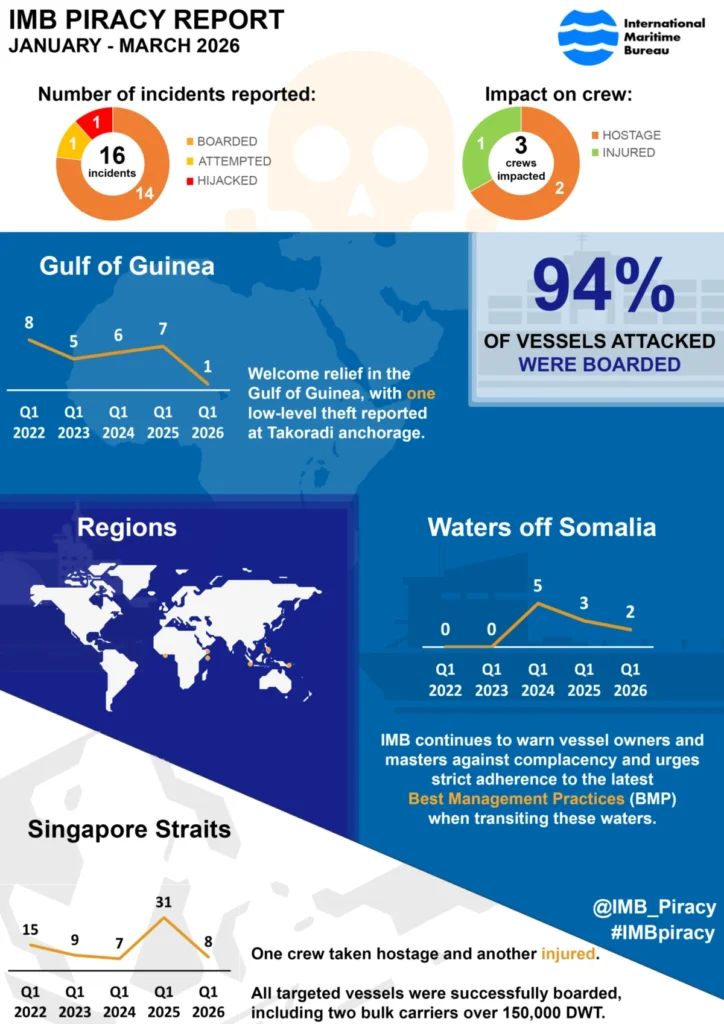
The data published by the PRC—which includes annual and quarterly reports on global piracy—serves as the benchmark for insurance premiums, security risk assessments, and governmental policy decisions. When the IMB issues an alert, the maritime industry listens.
Data points tracked by the PRC include:
- Geographic Hotspots: Precise mapping of incidents to help vessels adjust their transit routes.
- Modus Operandi: Analysis of how attackers board ships (e.g., use of ladders, weapons, speedboats) to help shipowners harden their defenses.
- Vessel Vulnerability: Assessing which vessel types (tankers, bulk carriers, or container ships) are targeted and why.
This transparency is not just for the benefit of shipowners. It allows international authorities to allocate limited naval assets to regions where they are most needed, maximizing the efficiency of maritime patrol operations.
Official Perspectives: The Leadership of the ICC
The IMB functions under the umbrella of the International Chamber of Commerce (ICC), the world’s largest business organization. Representing more than 45 million companies in over 170 countries, the ICC provides the institutional weight necessary to lobby for safer seas.
Michael Howlett, Director of the ICC International Maritime Bureau, emphasizes that the PRC is more than just a reporting office. "The PRC operates as a 24-hour, single point of contact, providing free support to vessels under threat and delivering transparent, reliable data to the maritime industry, authorities and governments worldwide," says Howlett.
His office serves as the primary liaison between the private sector and intergovernmental organizations like the International Maritime Organization (IMO). By channeling the collective voice of the global business community, the ICC ensures that maritime safety remains at the top of the international agenda.
Implications for Global Trade and Regulation
The implications of the IMB PRC’s work extend far beyond the hulls of individual vessels. Security at sea is inextricably linked to the cost of consumer goods, the stability of supply chains, and the efficacy of international maritime law.
1. Economic Stability and Supply Chain Integrity
When piracy rates rise, shipping companies are forced to take longer, safer routes or pay exorbitant insurance premiums. These costs are eventually passed on to the consumer, contributing to inflation and supply chain volatility. By mitigating the risk of attack, the PRC plays a silent but vital role in keeping global trade costs manageable.
2. Legal and Regulatory Standard Setting
The ICC’s influence is instrumental in promoting "responsible business conduct." Through the IMB PRC, the ICC advocates for a global approach to regulation. This involves encouraging states to uphold their obligations under the United Nations Convention on the Law of the Sea (UNCLOS), ensuring that pirates are prosecuted in the jurisdictions where they are captured.
3. The Human Element
Often lost in the statistics of "cargo losses" and "insurance costs" is the human reality. The IMB PRC is dedicated to the safety of seafarers. Being taken hostage is a traumatic experience that carries long-term psychological consequences. The PRC’s focus on providing support to vessels under threat is, at its core, a humanitarian endeavor aimed at protecting the essential workers who keep the world running.
Future Challenges: Adapting to New Threats
As we look toward the future, the maritime security environment is evolving. The digitalization of the shipping industry brings new vulnerabilities, including the potential for cyber-piracy. Furthermore, the rise of regional conflicts in the Red Sea and other strategic choke points has created a complex security environment where traditional piracy is now intertwined with state-sponsored aggression and maritime terrorism.
The IMB PRC remains committed to evolving alongside these threats. By maintaining a robust network of contacts and leveraging advanced technology, the organization ensures that the maritime community is never left in the dark.
Engaging with the IMB
For companies and stakeholders seeking to stay informed, the IMB provides essential resources. Regular updates from the PRC can mean the difference between a secure transit and a high-stakes emergency.
For more information, please contact:
Michael Howlett
Director, ICC International Maritime Bureau
Tel: +44 207 423 6960
Email: [email protected]
Conclusion: A Global Partnership for Safer Seas
The International Chamber of Commerce (ICC) operates on the core mission of making business work for everyone, every day, everywhere. Through a unique mix of advocacy, solutions, and standard setting, the ICC and the IMB PRC have established a gold standard for security and cooperation.
Maritime piracy is not a problem that any single nation can solve alone. It requires a collaborative effort that brings together the private sector, governmental agencies, and international bodies. The IMB Piracy Reporting Centre serves as the glue in this coalition, ensuring that information flows freely, warnings are issued promptly, and the voices of the maritime community are heard at the highest levels of governance.
As long as the seas remain a vital artery for global prosperity, the vigilance provided by the IMB PRC will remain an indispensable asset. By championing transparency, providing professional support, and fostering a global approach to maritime safety, the IMB continues to protect not only the ships and the cargo they carry but the integrity of the global economy itself.
In an era of uncertainty, the IMB Piracy Reporting Centre stands as a testament to what can be achieved when private enterprise takes the lead in addressing public security challenges. Whether through the advocacy of the ICC or the real-time operational support of the PRC, the maritime industry is better equipped today than ever before to face the challenges of the open ocean. Through continued partnership and the commitment to data-driven security, the goal of "safe seas for all" remains not just an aspiration, but an achievable reality.