
For many homeowners, the kitchen is the heart of the residence—a place where functionality meets daily life. However, for the millions of Americans living in manufactured homes, the kitchen can quickly become a source of frustration. A simple trip to a local big-box hardware store often ends in disappointment: a faucet that looks perfect on the shelf, only to prove incompatible with the unique plumbing configurations of a double-wide, or cabinet hinges that fail to align with proprietary factory drill patterns. This "Saturday-wasting" cycle of purchasing, testing, and returning is a rite of passage for mobile home owners, but it is an unnecessary one.
Understanding the unique DNA of a manufactured home kitchen is the key to transforming maintenance from a scavenger hunt into a systematic, predictable process. By moving away from "off-the-shelf" assumptions and adopting a strategy rooted in precision measurement and specialized sourcing, homeowners can reclaim their weekends and ensure their home’s longevity.
The Genesis of Non-Standard Sizing
To understand why your kitchen doesn’t adhere to the "standard" dimensions found in site-built housing, one must look at the post-World War II housing boom. As the manufactured housing industry scaled rapidly to provide affordable, rapid-assembly homes for a growing middle class, efficiency was the driving force.
Factories optimized every square inch to reduce weight and material costs. Consequently, they established their own internal standards for cabinet depths, drawer slide lengths, and hinge placements. These were not errors; they were engineering choices designed to balance structural integrity with the logistics of highway transport. A generation later, these proprietary specifications remain, meaning a cabinet door in a 1980s mobile home may operate on a hinge configuration that no longer exists in mass-market retail.
The Myth of the "Standard" Kitchen
When homeowners attempt to apply residential construction norms to a manufactured home, they inevitably encounter friction. Cabinet boxes in these homes are frequently shallower than the 24-inch depth typical of traditional homes. Drawer slides are often shorter, and hinge plates are mounted at custom intervals to accommodate thinner, lighter-weight wall materials.
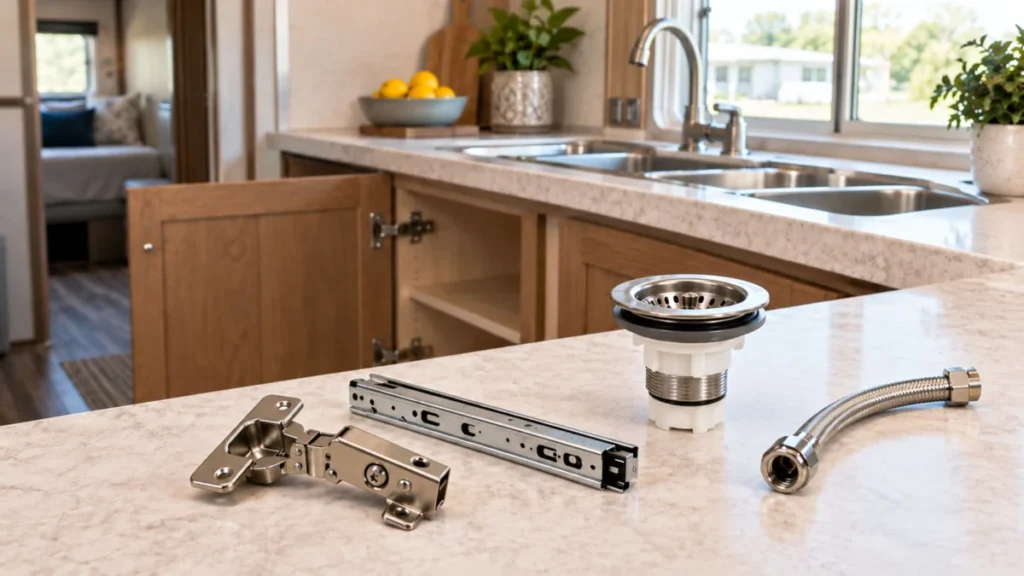
What this means for the homeowner: Never purchase replacement components based on labels or generic descriptions. The only reliable metric is the physical part itself. Before heading to a supplier, extract the old component, place it on a flat surface, and measure it. Key dimensions—hinge cup diameter, screw hole spacing, total slide length, and door thickness—should be recorded. Keeping a running list of these dimensions on a piece of painter’s tape inside a cabinet door is a professional-grade habit that saves hours of guesswork.
The Chronology of a Successful Repair
Approaching a kitchen repair requires a disciplined, five-step methodology. By treating each fix as a technical project rather than an impulse purchase, you eliminate the risk of the "half-inch error."
- Diagnostic Extraction: Remove the damaged part. Do not attempt to measure while the item is still installed, as angles and lighting can distort your readings.
- Documentation: Use a digital camera to photograph the part from multiple angles, including any serial numbers or manufacturer markings.
- Verification of Proprietary Status: Assume the part is proprietary. Research the part against the original home manufacturer’s specs if available, or cross-reference with specialized mobile home parts databases.
- Specialized Sourcing: Bypass the general hardware aisle. Consult catalogs from retailers who specifically serve the manufactured housing industry.
- Installation and Reinforcement: When installing, check the underlying substrate. If the material is compromised, reinforce it with hardwood backing before tightening the final screws.
Supporting Data and the "Universal" Exception
While cabinets and hardware are often proprietary, some elements of the mobile home kitchen are universal. Standard plumbing fixtures, such as specific braided water supply lines and certain P-trap configurations, often mirror those found in site-built homes. Identifying these "crossover" components can save significant time and shipping costs.
However, the list of truly universal items is short. Sinks, range hoods, and counter sections are almost exclusively manufactured-home-specific. According to industry logistics data, the cost of shipping oversized or heavy kitchen components often exceeds the price of the part itself. Therefore, the "measure twice, buy once" rule is not just a suggestion—it is a financial necessity.
Economic Context and Professional Assistance
When budgeting for kitchen repairs, homeowners often underestimate the impact of labor and logistics. While parts are generally affordable, the cost of professional installation varies by region. The U.S. Small Business Administration (SBA) provides data on local economic conditions that influence contractor rates. When hiring, ask specifically for a contractor’s experience with manufactured homes. A professional familiar with the specific wall thicknesses and framing styles of mobile homes will work more efficiently, ultimately saving you money.
For tasks involving gas lines or electrical systems, professional intervention is non-negotiable. Attempting a DIY repair on a gas-fed range or a high-voltage hood fan creates a liability risk that far outweighs the cost of a service call.
Official Standards and Regulatory Oversight
The manufactured housing industry is governed by the U.S. Department of Housing and Urban Development (HUD). Federal construction standards for these homes are well-documented and provide the ultimate reference for any major structural or systems-level repair.
If you are uncertain about the compliance or structural requirements of a component in your kitchen, the HUD website is the authoritative source for information, rather than anecdotal advice found on online forums. Understanding these federal standards can also be an asset during property resale. When a home is documented as having been maintained according to its specific design standards—using the correct, non-modified parts—it often signals to potential buyers that the home has been cared for by a knowledgeable owner.
Implications for Property Value
Maintenance is an investment. A kitchen that features properly fitted, flush-closing cabinet doors and correctly installed hardware does more than improve daily usability; it improves the "curb appeal" of the interior.
When a prospective buyer walks through a mobile home, the "fit and finish" of the kitchen is often the primary indicator of the overall quality of the home’s maintenance. By keeping detailed records of repairs, sourcing parts from reputable, specialized suppliers, and maintaining the structural integrity of the mounting points, you are building a paper trail of quality. This transparency can be a decisive factor when the time comes to list the property for sale.
The Failure Point: Substrate Integrity
Perhaps the most common error is focusing entirely on the hardware while ignoring the surface it attaches to. In many older manufactured homes, kitchen cabinets are constructed from particle board or thin composite materials that are highly susceptible to moisture. Over time, high humidity in the kitchen can cause these materials to soften or crumble.
A brand-new, high-quality hinge is useless if the wood behind it is too soft to hold the screws. Before completing any installation, use a screwdriver to gently test the density of the cabinet frame near the mounting points. If the material yields easily, you must reinforce it. A simple hardwood block, glued and clamped behind the frame, provides a solid anchor point. This simple "extra step" is the difference between a repair that lasts a week and one that lasts a decade.
Conclusion: Discipline Over Degree
You do not need a background in engineering or a specialized trade degree to maintain a mobile home kitchen. You need a tape measure, a smartphone for documentation, and the discipline to prioritize measurement over convenience.
The proprietary nature of these kitchens, which makes them appear difficult to service, is actually a pathway to success. Once you identify a specialized supplier—one that understands the specific wall thicknesses, cabinet depths, and plumbing configurations unique to manufactured housing—you gain access to a world of parts that actually fit.
Stop driving to the big-box store in hopes of finding a miracle solution. Instead, pull the cabinet door, take the measurement, document the part, and source it from a professional who understands the specific requirements of your home. By shifting your approach from reactive to analytical, you turn the inherent quirks of the manufactured home kitchen into a manageable, predictable, and rewarding aspect of homeownership.