
Introduction: A Symbol of Cultural Conflict
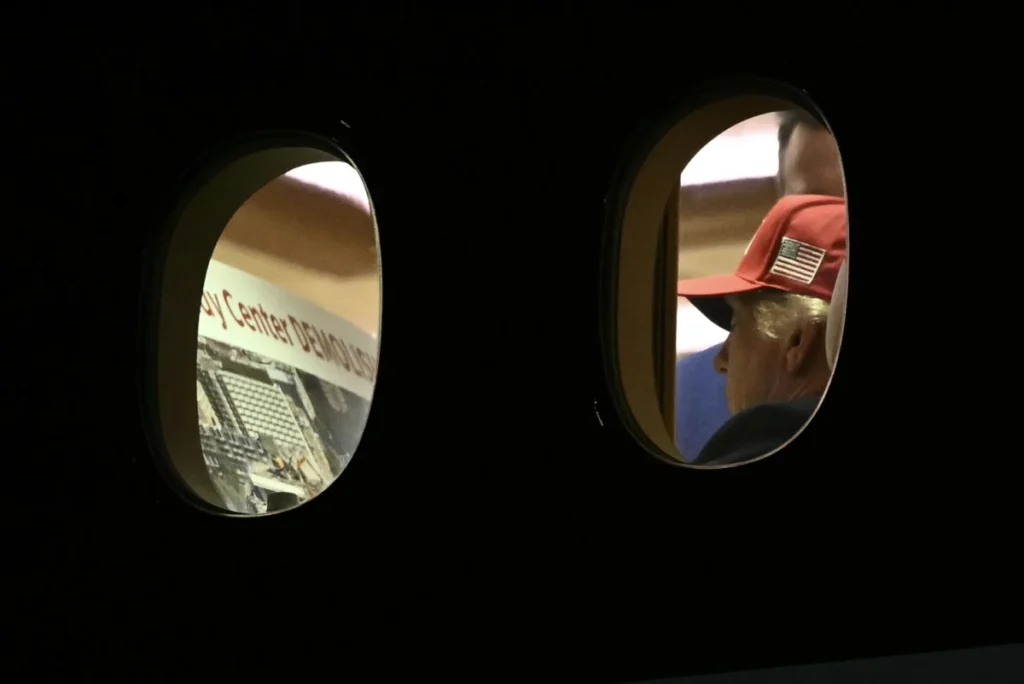
The iconic skyline of Washington, D.C., has long been defined by the sweeping, brutalist architecture of the John F. Kennedy Center for the Performing Arts. However, the institution currently finds itself at the epicenter of a volatile political and legal tug-of-war. Tensions reached a fever pitch this week following the emergence of a photograph capturing former President Donald Trump disembarking from Air Force One at Joint Base Andrews. In the image, taken by Getty photographer Brendan Smialowski, the former president is seen sporting a red baseball cap while holding a placard that appears to bear the chilling inscription: “Kennedy Center DEMOLISHED.”
This visual, coupled with recent rhetoric from the former president suggesting the facility is on the verge of being “ripped down,” has triggered an emergency legal filing by Democratic U.S. Representative Joyce Beatty. As an ex officio trustee of the Center, Beatty is demanding that a federal judge intervene to ensure the structural integrity of the landmark, fearing that the administration’s aggressive maneuvers are moving beyond political posturing and into the realm of physical destruction.
Chronology of a Crisis
To understand the current state of emergency, one must look at the rapid deterioration of the relationship between the Kennedy Center’s board—largely composed of Trump appointees—and the preservationist community.
- August 2026: The Board of Trustees votes to officially rename the venue to "The John F. Kennedy Center for the Performing Arts, Restored and Renovated by President Donald J. Trump," citing his alleged philanthropic contributions.
- Early September 2026: Activist groups, including "Hands Off the Arts," label video evidence provided by the administration—allegedly showing significant rain-related structural damage—as "propaganda" designed to justify closure.
- Tuesday, September 15, 2026: Federal Judge Cooper issues a landmark ruling prohibiting the inscription of Trump’s name on the building’s facade.
- Tuesday, September 15, 2026: Hours after the court ruling, the Center abruptly shuts its doors. Management initially cites a "pulled fire alarm" before pivoting to claims of "imminent life-safety risks."
- Wednesday, September 16, 2026: President Trump publicly suggests that without his administration’s specific intervention and "recognition," the building will be closed and demolished.
- Thursday, September 17, 2026: Rep. Joyce Beatty files an emergency request for a court hearing to clarify the prohibition against demolition.
The Legal Landscape: Beatty’s Emergency Filing
The emergency filing submitted by Representative Joyce Beatty is a direct response to what she perceives as a bad-faith effort to circumvent judicial oversight. The motion explicitly argues that the closure of the Center is not a safety measure, but a calculated prelude to demolition.
“It goes without saying that demolishing the Kennedy Center’s main building would violate the Court’s preliminary injunction,” the filing states. “Closure is both a prelude to and the necessary consequence of demolition. But out of an abundance of caution, Plaintiff also respectfully requests the Court to make crystal clear that its order prohibits demolishing the structure.”
The legal team representing the plaintiffs emphasizes that the court has already enjoined the administration from shutting down the institution without board approval and prior judicial review. The sudden closure on Tuesday, justified by vague "life-safety risks," is viewed by legal scholars as a classic "pretextual" maneuver. By declaring the building unsafe, the administration creates a justification for abandonment, which then serves as a springboard for further structural changes—or in this case, total demolition.
The President’s Narrative vs. Institutional Reality
The core of the conflict lies in the definition of "renovation." President Trump’s rhetoric has consistently focused on the idea that the federal government, under his leadership, has saved the Kennedy Center from neglect.
In a statement delivered on Wednesday, the former president remarked: “For me to go and fix it and subsidize it, I think the Trump administration should have recognition. If we don’t do that, it’s going to close and get ripped down.”
This framing suggests that the building is a failing asset that owes its survival to the former president’s patronage. However, opponents and preservationists argue that the “renovations” are merely a vehicle for branding. The legal battle over the name change—specifically the court’s decision to block the addition of his name to the facade—appears to have angered the administration, leading to the current retaliatory closure.
The Preservationist Uprising
The crisis has galvanized the architectural and cultural preservation community. Beyond the legal challenges brought by Representative Beatty, a coalition of eight national preservationist groups has formally petitioned for a change in leadership.
In a joint statement released this week, these groups called for the current board to step aside immediately, citing a fundamental conflict of interest. The coalition has gone as far as to request that the court place the Kennedy Center into receivership. Receivership would strip the current board of its decision-making power and place the institution under the control of a court-appointed independent administrator.
The groups argue that the board’s actions—ranging from the attempt to rebrand the center to the sudden, unverified claims of "imminent life-safety risks"—constitute a breach of fiduciary duty to the American public. By prioritizing the political legacy of a single individual over the long-term preservation of a national monument, the board has, in their view, forfeited its right to oversee the institution.
Implications: A National Cultural Asset at Risk
The potential demolition or permanent closure of the Kennedy Center carries implications that extend far beyond the borders of Washington, D.C. The Center is not merely a venue; it is a federal memorial to a slain president and a hub for the performing arts that serves as a cornerstone of the American cultural identity.
1. The Precedent of Political Interference
If an administration is permitted to close and threaten the demolition of a major cultural institution as a reaction to unfavorable court rulings, the precedent would be profound. It suggests that federal properties can be weaponized in political disputes, potentially subjecting other national landmarks to similar threats based on the whims of the executive branch.
2. The Erosion of Public Trust
The dispute over the "rain-related damage" video is a microcosm of the "post-truth" era. When the government provides visual evidence that activists label as "propaganda," it creates an environment where objective reality is contested. The public is left unable to determine if the building is truly in danger of collapse or if the danger is being manufactured to facilitate a political agenda.
3. The Future of the Kennedy Center
The immediate future of the Center remains in the hands of the court. Judge Cooper’s role has become increasingly difficult; he is tasked with not only managing a property dispute but also navigating a high-stakes power struggle between the judiciary and the executive. If the court denies the request for a hearing or fails to act decisively, the administration may feel emboldened to proceed with its plans for the structure.
Conclusion: A High-Stakes Hearing
As of this writing, a hearing has not yet been scheduled, but the urgency expressed by Rep. Beatty and the preservationist coalition suggests that time is of the essence. The photograph of the former president with the "DEMOLISHED" placard serves as a chilling backdrop to the proceedings. While it may be interpreted by some as a political stunt or a cryptic message to his base, to those tasked with protecting the Kennedy Center, it is a statement of intent.
The case of the Kennedy Center is now a litmus test for the independence of federal institutions. Whether the building is truly suffering from catastrophic structural issues or is simply the victim of a political ego, the outcome of this legal battle will define the standards for how the United States protects its cultural heritage against political volatility. For now, the lights remain dimmed, the doors remain locked, and the nation waits to see if the brutalist concrete walls of the Kennedy Center will survive the political storm.