
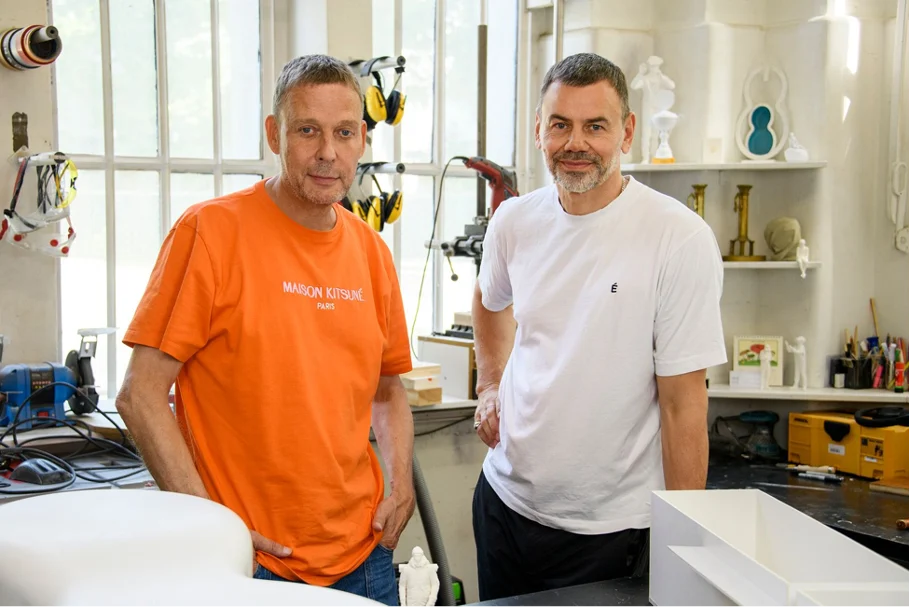
As the Hirshhorn Museum and Sculpture Garden in Washington, D.C., prepares to emerge from a four-year, $68 million "revitalization," the institution has unveiled a centerpiece installation that promises to challenge the perceptions of every passerby on the National Mall. Come October 31, visitors will be greeted not by the expected traditional bronze or stone monuments, but by a 28-foot-tall, upended swimming pool. Titled Eight, this stainless-steel monolith, created by the Berlin-based Scandinavian artist duo Elmgreen & Dragset, serves as the crowning jewel of the museum’s reimagined outdoor landscape.
The Geometry of Displacement: Understanding ‘Eight’
The sculpture is, in essence, a masterclass in the aesthetic of displacement. Rendered in gleaming stainless steel with a striking, lacquered cyan interior, the work captures the structural essence of a classic swimming pool—complete with a diving board, a ladder, and integrated lighting—yet forces it into a vertical, impossible orientation.
By taking an object associated with leisure, communal gathering, and aquatic movement and rendering it "eternally unswimmable," Elmgreen & Dragset invite viewers to confront the familiar in a state of profound alienation. The work is the fourth iteration in a series of pool-themed installations by the duo, following similar high-profile projects in Miami and New York. While those previous installations were grounded in their respective urban fabrics, Eight stands as a monumental vertical interruption against the backdrop of D.C.’s neoclassical architecture.
A Chronology of the Hirshhorn’s Revitalization
The arrival of Eight is the final act in a complex, years-long endeavor to modernize one of the Smithsonian’s most distinctive properties.
- 2020: The Hirshhorn Museum and Sculpture Garden officially closes its outdoor plaza to the public. The museum announces a $68 million capital project aimed at repairing the sunken garden’s infrastructure, which had suffered from decades of drainage issues and structural degradation.
- 2021–2022: Renowned Japanese artist and photographer Hiroshi Sugimoto is commissioned to lead the redesign. Sugimoto’s vision focuses on restoring the original 1974 intent of architect Gordon Bunshaft while introducing contemporary upgrades to accessibility and landscaping.
- 2023: Construction crews work to reconfigure the garden’s circulation, including the installation of a new monumental staircase and a series of terraced viewing platforms designed to better integrate the art with the garden’s brutalist geometry.
- October 2024: The revitalization project reaches completion. The museum announces the acquisition of Eight, designating it as the focal point of the reopened space.
- October 31, 2024: The official grand reopening of the Hirshhorn Sculpture Garden, featuring the public debut of Eight.
Supporting Data: The Logistics of the ‘Pool’
The installation of Eight is a feat of engineering as much as it is an artistic statement. Standing 28 feet high, the sculpture required specialized fabrication to ensure that the stainless-steel structure could withstand the heavy winds and fluctuating temperatures of the Mid-Atlantic climate while maintaining its pristine, mirror-like finish.
The "cyan" interior is achieved through a multi-layer lacquer process, designed to catch and reflect light even on the overcast days common in the capital. The inclusion of functional lighting elements within the sculpture suggests that the piece will serve as a beacon at night, effectively transforming the Sculpture Garden into a luminous, surreal environment after the sun sets.
The budget for the garden’s revitalization, while primarily focused on structural repairs—such as waterproofing the lower levels and updating electrical and drainage systems—provided the necessary infrastructure to support heavy, permanent installations like Eight. The integration of this work is part of a broader Smithsonian strategy to activate outdoor spaces, turning them into "living rooms" for the public rather than static display cases for history.
Official Responses and Curatorial Perspectives
The Hirshhorn has been unequivocal in its support of the acquisition, viewing it as a bridge between the museum’s history and its future. Anne Reeve, a curator at the Hirshhorn, has lauded the duo as "virtuosos of transformations."
"Elmgreen & Dragset possess the rare ability to manipulate the environment in a way that feels both jarring and intimate," Reeve noted in a recent press statement. "They work within the traditional confines of galleries, but they are most effective when they take the mundane—like a swimming pool—and pull it out of its expected context, forcing the viewer to reconsider the space they occupy."
The artists themselves, Michael Elmgreen and Ingar Dragset, have framed the work as a social commentary on the nature of public institutions. "For us, swimming pools can be synonymous with public access, togetherness, and community—much like the Hirshhorn itself," the duo stated. "While Eight appears empty, it is, in a sense, overflowing. It is a vessel designed to be filled by the imaginations of the visitors. It is a stage for the viewer’s own narrative."
Implications: The Legacy of Elmgreen & Dragset
To understand the weight of Eight, one must look at the duo’s history of "interventionist" art. Since their partnership began in 1995, Elmgreen & Dragset have consistently used public space as their canvas, often with a biting, satirical edge.
Their 2005 work, Prada Marfa, remains one of the most famous examples of site-specific art in the 21st century. By building an ersatz, luxury fashion boutique in the middle of a desolate Texas highway, the duo forced a collision between high-end consumerism and the emptiness of the American landscape. Similarly, their 2008 Memorial to the Persecuted Homosexuals under National Socialism in Berlin used a minimalist, brutalist aesthetic to create a space for quiet, individual reflection on systemic state violence.
By placing Eight on the National Mall, the Hirshhorn is inviting this same brand of institutional critique into the heart of the federal government. The National Mall is a landscape dominated by symbols of power, war, and political history. A vertical, empty, cyan-colored swimming pool is a subversive addition to this landscape. It asks questions about class, leisure, and the "privatization" of public space—all while providing an undeniably "Instagrammable" landmark that will likely draw millions of visitors.
A New Era for the Hirshhorn
The reopening of the Sculpture Garden is not merely a repair project; it is a rebranding of the Hirshhorn as a space of dynamic, contemporary dialogue. By selecting Eight as the flagship acquisition, the museum is signaling that it is not afraid of controversy or absurdity.
The implication for the future of D.C.’s art scene is significant. As museums worldwide grapple with how to remain relevant in a digital-first world, the Hirshhorn is betting that physical, large-scale installations that manipulate space and memory are the key to drawing audiences back to the museum.
As of October 31, when the gates finally swing open, the public will have the opportunity to judge whether Eight succeeds as an architectural intervention or remains a perplexing oddity. However, one thing is certain: the Hirshhorn Sculpture Garden will no longer be a place one simply walks through. It will be a place one must negotiate—a place where, as the artists suggest, the emptiness of a pool becomes the perfect container for the collective imagination of the public.
In the shadows of the Capitol and the Washington Monument, the presence of a 28-foot-tall, empty pool is a reminder that art’s primary function is not to decorate, but to disrupt. Through the work of Elmgreen & Dragset, the Hirshhorn has ensured that its garden will be a site of disruption for years to come.