
Introduction: The Invisible Shield of Global Trade
The global economy is built upon the silent, relentless movement of vessels across the world’s oceans. More than 80% of global trade by volume is carried by sea, traversing vast, often lawless expanses of international waters. Yet, this lifeline is perpetually threatened by the age-old scourge of maritime piracy and armed robbery. Standing as the primary bulwark against these threats is the International Maritime Bureau (IMB) Piracy Reporting Centre (PRC). Since its inception in 1991, the PRC has evolved from a simple notification desk into a sophisticated, 24-hour nerve center that acts as the global conscience and primary intelligence hub for maritime security.
As the geopolitical landscape shifts and criminal methodologies evolve, the PRC remains the definitive point of contact for ships under duress. By bridging the gap between vulnerable vessels and national response agencies, the IMB is not merely reporting crime—it is actively orchestrating the safety of the world’s most critical supply chains.
Main Facts: The Mandate of the IMB PRC
The IMB Piracy Reporting Centre operates on a singular, unwavering mission: to protect the lives of seafarers and the integrity of global shipping. Its core functions are multifaceted:
- 24/7 Surveillance and Response: The PRC maintains a constant vigil, providing an around-the-clock emergency line for shipmasters and vessel owners. When a distress signal is received, the PRC initiates a rapid-response protocol, coordinating with local maritime authorities, coast guards, and regional navies to ensure help is dispatched with maximum efficiency.
- Intelligence Dissemination: Beyond immediate crisis management, the PRC serves as an information clearinghouse. By issuing real-time warning broadcasts and email alerts, it ensures that vessels operating in high-risk areas—such as the Gulf of Guinea, the Singapore Strait, and the waters off Somalia—are aware of current threats, allowing them to adjust their routes or heighten security measures proactively.
- Data Analytics and Pattern Recognition: The PRC is the world’s premier repository for piracy data. By meticulously cataloging every actual, attempted, and suspected incident, the bureau provides the maritime community, governments, and international organizations with the insights necessary to understand the shifting tides of piracy.
Chronology: A History of Vigilance
To understand the importance of the IMB PRC, one must look at the historical trajectory of maritime crime.
The 1990s: Establishing the Perimeter
Formed in 1991, the PRC was a response to a burgeoning crisis in Southeast Asian waters. At the time, piracy was largely localized, characterized by opportunistic boarding of slow-moving tankers. The IMB recognized that without a centralized reporting mechanism, maritime crimes were being underreported, leading to a lack of political will to tackle the issue.
The 2000s: The Rise of Somali Piracy
The turn of the millennium saw the escalation of Somali piracy, which moved from simple armed robbery to sophisticated, large-scale hijackings for ransom. The PRC played an instrumental role during this decade, providing the data that eventually led to the deployment of international naval task forces, such as Operation Atalanta.
The 2010s to Present: The Digital and Regional Shift
In recent years, the nature of piracy has morphed again. While Somali piracy has been largely contained through the use of Private Maritime Security Companies (PMSCs) and hardened vessel protocols, new hotspots have emerged. The Gulf of Guinea has seen an increase in kidnapping for ransom, while the Singapore Strait remains a persistent zone for armed robbery against vessels underway. The PRC has adapted by integrating digital tracking and AI-driven predictive modeling into its reporting systems.
Supporting Data: The 2025 Mid-Year Landscape
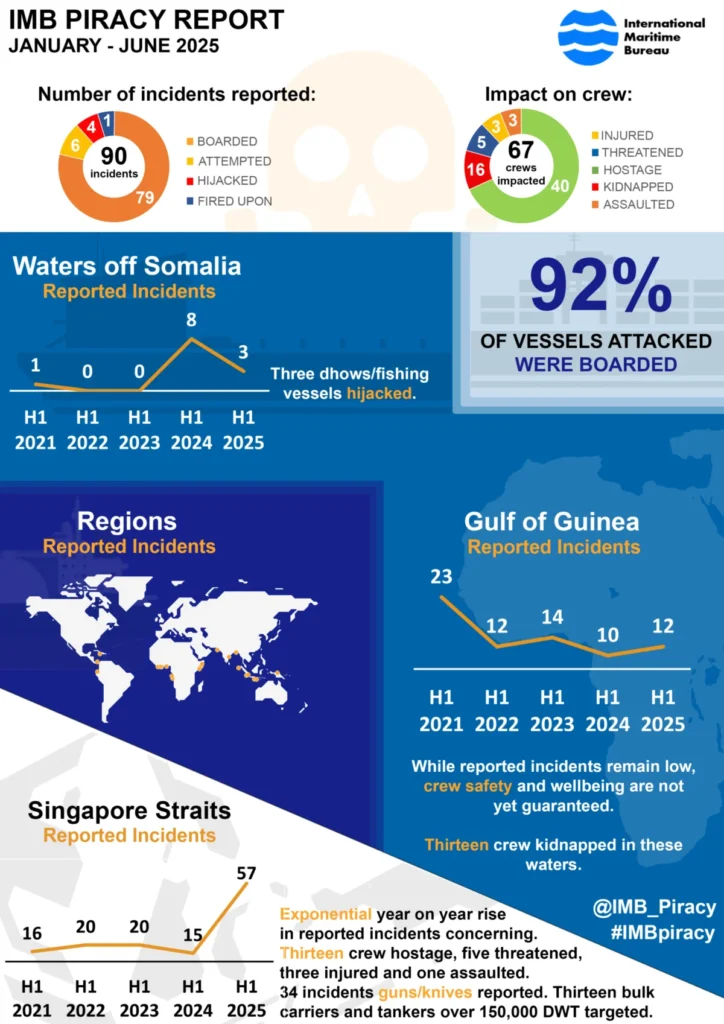
The recently released 2025 Jan–June Piracy and Armed Robbery Against Ships report offers a sobering look at the current maritime environment. While global awareness has increased, the data underscores the necessity of the IMB’s continued vigilance.
- Incident Trends: The first half of 2025 has highlighted that piracy is not a static threat. Incidents of armed robbery—where perpetrators board a ship to steal cargo or crew belongings—continue to dominate the statistics, particularly in anchorage areas.
- The Importance of Underreporting: The IMB consistently emphasizes that official statistics are likely the "tip of the iceberg." Many incidents go unreported due to fear of insurance premium hikes or operational delays. The PRC’s data serves as a critical baseline, but it relies entirely on the cooperation of shipmasters.
- The Power of Reporting: The IMB encourages all stakeholders to report even suspected incidents. This data is the primary leverage used by the IMB to lobby governments for increased naval presence in specific high-risk corridors.
Official Responses and Strategic Implications
The work of the IMB does not happen in a vacuum. It requires a delicate balance of diplomacy, operational expertise, and legal advocacy.
The Diplomatic Reach
Michael Howlett, Director of the ICC International Maritime Bureau, has frequently noted that maritime piracy is a symptom of broader regional instability. When a vessel is attacked, the IMB engages with flag states and littoral nations to emphasize that safe transit is a global public good. By providing hard data, the PRC gives international bodies like the International Maritime Organization (IMO) the ammunition they need to hold sovereign nations accountable for the security of their territorial waters.
The Operational Imperative for Shipowners
For shipowners, the implications are clear: the cost of a single piracy incident—in terms of ransom, delayed cargo, and insurance premiums—far outweighs the cost of preventative security. The IMB’s guidance on "Best Management Practices" (BMP) is the gold standard for vessel security. Adherence to these protocols, combined with active reporting to the PRC, remains the most effective deterrent against modern maritime criminality.
The Legal and Ethical Dimension
Piracy remains one of the few crimes that fall under the principle of "universal jurisdiction." The IMB’s reporting ensures that evidence is preserved and that the legal process—often the most difficult hurdle in prosecuting pirates—can begin. By documenting the "who, what, where, and when," the PRC provides the essential chain of custody for evidence that can eventually lead to convictions.
Implications: The Future of Maritime Security
As we look toward the latter half of the decade, the IMB Piracy Reporting Centre faces new challenges. The rise of autonomous shipping, the increasing use of drones in maritime attacks, and the expansion of piracy into new regions necessitate a constant evolution of the PRC’s capabilities.
Adapting to New Technology
The next phase of the PRC’s development involves integrating satellite imagery and real-time ship-tracking data to create a "live" map of piracy risks. This will allow the PRC to issue warnings even before a ship is approached, essentially moving from a reactive reporting body to a proactive security partner.
The Call to Action
The effectiveness of the IMB is inextricably linked to the participation of the global shipping community. As Director Michael Howlett has frequently emphasized, silence is the pirate’s best friend. Every master who reports a suspicious approach—no matter how minor—is helping to build a safety net that protects the entire fleet.
Conclusion: A Commitment to the Seafarer
The IMB Piracy Reporting Centre stands as a testament to what international cooperation and dedicated intelligence gathering can achieve. It is a vital, 24-hour guardian for those who spend their lives on the waves. By providing the data, the alerts, and the support needed to navigate an increasingly dangerous world, the PRC ensures that global trade continues to flow, even in the face of those who would seek to disrupt it.
For those operating on the high seas, the message from the IMB is clear: You are not alone. The PRC is watching, waiting, and ready to act.
For further inquiries or to access the latest intelligence on global maritime security, stakeholders are encouraged to contact:
Michael Howlett
Director, ICC International Maritime Bureau
Tel: +44 207 423 6960
Email: [email protected]
To review the latest findings, request a copy of the 2025 Jan–June Piracy and Armed Robbery Against Ships report via the official ICC-CCS website.