
For centuries, the painted tombs of Tarquinia, Italy, have stood as silent, subterranean witnesses to the enigmatic Etruscan civilization. Dating from the 7th to the 1st century BCE, these burial chambers are world-renowned for their vivid, kaleidoscopic frescoes depicting banquets, athletic contests, and mythological scenes. While art historians have long analyzed the iconography, a groundbreaking study published this August in the Journal of Archaeological Method and Theory suggests that these tombs were not merely static monuments to the dead. Instead, they were sophisticated "sensory machines" designed to manipulate the bodies, emotions, and perceptions of the living.
By marrying classical archaeology with cutting-edge Artificial Intelligence (AI) and acoustic modeling, researchers Maurizio Forte of Duke University and Jacqueline Ortoleva of the University of Oxford have unveiled a startling possibility: the Etruscans were master architects of immersive, psychological environments.
The Architecture of Afterlife: Main Facts and Methodology
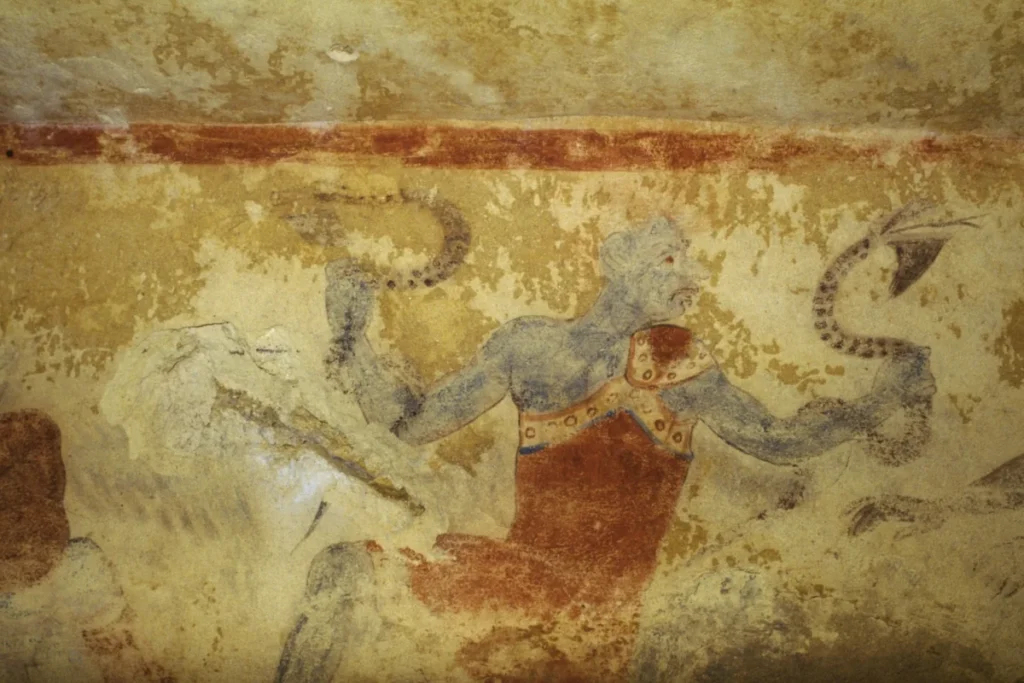
The study focuses on two specific 5th-century BCE sites: the Tomba del Gallo and the Tomba dei Demoni Azzurri (Tomb of the Blue Demon). To understand the visceral impact these spaces had on ancient mourners, Forte and Ortoleva moved beyond traditional visual analysis. They treated the tombs as active "experiential strategies."
To reconstruct the sensory environment, the team employed a multi-modal approach. They conducted detailed acoustic surveys, utilizing recorded handclaps within the chambers to measure reverberation patterns and sound decay. Simultaneously, they utilized AI modeling to map the movement of visitors through the narrow passages of the tombs. By simulating the flickering quality of torchlight against the painted walls, the researchers could effectively "re-animate" the space, allowing them to experience the tomb as an ancient Etruscan mourner would have 2,500 years ago.
The findings indicate that the architecture was far from accidental. The structural geometry—the narrowing walls, the descending entrance passages (dromos), and the specific spatial volumes—was engineered to produce profound somatic and affective responses in those who entered.
A Chronology of the Etruscan Funerary Experience
To understand the evolution of these spaces, one must look at the trajectory of Etruscan funerary development.
- 7th Century BCE: The emergence of monumental tumuli and chamber tombs marked a shift toward more elaborate public displays of status.
- 6th Century BCE: The zenith of fresco painting begins. The focus shifts toward the depiction of communal life and the "joyful" afterlife, with themes of banqueting and music becoming central.
- 5th Century BCE (The Period of Study): A period of heightened psychological sophistication. The tombs—specifically the Tomba del Gallo and the Tomb of the Blue Demon—begin to show signs of intentional spatial design meant to influence the mental state of the visitor.
- 4th to 1st Century BCE: As the Etruscan civilization faced increasing pressure and eventual assimilation by the Roman Republic, tomb iconography shifted toward more somber, underworld-focused themes, reflecting a changing societal relationship with mortality.
By the 5th century BCE, the Etruscans had perfected a form of "liminal technology." The dromos, or entrance passage, served a critical psychological function. As visitors descended into the earth, the narrowing walls forced a physical orientation that transitioned the mourner from the chaotic, bright world of the living into the compressed, controlled reality of the tomb.
Supporting Data: The Sensory Arsenal
The research highlights how multiple sensory inputs were layered to create a cohesive, immersive experience. The visual element was not merely a painting; it was a performance.
The Visual-Luminous Axis
When the tomb was lit by flickering torches, the static images of dancers and banqueters would appear to move. The AI modeling confirms that the rhythmic movement of flame created a strobe-like effect across the walls, transforming the painted figures into shifting entities. This was not just art; it was an attempt to bridge the gap between the static painting and the kinetic reality of a funeral ritual.
The Olfactory and Aural Layers
The researchers argue that the tomb was a total sensory environment. The smell of incense and libations, such as wine or oils, would have been amplified by the confined, low-ceilinged spaces. Furthermore, the acoustic properties of the tombs were carefully calibrated. The reverberation of human voices, the chanting of lamentations, and the sound of ritual instruments like the aulos (double flute) would have bounced off the plastered walls, creating a soundscape that could either induce calm or create an overwhelming sense of vertigo.
Comparative Spatial Impact
The data suggests that the two tombs served different emotional purposes:
- Tomba del Gallo: The acoustics and geometry suggest a space designed to prioritize calm and order, perhaps facilitating a structured mourning process.
- Tomb of the Blue Demon: In contrast, this tomb appears designed to precipitate feelings of disorientation and "disembodiment." The specific placement of the terrifying "Blue Demon" figure, combined with the acoustic "dead spots" or intense echoes within the chamber, suggests a space meant to confront the visitor with the visceral reality of the afterlife’s uncertainty.
Official Responses and Scholarly Discourse
The scholarly community has reacted to the study with significant interest, noting that it represents a paradigm shift in how we interpret archaeological remains. Traditionally, "funerary architecture" has been categorized based on its decorative style or the social status of the occupant. However, Forte and Ortoleva’s work challenges this reductionist view.
"If Etruscan funerary architects were deliberately engineering spatial geometry, pictorial content, and acoustic experiences," the authors state, "then we must fundamentally reconsider the category of ‘funerary architecture’ across the ancient Mediterranean and beyond."
The use of AI in this study is particularly noteworthy. By simulating conditions that cannot be replicated today, the researchers have created a "digital laboratory" that allows for the testing of hypotheses that were previously relegated to pure speculation. While some traditionalists remain cautious about the potential for AI to "over-interpret" ancient data, the consensus is that the integration of acoustic science and spatial modeling provides a more empirical basis for understanding how the ancient mind interacted with its built environment.
The Implications: A New Archaeology of Experience
The implications of this study reach far beyond the borders of Tarquinia. By establishing that the Etruscans used architecture to "activate the sensorium," the research suggests that ancient societies were far more attuned to the psychological impact of their built environments than previously assumed.
Redefining Funerary Architecture
The term "funerary architecture" is now poised for a revision. Rather than viewing these sites as passive repositories for the deceased, we must now consider them as "active" sites of cognitive engagement. This suggests that the ancient Mediterranean was a landscape populated by structures designed to alter human consciousness—whether for religious, political, or psychological purposes.
The Role of Technology in the Humanities
This study serves as a masterclass in the digital humanities. It demonstrates that AI is not merely a tool for data processing, but a powerful instrument for empathy. By simulating the ancient experience, researchers are better able to understand the anxieties, beliefs, and hopes of a civilization that left behind no written literature of its own.
Future Research
The success of this study at the Tomba del Gallo and the Tomb of the Blue Demon paves the way for a broader analysis of other Etruscan sites. Future research will likely focus on:
- Cross-site comparisons: Analyzing whether specific families or cities used unique "sensory signatures" in their tomb designs.
- Expanded AI Modeling: Incorporating more variables, such as crowd density and duration of stay, to see how the experience changed when the tomb was occupied by a large group of mourners versus a single individual.
- Cross-Cultural Analysis: Investigating whether similar sensory engineering techniques were employed by contemporary civilizations, such as the Greeks or the Phoenicians.
Ultimately, the work of Forte and Ortoleva forces us to confront our own relationship with the past. We are reminded that the ancients were not fundamentally different from us; they were masters of their own environments, capable of creating deeply evocative and emotionally resonant spaces. The "Blue Demon" does not merely stare back at us from the wall—he reminds us that the struggle to process death, to understand the transition from life to the void, is a timeless human endeavor that, for the Etruscans, began with the very walls that enclosed their final resting places.