
LONDON – January 15, 2026 – The global maritime landscape faced significant turbulence in 2025, with the International Maritime Bureau (IMB) reporting a marked increase in piracy and armed robbery against ships. As global supply chains continue to recover from geopolitical volatility, the latest data from the IMB’s Annual Piracy and Armed Robbery Report paints a concerning picture of heightened insecurity at sea, despite successful international efforts to mitigate threats in traditionally high-risk zones like the waters off Somalia.
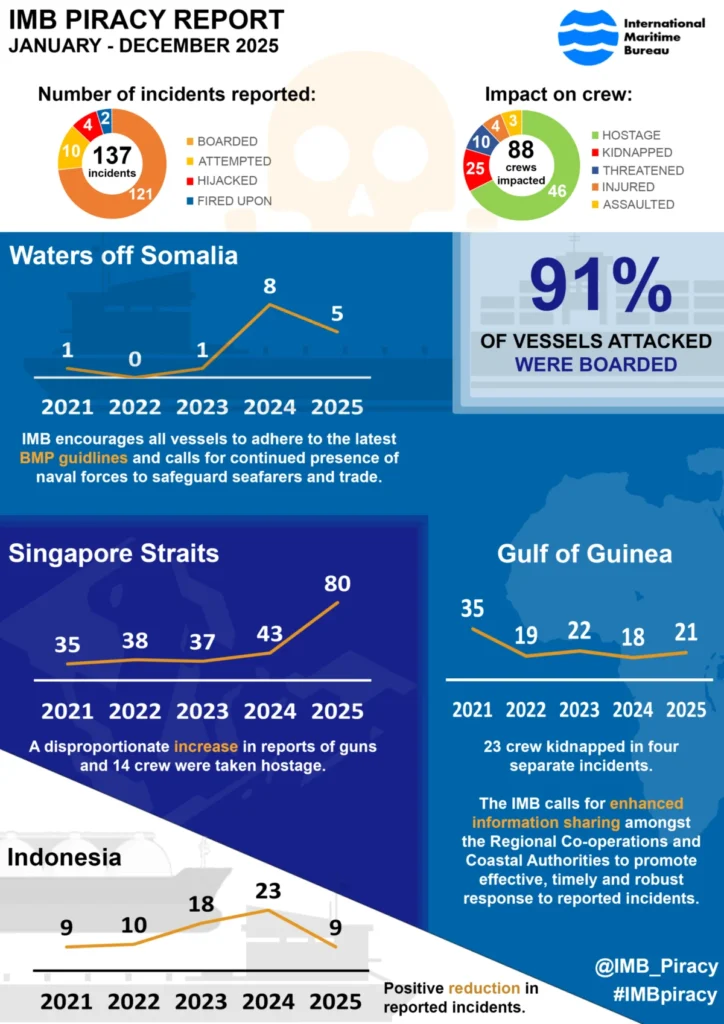
The report, which documents a total of 137 incidents for the year 2025—up from 116 in 2024 and 120 in 2023—serves as a stark reminder that the high seas remain a perilous environment for seafarers. While the majority of these incidents are classified as "low-level" opportunistic crimes, the underlying data reveals a disturbing trend toward increased violence and the more frequent deployment of firearms, raising alarms among shipping lines, insurance providers, and international policymakers.
The Landscape of 2025: Key Facts and Findings
The 2025 maritime security report highlights a multifaceted threat environment. Of the 137 reported incidents, the IMB confirms that 121 vessels were boarded by unauthorized parties, four vessels were hijacked, and two were fired upon. Additionally, 10 attacks were attempted but ultimately thwarted by onboard security measures.
The surge in incident reports is largely concentrated in the Singapore Straits, which has seen an uptick in unauthorized boardings. This region, a critical artery for global trade connecting the Indian and Pacific Oceans, has become a hotspot for opportunistic criminals who target slow-moving vessels or those with limited freeboard.
Conversely, the threat of Somali-based piracy, which plagued the maritime industry for over a decade, remains contained. The continued, robust presence of international naval forces in the Gulf of Aden and the Western Indian Ocean is widely credited with suppressing large-scale hijackings. However, experts warn that the transition from high-seas piracy to localized, low-level armed robbery represents a shift in the criminal business model, rather than a total eradication of maritime crime.
A Chronological Overview of Maritime Security (2023–2025)
The trajectory of maritime crime over the past three years suggests a period of transition following the relative stability of the mid-2020s.
- 2023: The industry recorded 120 incidents. At this stage, the maritime community was cautiously optimistic that improved reporting mechanisms and regional naval cooperation were beginning to bear fruit. Kidnappings were a persistent issue, with 14 crew members taken, while 73 were held hostage.
- 2024: A slight dip in total incidents to 116 was observed. However, this year was marked by a spike in hostage-taking, with 126 crew members held against their will, highlighting a volatile security environment despite the lower raw number of overall attacks.
- 2025: Total incidents climbed to 137. The data indicates a year where attackers became more brazen, as evidenced by the 42 reported instances involving firearms—a significant increase from the 26 incidents recorded in 2024. This year marked a pivot point where the "low-level" classification of crimes masked the rising lethality of the confrontations.
Supporting Data: The Human Cost of Maritime Crime
While the IMB emphasizes that most incidents in 2025 were "low-level," the human cost remains unacceptable. The statistics surrounding crew welfare provide a sobering look at the reality faced by seafarers.
Hostage and Kidnap Statistics
In 2025, 46 crew members were taken hostage, a figure that, while lower than the 126 reported in 2024, reflects the ongoing danger of boarding incidents. More alarmingly, the number of crew members kidnapped reached 25, a significant rise from the 12 reported in 2024 and 14 in 2023. Kidnapping for ransom remains a primary driver for criminal syndicates operating in certain coastal regions.
Escalation of Weaponry
A major point of concern for the IMB is the changing profile of the perpetrators. In 2025, the use of firearms was reported in 42 separate incidents. This marks a 60% increase in the use of guns compared to the previous year. While the use of knives—a staple of low-level opportunistic robbery—declined slightly from 39 incidents in 2024 to 33 in 2025, the trend toward lethal weaponry indicates that perpetrators are becoming more willing to engage in armed conflict with ship crews.
Beyond hostage-taking and kidnapping, the violence inflicted upon crews is documented through other grim metrics: 10 crew members were threatened, four sustained physical injuries, and three were victims of direct assault.
Official Responses and Strategic Perspectives
The International Chamber of Commerce (ICC), which oversees the IMB, has been vocal about the implications of these figures for global economic stability. ICC Secretary General John W.H. Denton AO issued a call to action, framing maritime security as a fundamental pillar of global prosperity.
"Maritime trade remains a cornerstone of real economic activity and growth," Denton stated. "The rise in reported maritime incidents highlights the importance of protecting seafarers and securing key shipping routes—not only for crew safety, but for the stability of global supply chains and the economies that depend on them."
Denton’s sentiment is echoed by maritime security analysts who advocate for "layered defense" strategies. This includes not only the deployment of naval assets but also the rigorous adherence to Best Management Practices (BMP), which encourage vessels to harden their ships through physical barriers, citadel procedures, and enhanced watch-keeping, particularly when transiting known high-risk areas.
Implications for Global Trade and Future Security
The rise in maritime incidents has profound implications for the global economy. Shipping companies are facing increased insurance premiums, which are inevitably passed down the supply chain, contributing to inflationary pressures on imported goods. Furthermore, the psychological impact on seafarers cannot be overstated; the persistent threat of violence contributes to the ongoing labor shortage in the maritime industry, as experienced personnel opt for shore-based careers to avoid the risks of the sea.
The Singapore Straits: A Case Study in Congestion and Crime
The focus on the Singapore Straits is critical. As one of the world’s busiest shipping lanes, the sheer volume of traffic creates a unique environment where attackers can blend in with local small-craft traffic. The IMB report suggests that local authorities must intensify patrols and increase inter-agency communication to combat these frequent, opportunistic boardings.
The Role of International Cooperation
The containment of the Somali piracy threat remains the "gold standard" for what can be achieved through international cooperation. By pooling resources, coordinating naval patrols, and establishing reporting centers, the international community proved that piracy could be suppressed. The current rise in incidents elsewhere suggests that this model of cooperation needs to be updated and applied to emerging hotspots.
"Ensuring safe passage at sea requires sustained cooperation," Denton remarked, emphasizing that maritime commerce is a shared responsibility. "Regional and international partners must work together to safeguard maritime trade, not just as a matter of policy, but as an economic imperative."
Looking Ahead
As the maritime industry moves through 2026, the focus will likely remain on three core areas:
- Technological Integration: Utilizing AI-driven surveillance and long-range identification tracking (LRIT) to provide early warnings to vessels in high-risk zones.
- Regulatory Pressure: Pressing coastal states to take greater responsibility for policing their territorial waters and prosecuting those captured during maritime robberies.
- Seafarer Support: Ensuring that the mental and physical health of crew members remains a priority, recognizing that the human element is the most vulnerable component of the maritime supply chain.
In conclusion, the 2025 IMB report serves as a wake-up call. While the maritime industry has weathered various storms, from global pandemics to geopolitical trade wars, the persistent and rising threat of piracy and armed robbery highlights that the "highway of the seas" remains under siege. Without a concerted, multinational effort to address both the root causes of these crimes and the immediate security gaps, the stability of global commerce will continue to be tested by those who seek to profit from the vulnerability of the world’s vessels.