By Dani James | Retail Dive
Published: September 11, 2026
In the fast-paced, often unforgiving arena of publicly traded retail, the debut of a direct-to-consumer (DTC) brand is rarely a smooth transition. However, Reformation, the Los Angeles-based powerhouse known for its blend of sustainability and high-fashion aesthetics, has delivered a decisive statement in its second-quarter earnings report. Reporting a robust 24% jump in net revenue, the company has effectively quieted initial market jitters, positioning itself as a resilient player in a volatile sector.
As Reformation navigates its first year as a public entity, the latest financial results serve as more than just a ledger of sales; they represent a validation of the brand’s unique “speed-to-market” operational model. With a clear path for expansion and a disciplined approach to inventory, the company is proving that sustainable fashion can achieve scalable, profitable growth.
The Core Facts: A Strong Opening Performance
Reformation’s Q2 fiscal results are underscored by a 24% year-over-year revenue increase, a figure that significantly outperformed the tempered expectations set during the company’s IPO roadshow earlier this summer.
The brand, which went public in July, entered the stock market amid a climate of high interest rates and cautious consumer spending. While its IPO valuation was initially pegged at the lower end of its $1 billion target, the Q2 results suggest that the underlying business is far more robust than skeptical investors previously assumed. The company’s ability to maintain high full-price sell-through rates while managing its supply chain has become a cornerstone of its investor pitch.
Chronology: From Private Darling to Public Player
The journey to this earnings report was marked by strategic pivots and meticulous planning:
- Pre-IPO Strategy (Early 2026): Reformation spent the first half of the year fine-tuning its supply chain, emphasizing its “proven performance” strategy—a method where the majority of inventory is produced based on real-time data rather than long-term seasonal forecasting.
- The July IPO: Reformation officially listed on the public exchange in July. Despite hitting the lower end of its projected valuation range, the company raised the necessary capital to fuel its aggressive brick-and-mortar expansion strategy.
- Late August/Early September: The retail sector faced significant macroeconomic headwinds, including inflationary pressures on apparel. Investors watched closely to see if Reformation’s premium pricing model would alienate its core demographic.
- September 10, 2026: Reformation held its Q2 earnings call, where CEO Hali Borenstein and CFO Joshua Moore presented the 24% revenue growth, effectively signaling that the brand’s appeal remains insulated from broader market downturns.
Supporting Data: Operational Efficiency as a Moat
The success of Reformation in the current quarter is rooted in its operational agility. Unlike traditional retailers that lock in inventory bets 12 months in advance, Reformation has built a "fast-fashion-adjacent" supply chain that prioritizes sustainability.
The "Proven Performance" Metric
CEO Hali Borenstein highlighted a staggering statistic during the earnings call: approximately 90% of the company’s DTC revenue is generated by styles with "proven performance" behind them. This means the brand rarely launches a product without having first tested a similar silhouette or fabric in a smaller, controlled rollout.
Furthermore, the company produces more than 50% of its total product volume in 60 days or less. This reduction in lead time acts as a hedge against the “markdown culture” that plagues much of the industry; by producing less, but producing what the consumer is currently demanding, Reformation avoids the inventory bloat that forces competitors into damaging end-of-season sales.
The Retail Footprint
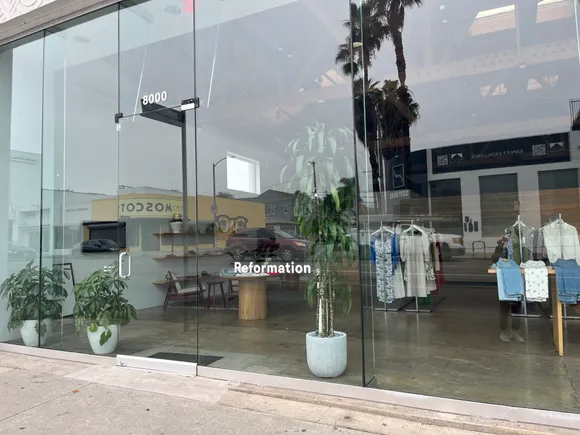
As of the end of Q2, Reformation operated 70 physical storefronts. The company’s strategy is not to saturate the market, but to strategically place boutiques in high-traffic, fashion-forward urban hubs. The management team has outlined a clear trajectory: they intend to double this fleet over the next five years. For the remainder of 2026, the company expects to open an additional nine to 10 stores, bringing the total annual expansion to 15 or 16 new locations.
Official Responses: Leadership Perspectives
During the analyst call, the leadership team emphasized a long-term vision that balances aggressive growth with the sustainability mandates that define the brand.
CEO Hali Borenstein on Agility:

"Rather than making large inventory bets up to 12 months in advance like many brands, we respond to what customers actually tell us they want. Our supply chain is built for speed, sustainability, and quality. We aren’t just selling clothes; we are selling a model that minimizes waste."
CFO Joshua Moore on Fiscal Discipline:
"Our focus for the second half of the year remains on balancing new store openings with digital channel optimization. We have the capital to fund our 15-16 store expansion plan while maintaining healthy margins, even as we absorb the costs associated with being a newly public company."
Implications: What This Means for the Market
The William Blair analyst note released on Friday paints a cautiously optimistic picture of the company’s future. Analysts noted that while the initial skepticism surrounding a new apparel entrant was understandable, Reformation’s performance metrics suggest a "compelling opportunity."
The "Volatility" Risk
The analysts did not shy away from the risks. They pointed out that the very model that gives Reformation its speed—short lead times—can also be a liability. Because the model is “reactionary,” any sudden shift in global logistics or raw material availability could lead to immediate, visible volatility in the company’s quarterly performance. Unlike legacy retailers with deep inventory buffers, Reformation has less room for error.
The Future of Sustainable Fashion
Reformation is essentially testing a hypothesis: Can a brand be truly sustainable, ethically manufactured, and high-growth simultaneously?

If the current trend continues, Reformation will serve as the blueprint for the next generation of apparel companies. Investors are no longer looking for brands that just "sell products"; they are looking for brands that possess "clear visibility in the model." By prioritizing data-backed production, Reformation has managed to turn the volatility of the fashion industry into a manageable, and even profitable, asset.
Long-Term Outlook
As we move into the second half of 2026, the industry will be watching to see if the brand can maintain its 24% growth rate as the store count expands. The transition from 70 stores to a potential 140+ will require significant operational scaling. However, if the current Q2 results are any indication, Reformation has the leadership and the infrastructure to navigate this growth without diluting the brand equity that made it a household name in the first place.
For now, the market has received a clear message: Reformation is not just a trend-driven boutique, but a data-driven retail powerhouse that is here to stay. Whether the stock price will eventually climb to meet the initial $1 billion valuation remains a question for the market, but the operational foundation is firmer than it has ever been.
Summary of Key Performance Indicators (Q2 2026)
- Net Revenue Growth: +24% Year-over-Year.
- Inventory Strategy: 90% of revenue from proven styles.
- Supply Chain Speed: 50%+ of products manufactured in <60 days.
- Store Count: 70 (as of end of Q2).
- Expansion Target: 15-16 new stores scheduled for 2026.
This article is based on the Q2 2026 earnings transcript provided via Seeking Alpha and independent analysis from William Blair.