In the heart of France’s Basque Country, the city of Bayonne has quietly re-emerged as a focal point of European art. The Musée Bonnat-Helleu, a historic institution founded in 1891, has reopened its doors following an arduous 14-year renovation. The result is a revitalized space that has doubled its exhibition capacity, positioning itself as a bold, contemporary forum for dialogue. Often affectionately dubbed the “Little Louvre,” the museum is currently serving as a lightning rod for broader, often contentious, debates regarding the role of public institutions in a polarized political climate.
A Chronology of Renewal and Leadership
The journey to the museum’s current state has been decades in the making. Founded at the end of the 19th century, the institution holds a staggering collection of approximately 7,000 works, spanning from antiquity to the dawn of the 20th century. However, the path to modernization was far from linear.
The 14-year closure for renovations represented a significant period of institutional transition. As the physical structure underwent massive upgrades to accommodate modern exhibition standards, the leadership faced the daunting task of defining the museum’s future identity. In a strategic move to infuse the institution with local perspective and youthful energy, the museum appointed Barthélémy Etchegoyen Glama as its leader ten months prior to the reopening. A 33-year-old native of the Basque Country and a former advisor to the Louvre’s leadership, Etchegoyen Glama has brought a vision that seeks to balance the preservation of history with an urgent, inclusive approach to storytelling.
The “Mythologies” Manifesto
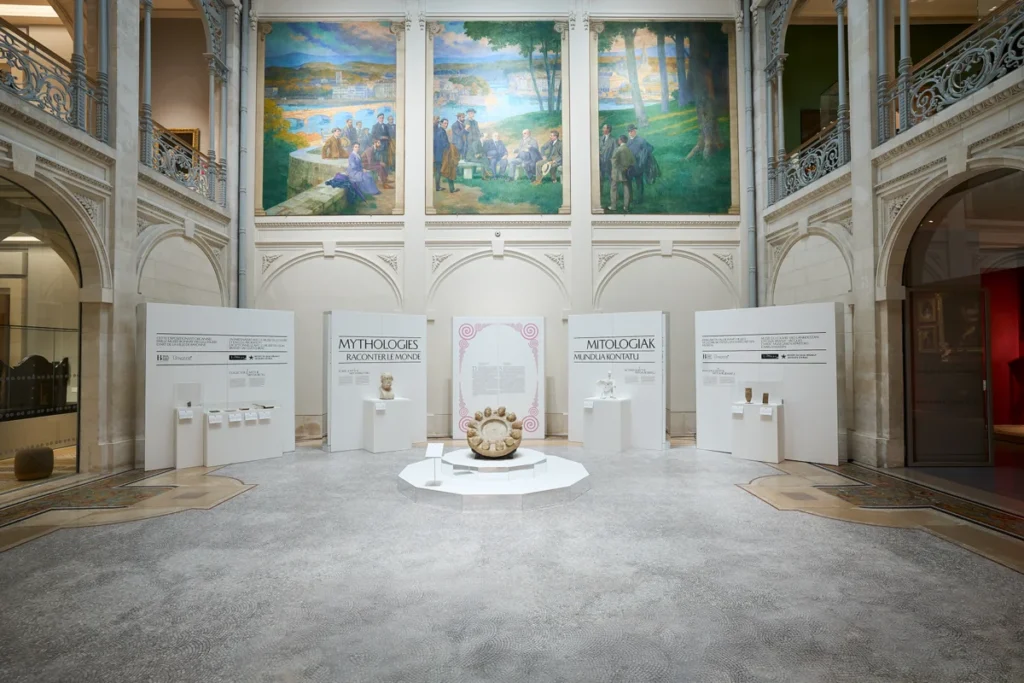
Last month, the Musée Bonnat-Helleu unveiled its first major temporary exhibition since the renovation, titled Mythologies: To Tell the Story of the World. The exhibition is more than a mere collection of artifacts; it is a declaration of intent. Running through November 9, the show features rare loans from the Louvre and Paris’s Quai Branly museum, serving as a “manifesto for the museum we want,” according to Etchegoyen Glama.

The exhibition design is deliberately kaleidoscopic. By juxtaposing ancient masterpieces with contemporary folk art and local design, the curators invite visitors to witness the parallel ways societies across time and geography have processed the human experience. Upon entering the gallery, a visitor is greeted by a lamina—a goose-woman mask from Basque tradition crafted by the Owantshoozi studio—placed in direct dialogue with a classical bust of Homer on loan from the Louvre. Further in, Raphael’s 1503–05 Renaissance masterpiece Saint George and the Dragon hangs beside Syrian icon paintings of the same subject by Ne’meh al-Musawwir. The exhibition concludes with a 2025 “Hartza” (man-bear) costume, a symbol of spring in local carnivals.
This juxtaposition creates a narrative flow that eschews traditional, school-based chronologies in favor of thematic connectivity. It is a bold approach that challenges the visitor to look past the "blockbuster" title and engage with the underlying threads of our shared, yet disparate, histories.
The Cultural Landscape: A Climate of Backlash
While Mythologies has received significant critical acclaim in France, its methodology—which prioritizes social connectivity over purely academic, disciplinary advancement—is increasingly being scrutinized. The museum world today finds itself in a state of tension, caught between a desire to democratize art history and a conservative pushback that views these inclusive, decolonial approaches as politically charged.
Etchegoyen Glama, while diplomatic, acknowledges that this “open-ended” form of storytelling is encountering resistance. This is not a localized phenomenon; it is a global trend. In the United States, the previous Trump administration targeted the Smithsonian Institution, accusing it of promoting a “divisive, race-centered ideology.” In Europe, the winds of change are blowing in a similar, if more subtle, direction.

The Italian government has aggressively moved to reshape its cultural institutions, installing new leadership as part of a campaign against what Prime Minister Giorgia Meloni has termed a “left-wing dominance” in the sector. In France, the atmosphere is equally charged. The cancellation of a major exhibition on French Caribbean artists at the Centre Pompidou-Metz, officially blamed on financial and logistical disputes with curator Claire Tancons, has become a symbol of the friction between curators and institutional leadership. The exhibition will now open at Harvard University, fueling further speculation about the viability of such topics in the current French cultural climate.
Institutional Shifts and the Louvre Transition
The shifting tide is nowhere more evident than at the Louvre itself. The resignation of former president Laurence des Cars, who was widely credited with steering the museum toward social awareness and contemporary engagement, has been viewed by many insiders as a turning point.
The appointment of Christophe Leribault as her successor is seen by critics as a move toward a "safer," more traditional direction. Reports from the French press and statements from museum insiders suggest that Leribault, whose background is rooted in Paris-region museums, intends to scale back the Louvre’s contemporary art program. In an interview with Le Monde, Leribault stated he was not there to “undo the work of his predecessors,” yet he has signaled a clear intention to refocus on the core, Western-centric canon.
This trend toward regression, as described by art historian Anne Lafont, poses a threat to the progress made regarding colonial and racial history in art. Lafont, a member of the Louvre’s scientific council, notes that while the inclusion of women artists has become standard, the same cannot be said for the interrogation of imperial histories. “We had the feeling that a window was opening in France,” Lafont said. “Perhaps it will be difficult to open it wider, or even to leave it open at all.”

Ethical Challenges and Global Standards
The tension between the museum as a “neutral” repository and the museum as a “social forum” is also playing out in the professional regulations of the field. The International Council of Museums (ICOM) adopted a new code of ethics this past June, emphasizing the museum’s role in “practicing social justice” and “upholding human rights.”
This stance has drawn sharp criticism from segments of the French art press. Jean-Christophe Castelain, writing for Le Journal des Arts, argued that ICOM is overstepping its mandate by politicizing the role of museums. For traditionalists, the museum’s primary responsibility is to preserve history, not to serve as an arbiter for the divisions of the contemporary world.
Conversely, some curators remain optimistic. Anne Dressen, of the Musée d’Art Moderne de Paris, observes that while museum staff are under pressure to avoid controversy—a phenomenon documented in the 2024 NEMO report on political influence—many institutions are quietly continuing to innovate. She points to the widespread adoption of more nuanced wall labels that acknowledge tainted provenance and complex histories as evidence that the shift toward transparency is institutionalizing, regardless of the political headlines.
The Future: A Museum for the Public
Despite the broader anxieties, the Musée Bonnat-Helleu remains committed to its new, visitor-centric ethos. The permanent collection’s "Gallery of the Bodies" is the clearest expression of this. By organizing the space around themes like "The Moving Body" or "The Body after Death," rather than the traditional geography-based galleries, the museum forces a dialogue between an ancient Egyptian sculpture and a work by the museum’s namesake, Léon Bonnat.

For Etchegoyen Glama, this is not just an aesthetic choice; it is a necessity. By stripping away the academic silos, the museum becomes accessible to a "less exclusive" public. “The whole history of art is about connection through time and space,” he asserts. “By placing these works together, visitors can enter the collection and the history of art first through their feelings and their senses.”
As the museum landscape in Europe continues to fracture, the Musée Bonnat-Helleu stands as a test case for whether a small, regional institution can successfully navigate the crosscurrents of history and politics. Whether it serves as a blueprint for the future or an outlier in a regressive era remains to be seen. What is clear, however, is that the “Little Louvre” has no intention of retreating into the shadows of the past; it is firmly focused on the complex, and often uncomfortable, realities of the present.