

Southern California rests atop one of the most volatile and closely scrutinized tectonic landscapes on the planet. For decades, the region has been a focal point for seismologists, not because of the earthquakes that have occurred, but because of those that are overdue. New, groundbreaking research suggests that the geological "clock" in this region is reaching a critical threshold.
A study led by Dr. Liliane Burkhard of the University of Bern, and published in the Journal of Geophysical Research: Solid Earth, provides a sobering look at the tectonic forces currently accumulating beneath the Los Angeles basin and its surrounding inland valleys. By modeling 1,000 years of seismic history, researchers have identified that the stress levels across the San Andreas and San Jacinto fault systems have reached—and in some sectors, eclipsed—the highest values recorded in the last millennium.
The Mechanics of a Looming Rupture
Earthquakes are the earth’s way of balancing a budget. Tectonic plates are in constant, agonizingly slow motion, sliding against one another. When sections of the crust become locked due to friction, they accumulate elastic energy like a stretched rubber band. When that stress finally overcomes the frictional resistance, the crust snaps, releasing energy in the form of seismic waves.
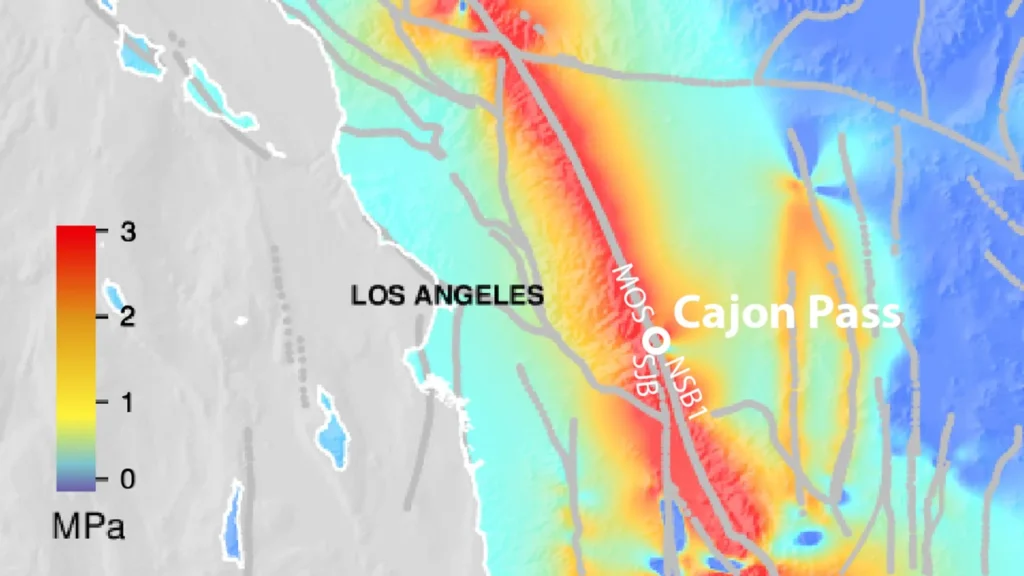
In Southern California, the San Andreas and San Jacinto faults act as the primary conduits for this tectonic motion. Their intersection at Cajon Pass, a geologically complex junction northeast of Los Angeles, serves as a pivotal point for the region’s seismic future. It is here that a rupture—a tear in the earth’s crust—might either terminate or jump from one fault to the other, potentially triggering a "multi-fault" event that would amplify the scale of devastation.
A Millennium of Seismic Data
To understand the current state of these faults, the research team—which included experts from the University of Hawaiʻi at Mānoa, the U.S. Geological Survey (USGS) Earthquake Science Center in Pasadena, and the Scripps Institution of Oceanography at UC San Diego—developed a sophisticated, physics-based, four-dimensional model.
The Chronology of Stress
The model does not merely look at the present; it reconstructs the past. By synthesizing radiocarbon dating, anomalous growth patterns in tree rings, and historical documentation of ground-surface ruptures, the team built a 1,000-year record of Southern California’s seismic history.
- The 1812 Wrightwood Event: A historical touchstone for the region, this earthquake demonstrated the capacity for a rupture to bridge the gap between fault systems, tearing through both the San Andreas and the San Jacinto faults in a single, through-going event.
- The 1857 Fort Tejon Earthquake: A massive magnitude 7.9 event. Notably, this rupture reached the Cajon Pass but failed to jump, leaving the San Jacinto fault relatively unaffected at the time.
By running these historical events through their simulation, the team could observe how stress was redistributed after each major quake and how it accumulated during the subsequent "quiet" intervals. According to Dr. Burkhard, the simulation tracks the entire lifecycle of a fault: the accumulation of stress, the sudden release during a rupture, and the slow, deep-crustal relaxation that occurs in the decades following an event.
The "Earthquake Gate" Hypothesis
Central to the study is the concept of the "earthquake gate" at Cajon Pass. Researchers found that this junction acts as a dynamic regulator rather than a static barrier. Whether a rupture continues or stops depends heavily on the "stress budget" of the surrounding faults at the exact moment the rupture arrives.
If both the San Andreas and San Jacinto faults are under high stress, the gate remains "open," allowing a rupture to cascade across the junction. If one is under significantly less stress than the other, the rupture is more likely to be contained.
The data revealed that the San Jacinto-Bernardino section is currently under 3.6 MPa (megapascals) of stress, while the Mojave South section of the San Andreas is at 2.8 MPa. Both values represent the highest points in the 1,000-year simulation. "Not only is it concerning that the stresses are reaching historic highs," Dr. Burkhard notes, "but the relative stress conditions between the two fault systems are approaching the range we associate with major ruptures that cross both faults simultaneously."
Implications for Southern California
The prospect of a "through-going" rupture—a quake that breaks multiple segments of both major fault systems—is the scenario that keeps disaster planners awake at night. Such an event would not be confined to a single neighborhood or city; it would affect a massive, interconnected geographic swath including the greater Los Angeles area, San Bernardino, Riverside, and the Coachella Valley.
Infrastructure Vulnerability
Cajon Pass is not just a geological junction; it is a critical artery for modern civilization. It hosts:
- Energy Infrastructure: Major high-voltage power lines and natural gas pipelines that fuel the Southern California economy.
- Transportation Corridors: Interstate 15, a primary trucking and travel route connecting Southern California to the rest of the nation, along with vital freight rail lines.
A rupture through this corridor could paralyze regional logistics, severing the supply chains that support millions of residents. The physical damage to building stock, combined with the collapse of infrastructure, presents a challenge that exceeds the capacity of many standard emergency response plans.
Official Responses and Hazard Assessments
While the study provides a clearer physics-based picture of the region’s seismic risk, officials at the USGS and other academic institutions are careful to contextualize these findings. The study does not provide a date or a deadline; it provides a framework for assessment.
"The study is not a prediction of when an earthquake will occur," Dr. Burkhard emphasizes. "What we can say is that the system is critically stressed and that physics-based models like ours give a clearer picture of the range of scenarios we should be prepared for."
Geologists and emergency management officials view this information as a tool for "stress-testing" current safety protocols. If a multi-fault rupture is a physically plausible scenario under current stress conditions, then urban planning and retrofitting efforts must be calibrated to accommodate that level of shaking.
Beyond California: A Global Framework
The implications of this research extend far beyond the borders of California. Complex fault junctions exist in high-seismicity regions worldwide, from the North Anatolian Fault in Turkey to the Alpine Fault in New Zealand.
The methodology developed by the University of Bern team—combining long-term historical records with high-resolution physics modeling—offers a blueprint for international scientists. By understanding how "earthquake gates" function in one part of the world, geophysicists hope to improve hazard maps globally.
Preparing for the Unknown
The fact that Southern California has not experienced a major, comparable earthquake since 1857 is, paradoxically, a source of danger. The "long quiet period" has allowed tectonic stress to reach levels that have not been seen in a millennium.
For residents, this research serves as a reminder of the inherent volatility of the landscape. While it is impossible to say whether the next rupture will be a localized event or a massive, multi-fault cascade, the science is clear: the energy is there, the faults are primed, and the "gate" at Cajon Pass is effectively ready to facilitate a major event should the right conditions arise.
As the scientific community continues to refine these models, the onus remains on policy makers, urban planners, and the public to use this data for proactive resilience. The "earthquake gate" is a reminder that in geology, as in life, the systems we rely on are only as stable as the forces acting upon them. With stresses at an all-time high, the focus must shift from the question of if to the imperative of preparedness.