

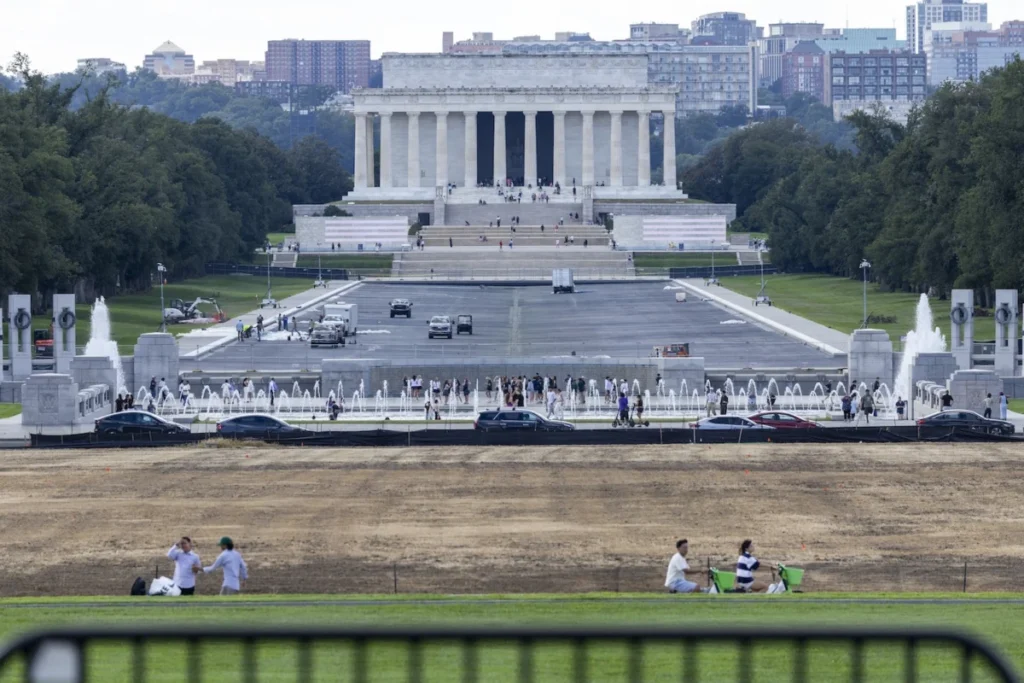
The Lincoln Memorial Reflecting Pool, an iconic centerpiece of the National Mall and a symbol of American civic life, has become the subject of an intensifying controversy. What was intended to be a long-overdue restoration project has devolved into a sprawling public works failure, characterized by shoddy craftsmanship, questionable contracting practices, and a disconnect between official government narratives and internal technical reports.
A recent exposé by the Washington Post, centered on a previously undisclosed 75-page “failure analysis” commissioned by the lead contractor, has cast a harsh light on the structural integrity of the pool’s new liner. The document paints a picture of systemic negligence that stands in stark contrast to the claims made by the Trump administration during the project’s disastrous rollout.
The Anatomy of a Failure: Main Findings
The inspection report, authored by Atlantic Coating Inspection (ACI) and dated August 6, serves as a damning forensic accounting of the $14.7-million repair project. While officials initially pointed toward external factors—specifically claims of vandalism—to explain the immediate degradation of the pool’s surface, the report contains no mention of such activities. Instead, it documents a catalog of technical deficiencies that suggest the failures were baked into the project from the start.
The report details widespread issues including blistering, peeling, and significant cracking across the pool’s new floor coating. Perhaps most alarming is the revelation of poor site management: the inspection found that the specialized protective coating was applied under rushed conditions, with workers continuing to apply the material as late as the day before the pool was refilled on June 4. Technical specifications for the product explicitly required a 72-hour “cure” period to ensure the material was fully bonded and dry. By bypassing these critical protocols, the contractor effectively ensured the failure of the project before the first gallon of water was even introduced.
Chronology of a Restoration Gone Wrong
To understand the gravity of this situation, one must look at the timeline of the restoration, which was marred by administrative haste and technical oversight from its inception.
- The Contract Phase: The project was initiated under a $14.7-million no-bid contract awarded to Atlantic Industrial Coatings (AIC). The contract was intended to address decades of chronic maintenance issues, including persistent leaks and aesthetic degradation that had plagued the pool for years.
- The Construction Window: Work commenced with the goal of having the site ready for summer visitors. However, as the deadline approached, pressure to reopen the site appears to have superseded rigorous quality control.
- The June 4 Refill: The pool was refilled on June 4. The immediate aftermath was visual proof of the project’s failure. Within mere days, the water turned a murky, unnatural green due to a massive algal bloom, while large, unsightly flakes of blue paint began to drift to the surface, signaling that the liner was already shedding.
- The August 6 Inspection: Following the public outcry over the pool’s deteriorating condition, AIC commissioned an internal inspection. The resulting 75-page document identified that the problems were not isolated incidents but systemic failures stemming from improper application and rushed timelines.
- The Fall Disclosure: With the release of the report in October, the disparity between the contractor’s private findings and the government’s public statements became a matter of national record.
Technical Deficiencies and Supporting Data
The “failure analysis” is not merely a summary; it is a granular breakdown of engineering incompetence. The documentation includes scores of high-resolution photographs that detail the specific nature of the liner’s failure.
The coating system, which was meant to provide a watertight, durable barrier, suffered from several distinct types of degradation:
- Blistering: Evidence of osmotic pressure buildup beneath the coating, likely due to contaminants trapped during the premature application.
- Delamination: Widespread peeling, where the coating failed to adhere to the substrate, directly linked to the lack of proper curing time.
- Surface Cracking: Stress fractures that suggest the material was not applied at the appropriate thickness or in a climate-controlled environment, leading to premature brittleness.
The data suggests that the haste to "check the box" on the project led to a scenario where the taxpayer-funded investment was essentially discarded within 72 hours of the pool’s reopening.
Official Responses and the Defense of the Status Quo
The response from the Department of the Interior has been one of procedural defense. In a statement issued in mid-October, a spokesperson emphasized that Atlantic Industrial Coatings (AIC) remains contractually obligated to rectify the defects.
“AIC is contractually obligated to fix the Reflecting Pool and is well on its way to doing so,” the statement read. The Department has maintained that the responsibility for the remediation lies entirely with the contractor, attempting to distance the federal government from the oversight failures that allowed such work to proceed.
However, this response raises more questions than it answers. Critics and government accountability advocates are questioning how a no-bid contract of this magnitude was managed without robust on-site oversight from the National Park Service. If the material required 72 hours to cure, why were government inspectors not present to ensure that the refill did not occur until the deadline had passed?
Implications for Public Works and Accountability
The Lincoln Memorial Reflecting Pool is more than just a water feature; it is a highly visible stage for American democracy. Its failure serves as a case study in the dangers of prioritizing speed and political optics over engineering best practices.
The Problem with No-Bid Contracts
The $14.7-million no-bid contract awarded to AIC has sparked a broader debate about the procurement processes within federal agencies. While no-bid contracts can expedite essential repairs, they often bypass the competitive bidding process that ensures high-quality work at fair market rates. When transparency is stripped away, the accountability loop—where the contractor is held responsible for the project’s long-term success—often dissolves.
Impact on the National Mall
The National Mall is managed by the National Park Service (NPS), an agency currently struggling with a massive maintenance backlog across the country. The Reflecting Pool disaster is a microcosm of the risks faced when infrastructure maintenance is underfunded or managed by inexperienced contractors. For the millions of tourists and citizens who visit the memorial annually, the sight of peeling paint and stagnant, discolored water is a jarring disruption of the sanctity of the space.
Future Oversight
Moving forward, this incident will likely lead to stricter oversight requirements for contractors working on National Historic Landmarks. The “failure analysis” report has provided a roadmap for what happens when industrial standards are ignored. The NPS is now faced with the dual challenge of forcing AIC to complete the repairs at no further cost to the taxpayer while simultaneously restoring public confidence in the stewardship of the Mall’s most iconic features.
As the remedial work continues, the focus will shift to whether the contractor can actually deliver a lasting solution or if the pool will remain a site of perpetual maintenance. For now, the Lincoln Memorial Reflecting Pool remains a sobering reminder that even the most revered national monuments are vulnerable to the mundane, yet devastating, realities of bureaucratic failure and poor construction management. The path to restoration will require not just a new coat of paint, but a complete overhaul of the oversight mechanisms that failed to protect one of America’s most precious landmarks.