

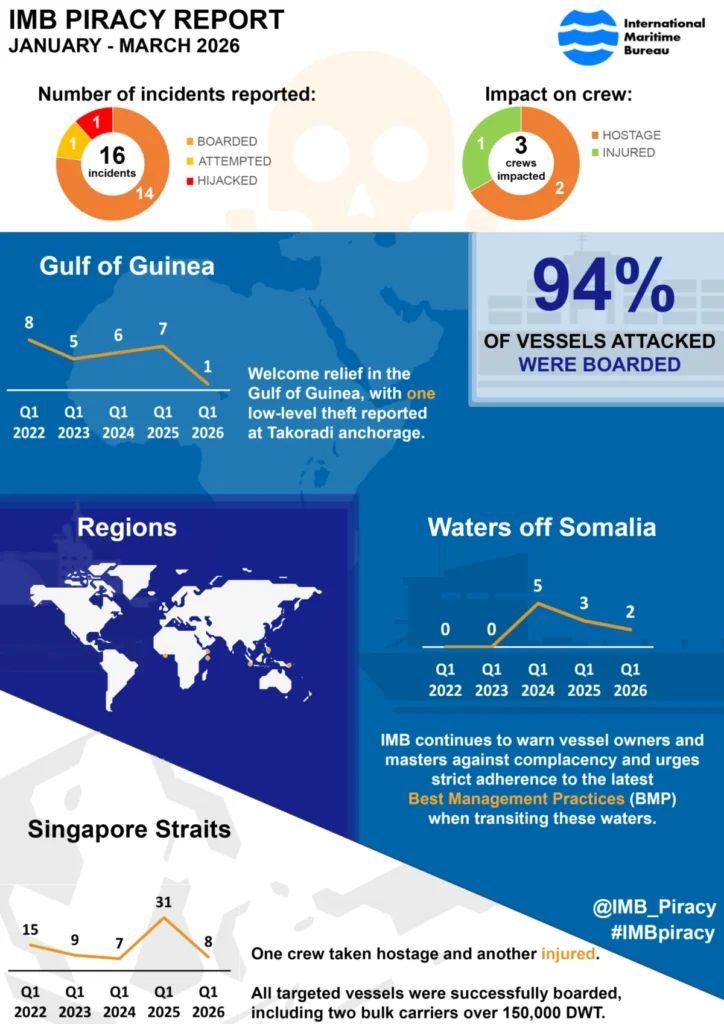
Introduction: The Invisible Shield of Global Trade
The global economy is a complex, fragile web of logistics, sustained by the silent passage of thousands of merchant vessels across the world’s oceans. Every day, 90% of global trade is transported by sea, yet this vital artery is constantly shadowed by the threat of piracy, armed robbery, and maritime crime. At the heart of the global effort to mitigate these threats stands the International Maritime Bureau (IMB) Piracy Reporting Centre (PRC).
As a specialized division of the International Chamber of Commerce (ICC), the IMB PRC serves as the maritime industry’s primary sentinel. Operating 24 hours a day, seven days a week, the Centre functions as a critical node in a global security network, providing immediate support to vessels under distress and serving as the definitive source of transparent, reliable data for governments, naval forces, and shipping companies alike.
The Mandate of the IMB Piracy Reporting Centre
The IMB PRC was established with a singular, vital mission: to combat maritime crime through information sharing and real-time coordination. By acting as a single point of contact for shipmasters, the PRC bridges the gap between a vessel in crisis and the naval authorities capable of responding.
Core Functions and Operational Objectives
The Centre’s operations are characterized by three primary pillars:
- Immediate Crisis Response: Providing 24/7 incident reporting and direct assistance to vessels currently experiencing threats.
- Data Intelligence: Compiling the world’s most comprehensive database on maritime security incidents, which allows for the mapping of "hotspots" and trends.
- Institutional Advocacy: Working with governments and international organizations to influence policy and ensure that maritime security remains a top priority on the global geopolitical agenda.
Chronology of Maritime Threats: A Historical Perspective
Maritime piracy is often viewed through a romanticized, historical lens, yet its modern incarnation is a sophisticated, violent, and highly lucrative criminal enterprise. Understanding the current necessity of the IMB PRC requires a look back at the evolution of maritime threats over the past three decades.
The 1990s: The Rise of Southeast Asian Piracy
In the 1990s, the focus of global maritime security was the Malacca Strait, one of the world’s busiest shipping lanes. Piracy was localized but rampant, characterized by hit-and-run robberies that threatened the flow of goods into Asian markets. It was during this era that the IMB PRC solidified its operational procedures, establishing the protocols for ship-to-shore reporting that remain in use today.
The 2000s: The Somali Crisis and Global Awareness
The dawn of the 21st century saw a shift toward the Horn of Africa. The collapse of the Somali state led to an unprecedented surge in piracy, with heavily armed syndicates hijacking large commercial tankers for multi-million-dollar ransoms. The crisis reached its zenith between 2008 and 2012, forcing the international community to deploy naval task forces. During this period, the IMB PRC became the primary conduit for information, coordinating with international naval coalitions to warn commercial vessels of high-risk zones.
2010–2024: Diversification and Regional Hotspots
In recent years, the threat has shifted again, moving toward the Gulf of Guinea and the waters of the Sulu-Celebes Seas. While the nature of the threat has changed—incorporating elements of kidnapping for ransom and boarding of vessels for theft—the IMB PRC’s role has only intensified. The focus today is not just on traditional piracy, but on the intersection of maritime crime with broader geopolitical instability.
Supporting Data: The Anatomy of Maritime Crime
Data is the most potent weapon in the IMB’s arsenal. By meticulously documenting every incident, the PRC provides the shipping industry with the intelligence required to conduct dynamic risk assessments.
Incident Categorization
The IMB categorizes incidents into three primary levels to ensure that response protocols are calibrated to the risk:
- Attempted Boardings: Situations where pirates approach a vessel but are deterred by security measures, such as barbed wire, water cannons, or the presence of a Citadel.
- Boarded Vessels: Instances where perpetrators have successfully breached the hull, though the crew may have successfully retreated to a secure location.
- Hijacked/Kidnapped: The most severe category, involving the seizure of the vessel or the abduction of crew members for ransom.
The Value of Transparent Reporting
The IMB’s data is unique because it is independent. Unlike governmental reports, which may be influenced by political considerations or regional sensitivities, the IMB provides a neutral account of incidents. This transparency is vital for insurance underwriters, who rely on these figures to determine premiums for shipping routes. Furthermore, this data informs the deployment of private maritime security companies (PMSCs) and influences the navigation routes chosen by major shipping conglomerates.
Official Responses and Strategic Collaboration
The effectiveness of the IMB PRC rests on its ability to act as a bridge between the private sector and public authorities.
Michael Howlett: The Voice of Maritime Security
Michael Howlett, Director of the ICC International Maritime Bureau, has consistently emphasized that maritime security is a collective responsibility. "The IMB PRC is not just a reporting desk," Howlett has noted. "It is a vital mechanism that ensures that when a ship is in trouble, the right people—whether that be the local coast guard or a regional naval task force—are informed immediately."
Under Howlett’s leadership, the Bureau has expanded its outreach to include cybersecurity training for crews, recognizing that the modern threat is not just physical boarding, but also the potential for digital intrusion into a ship’s navigation and logistical systems.
The Role of the International Chamber of Commerce (ICC)
As the parent organization, the ICC provides the global platform necessary for the IMB to effect change. With a reach spanning more than 45 million companies in 170 countries, the ICC leverages its influence to ensure that maritime security is discussed at the highest levels of the United Nations and the International Maritime Organization (IMO).
The ICC’s mission—to make business work for everyone—is nowhere more relevant than in the maritime sector. If the oceans are not safe, the global supply chain collapses, driving up costs for consumers and threatening the stability of nations dependent on imports.
Implications: The Future of Maritime Security
Looking ahead, the landscape of maritime security is poised for significant transformation. Several factors are currently dictating the strategic priorities of the IMB PRC.
The Technological Frontier
The integration of Artificial Intelligence (AI) and satellite surveillance into maritime security is the next major step. The IMB PRC is increasingly leveraging real-time satellite AIS (Automatic Identification System) data to track suspicious vessel patterns. By identifying "dark vessels"—ships that switch off their transponders—the IMB can provide early warnings to commercial operators, effectively moving the needle from reactive response to proactive prevention.
Geopolitical Instability and "Gray Zone" Threats
The current climate of international relations has introduced new complexities. Maritime security is increasingly linked to state-sponsored activity, where privateers or state-aligned proxies may disrupt commercial shipping to exert political pressure. This "gray zone" warfare presents a difficult challenge for the IMB, as it requires navigating delicate diplomatic waters while maintaining its commitment to objective, non-partisan reporting.
Environmental and Regulatory Pressures
As the shipping industry moves toward decarbonization, the design of vessels is changing. The IMB is working to ensure that the security protocols developed for traditional ships remain effective for new vessel types, including those powered by hydrogen or ammonia, which present unique risks if compromised or boarded.
Conclusion: A Call for Continued Vigilance
The work of the IMB Piracy Reporting Centre is a testament to the power of international cooperation in an increasingly fragmented world. By providing a 24/7 safety net for the men and women who navigate the world’s oceans, the IMB ensures that trade continues to flow, regardless of the threats that lurk in the deep.
The reliance of the global economy on maritime transit makes the IMB’s mission not merely an industry interest, but a public good. As we look toward an uncertain future defined by technological disruption and shifting geopolitical alliances, the need for the transparent, reliable, and expert guidance provided by the IMB PRC has never been more acute.
For stakeholders—from the captains on the bridge to the policymakers in capitals—the IMB remains the primary point of reference for security. By staying informed, supporting institutional efforts to bolster maritime security, and maintaining the highest standards of reporting, the international community can ensure that the oceans remain a highway of prosperity rather than a theater of conflict.
Contact Information for Security Coordination
For vessels requiring assistance, or for media and industry professionals seeking further intelligence on maritime security, the IMB Piracy Reporting Centre remains available at:
Michael Howlett
Director, ICC International Maritime Bureau
Tel: +44 207 423 6960
Email: [email protected]
About the ICC: The International Chamber of Commerce continues to champion the cause of secure, transparent, and fair global trade. Through its advocacy and the specialized work of its bureaus, the ICC remains the institutional backbone of the global business community, ensuring that the wheels of commerce continue to turn, every day, everywhere.



