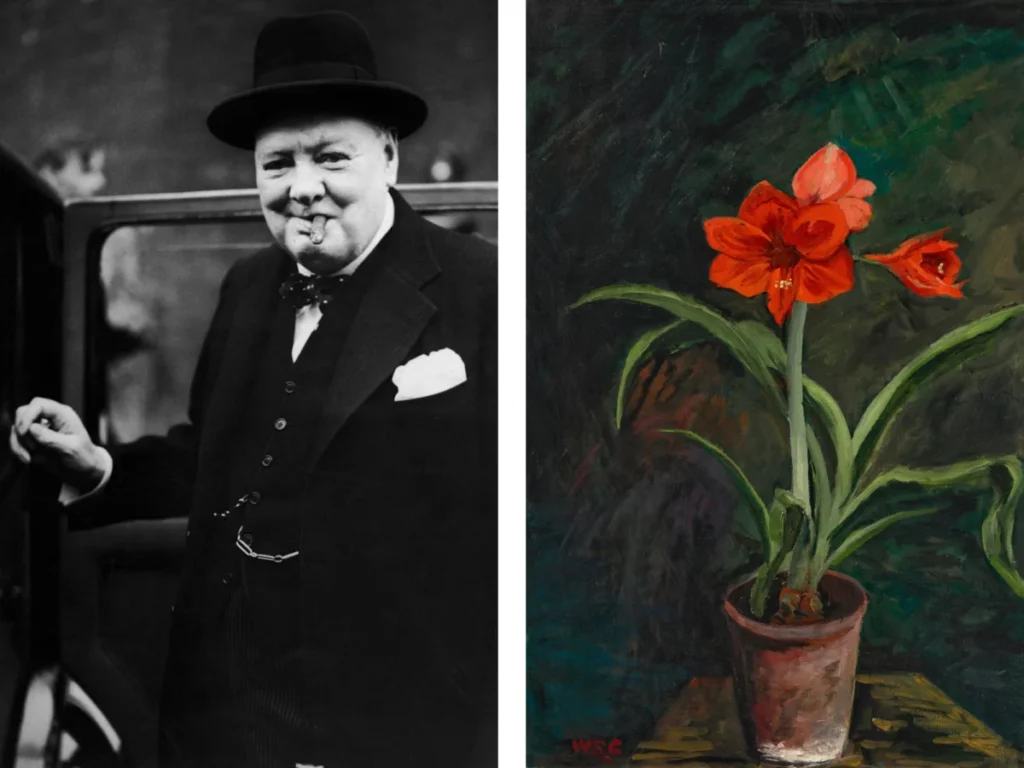
In the corridors of history, Winston Churchill is remembered primarily as the defiant statesman who steered Britain through the existential crisis of the Second World War. However, far from the pressures of the Cabinet Room, Churchill found a sanctuary in the quietude of the canvas. This October, a rare glimpse into the private life of the wartime leader will reach the public market as Christie’s prepares to auction his 1948 still-life, Amaryllis Lily, as the centerpiece of its Modern British and Irish Art Evening Sale in London.
Carrying a pre-sale estimate of £300,000 to £500,000 ($396,000–$661,000), the painting is not merely a collector’s item; it is a storied artifact that traces a line from the private collections of the Churchill family to the philanthropic mission of the Churchill Fellowship.
The Subject and Significance
Amaryllis Lily depicts a singular, vibrant red amaryllis belladonna—often referred to as the March lily—contained within a modest pot. Set against a somber, dark backdrop, the composition highlights Churchill’s penchant for focusing on the interplay of light and deep, saturated color. While he is often remembered for his expansive landscapes of the Mediterranean or his beloved Chartwell estate, this still-life offers a more intimate look at his technical growth.
"Amaryllis Lily is a striking example of Winston Churchill’s skill as a painter, demonstrating his sophisticated understanding of color and composition," says Pippa Jacomb, head of the Modern British and Irish Art Evening Sale at Christie’s. According to Jacomb, the piece serves as a bridge between Churchill’s amateur curiosity and his maturing mastery of the medium.
A Legacy of Philanthropy: The Provenance
The painting possesses a provenance that elevates its cultural value. Following its completion in 1948, Churchill gifted the work to his daughter, Lady Mary Soames. It remained within the family for nearly five decades, serving as a quiet witness to the post-war life of the Churchill household.
In 1995, Lady Mary Soames donated the painting to the Churchill Fellowship, a charity established in the wake of the former Prime Minister’s death to promote travel and the exchange of ideas. The proceeds from the upcoming Christie’s auction are earmarked for the fellowship’s "Making Space for the Arts" program, an initiative designed to foster creative accessibility and provide resources for artists. By selling the work, the fellowship is effectively completing a cycle: a painting created by a man who used art to heal his own mind will now provide the resources for others to explore their creative potential.
Chronology: The Evolution of Churchill the Painter
To understand the significance of Amaryllis Lily, one must examine the timeline of Churchill’s relationship with the easel, a pursuit that became his most enduring emotional outlet.
The 1930s: The Mentorship of William Nicholson
Churchill’s serious foray into painting began in the 1930s. It was during this formative period that he formed a profound friendship with the esteemed British painter William Nicholson. Their relationship was not merely social; it was pedagogical. In correspondence with the art historian John Rothenstein, Churchill famously identified Nicholson as the "person who taught me most about painting."
Nicholson’s influence is palpable in Amaryllis Lily. The restrained composition, which focuses the viewer’s eye entirely on the texture of the bloom rather than the surrounding environment, reflects the lessons learned during those afternoons spent at Chartwell Manor. In the gardens of his Kent home, Churchill had a purpose-built studio, a sanctuary where he could decompress from the shifting tides of geopolitics.
1948: The Maturation of Style
By 1948, the year Amaryllis Lily was painted, Churchill was a man who had seen the world transformed. The post-war era brought a different kind of pressure—the onset of the Cold War and his own political transition. Painting provided a sense of control and clarity. Unlike the broad, sweeping vistas he often painted, this still-life suggests a period of introspection. The boldness of the red amaryllis against the dark background indicates a painter who had shed the timidity of an amateur and embraced the dramatic potential of light and shadow.
Supporting Data: Churchill in the Art Market
The market for Churchill’s art has seen a dramatic appreciation in the 21st century. His works have transitioned from being "political curiosities" to being recognized as genuine contributions to 20th-century British art.
The pinnacle of this market movement occurred in 2021, when Christie’s sold Tower of the Koutoubia Mosque (1943) for an astonishing £8.29 million. That painting, famously gifted by Churchill to President Franklin D. Roosevelt after the Casablanca Conference, highlighted the global interest in works that combine historical provenance with artistic merit.
While Amaryllis Lily does not carry the historical weight of a wartime summit, its estimate reflects the steady, robust demand for his still-life works. Collectors recognize that while his landscapes are often more iconic, his still-lifes are the most revealing of his personal artistic voice and his disciplined adherence to the lessons of his mentors.
Official Responses and Curatorial Analysis
The auction house’s assessment of the work is largely centered on the "confidence" Churchill developed over the decades. Pippa Jacomb emphasizes that the 1948 piece reveals a painter who was no longer painting merely to mimic his mentors, but to express a specific vision.
"Painted in 1948, the work reflects the important influence of William Nicholson, particularly in its restrained composition and bold use of color," Jacomb notes. "While it pays homage to that mentorship, it also reveals the confidence Churchill developed as a still-life painter."
This confidence was born of necessity. Churchill famously remarked that painting was his "remedy" for the "black dog" of depression. For the statesman, the canvas was a place where he could correct mistakes with a stroke of a brush—a luxury he rarely enjoyed in the political arena.
Implications for the Art Market and Historical Preservation
The sale of Amaryllis Lily carries broader implications for the art market and the preservation of Churchill’s legacy.
The Democratization of Art
The "Making Space for the Arts" program, which will benefit from this sale, serves as a testament to the enduring impact of the Churchill Fellowship. By investing in the arts, the fellowship ensures that the creative spirit—which Churchill found so vital to his own mental health—is nurtured in future generations. This elevates the painting from a static object of wealth to a catalyst for future creativity.
Re-evaluating the "Amateur" Label
For decades, critics were hesitant to evaluate Churchill’s work objectively, often dismissing it as a mere hobby of a powerful man. However, the consistent performance of his paintings at auction—and the increasing interest from galleries—suggests a permanent shift in how his work is perceived. Historians now argue that his art cannot be divorced from his leadership; his ability to visualize the "big picture" in politics was arguably mirrored in the way he structured his compositions on canvas.
The Provenance Premium
The fact that this painting was held by his daughter, Lady Mary Soames, and then donated to the fellowship, creates a "provenance premium." In an age where digital provenance and provenance tracking are increasingly important, a direct line of ownership from the artist to his family and then to a charitable institution provides a layer of historical authenticity that is highly sought after by high-net-worth collectors.
Conclusion
As Christie’s prepares for the October 21 sale, Amaryllis Lily stands as a poignant reminder of the multifaceted nature of Winston Churchill. It is a work that captures the essence of his artistic journey—from the early guidance of William Nicholson to the quiet, introspective confidence of his later years.
Whether the final hammer price exceeds the £500,000 estimate remains to be seen, but the true value of the painting has already been realized through its long history of family stewardship and its future role in supporting the arts. For those who admire Churchill, not as a titan of history but as a human being who sought beauty in the face of a chaotic world, Amaryllis Lily represents a profound connection to the man behind the myth. As the bidding begins, the painting will move from the private gallery of his daughter’s memory into the public sphere, ensuring that the legacy of the "painter-politician" continues to influence the world in ways that transcend the written records of his wartime achievements.