In an era where the fashion industry is increasingly turning to generative AI to streamline production, cut costs, and conjure ethereal, algorithmically perfect advertising imagery, Spanish fashion house Desigual has chosen a radically different path. For its Fall 2026 campaign, the brand has opted to reject the polished sterility of the digital age in favor of a provocative, human-centric narrative. By enlisting the outspoken activist, model, and influencer Vivian Jenna Wilson, Desigual is not just selling a collection—it is launching a scathing critique of the very technology its competitors are rushing to embrace.
The campaign, titled “Born to Disobey,” serves as both a fashion showcase and a cautionary tale. It places Wilson at the center of a surreal, humorous, and unsettling domestic landscape where she interacts with a humanoid robot, ultimately highlighting the brand’s belief that true creativity remains an exclusively human endeavor.
The Narrative: A Cautionary Tale of Artificiality
The centerpiece of the campaign is a short film featuring Wilson, the eldest daughter of Elon Musk, in a series of vignettes that range from the mundane to the absurd. In the footage, Wilson is seen treating a humanoid robot with a blend of nonchalance and outright disdain. She mocks the machine’s repetitive, robotic mispronunciations of the brand name, uses it as a makeshift golf tee, tasks it with gardening, and even treats it as a bizarre, inanimate bedmate.
The climax of the film sees Wilson dragging the lifeless, metallic machine across a carpet by its ankles, delivering the campaign’s definitive closing line: “Some things aren’t meant to be fixed.”
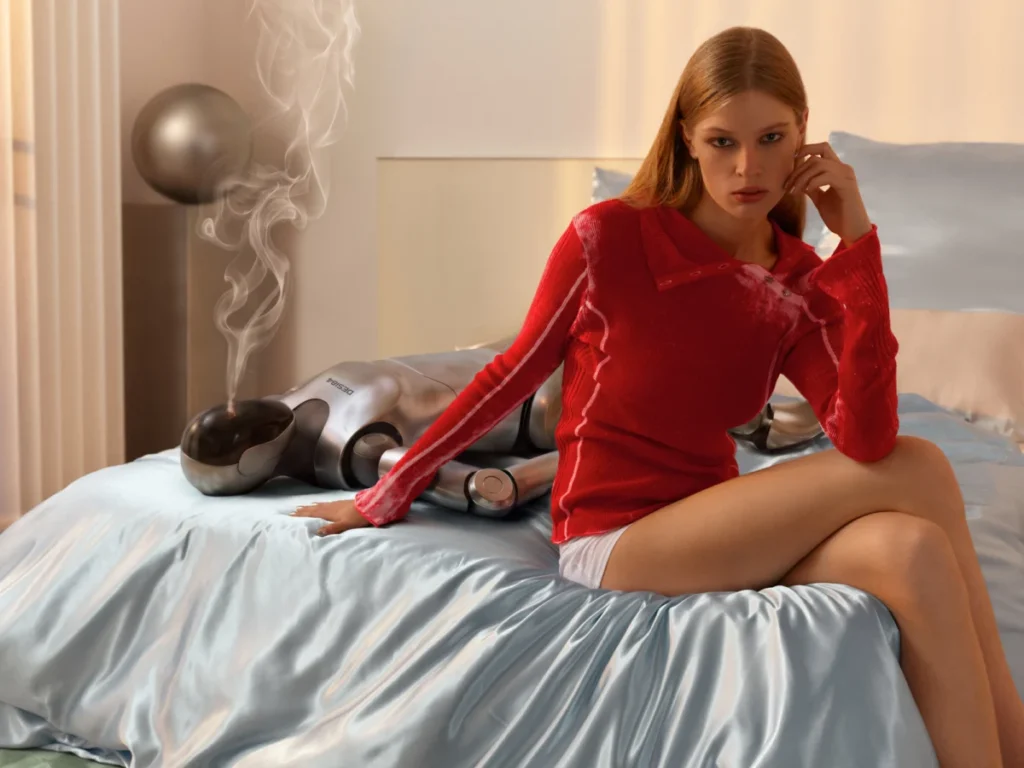
The imagery is striking: in one frame, Wilson lounges on a diving board while a robot appears to drown in the pool behind her; in another, she sits on a bed as smoke curls from the face shield of the machine beside her. These scenes are designed to jar the viewer, forcing a confrontation with the uncomfortable intersection of human existence and technological encroachment.
The Reality Behind the Screen: Human vs. Machine
One of the most immediate questions prompted by the campaign is whether the robot featured was a genuine piece of high-end robotics technology. The answer, according to Wilson, is a firm "no."
“Oh my goodness no, and I’m so glad,” Wilson said in a recent interview. “The technology isn’t quite there yet. It was a guy in a blue suit. We ended up gossiping about pop culture between takes.”
This revelation underscores the irony of the campaign. By using a human performer to simulate a machine—a process often used in film before the advent of full-scale CGI or AI—Desigual effectively demonstrated that the "human touch" remains the most versatile and relatable tool in storytelling. It was a creative choice that emphasized that even when we try to simulate the artificial, we rely on human intuition to make it convincing.
The Philosophy of Dissent: Wilson’s Critique of AI
Vivian Jenna Wilson’s participation in the “Born to Disobey” campaign is no mere modeling gig; it is a manifestation of her public stance against the rapid, unchecked integration of AI into daily life. Her critique, shared during discussions surrounding the campaign launch, is multifaceted, touching on cognitive, ecological, and socioeconomic concerns.
The Cognitive Cost of Automation
Wilson is particularly vocal about the dangers of intellectual laziness. “Stop using AI for everything — you’re going to give yourself a lobotomy,” she warns. Her argument centers on the loss of critical thinking. She posits that when individuals outsource the processing of complex information to algorithms, they risk losing their unique perspective and individual identity. “Outsourcing all of your critical thinking to AI is the easiest way to lose your individuality,” she asserts.
The Erosion of Artistic Integrity
Regarding AI-generated art, Wilson is unequivocal in her disapproval. “I find it egregious,” she states. “Art is human, it is emotion through expression.” To Wilson, the generative process—which relies on scraping existing data to produce a derivative output—is the antithesis of the creative impulse, which she defines as a visceral, human experience.
The Ecological and Socioeconomic Toll
Beyond the philosophical, Wilson points to the tangible consequences of the AI boom. She cites the massive ecological footprint of data centers, noting the excessive water consumption required for cooling, which exacerbates the global climate crisis. Furthermore, she highlights the human cost: the displacement of young professionals whose roles are being automated. “People my age are continuously getting overlooked in favor of companies replacing their jobs with AI,” she notes.
Finally, she warns of the ease with which algorithms can be weaponized. Because AI systems are susceptible to manipulation, they become conduits for misinformation, manufactured controversy, and profit-driven agendas. She urges consumers to practice "media literacy," asking, “Why am I being shown this? Why was this made? Why would they want me to see this?”
Desigual’s Strategic Shift: A New Focus on the U.S.
The “Born to Disobey” campaign is more than a cultural statement; it is a vital component of Desigual’s aggressive expansion into the U.S. market. By choosing a figure as polarizing and high-profile as Wilson, the Spanish brand is making a concerted effort to capture the attention of a younger, more politically and socially conscious demographic.
The collection itself—featuring the “Born to Disobey” slogan on T-shirts, alongside cow-print coats, low-slung jeans, and the brand’s iconic, kaleidoscopic print mixes—reflects this focus on individuality and rebellion.
To solidify this push, Desigual has arranged for Wilson to unveil and discuss the campaign alongside noted podcaster and journalist Amy Odell in New York City. This event serves as a platform to transition the conversation from the digital realm into real-world, face-to-face discourse, mirroring the brand’s commitment to "intuition, creativity, and humanity."
Implications for the Fashion Industry
The fashion industry currently stands at a crossroads. Luxury houses and mass-market retailers alike are investing millions into AI-driven design tools, AI-powered customer service bots, and virtual models. However, the Desigual campaign suggests that a counter-movement may be brewing.
The Value of Human Imperfection
If the luxury sector is defined by the "human touch"—the artisan, the tailor, the creative director—then the reliance on AI poses an existential threat to the value proposition of fashion. By highlighting the limitations of the machine, Desigual is betting that consumers will grow weary of the "uncanny valley" effect created by AI advertising.
Branding as Advocacy
The success of “Born to Disobey” will depend on whether audiences perceive it as an authentic extension of brand values or a cynical use of a high-profile activist to generate "clout." By aligning with Wilson, Desigual has moved beyond traditional celebrity endorsements into the realm of ideological partnerships. If this approach succeeds, we may see more brands attempting to define themselves not by what they can do with technology, but by what they refuse to do.
Conclusion
As the digital landscape becomes increasingly saturated with automated content, the human element becomes a premium commodity. Desigual’s Fall 2026 campaign is a timely reminder that technology should serve humanity, not replace it. Through the lens of Vivian Jenna Wilson, the brand has articulated a clear message: in a world obsessed with efficiency and optimization, the most rebellious act is to remain stubbornly, creatively, and imperfectly human.
Whether this message will resonate with the broader market remains to be seen. However, by choosing to "disobey" the industry-wide trend toward total automation, Desigual has ensured that its Fall 2026 collection will be remembered as the moment one brand decided to draw a line in the sand. As Wilson suggests, we are at a point where we must choose between the convenience of the algorithm and the vitality of the human spirit. For Desigual, the choice is clear—and it is one that, for the first time in years, makes the fashion industry look like it actually has a pulse.