
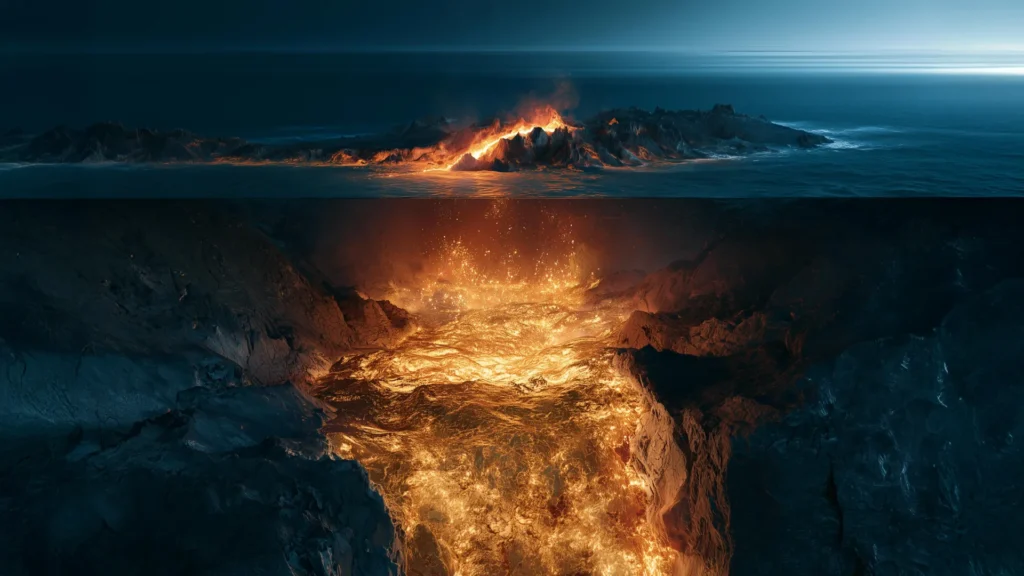
Deep beneath the churning currents of the Pacific Ocean, where tectonic plates grind against one another in a slow-motion dance of geological upheaval, Earth is engaged in a clandestine manufacturing process. For decades, geologists have been puzzled by the anomalous richness of gold found in "island arcs"—chains of volcanoes that rise above subduction zones, where one oceanic plate is forced beneath another. These volcanic regions are consistently more auriferous than the rest of the planet’s crust, but the precise mechanism of this enrichment has remained a "black box" of earth science.
New research, led by Dr. Christian Timm of the GEOMAR Helmholtz Centre for Ocean Research Kiel, has finally begun to unlock this mystery. By analyzing volcanic glass recovered from the seafloor, scientists have identified a multi-stage, water-assisted melting process that acts as a global refining system, concentrating gold long before it ever reaches the surface.
The Geography of Enrichment: Investigating the Kermadec Arc
To understand the origins of this hidden "gold kitchen," Dr. Timm’s team turned their attention to the Kermadec island arc and the adjacent Havre Trough, located north of New Zealand. This region is a quintessential subduction zone, characterized by intense volcanic activity and a complex tectonic architecture.
The study relied on the collection of 66 samples of volcanic glass. When molten magma erupts from a submarine volcano, the freezing cold of the deep ocean causes it to solidify almost instantaneously. This rapid cooling acts as a geological time capsule, "locking" the chemical signature of the magma at the exact moment of its birth. By collecting these samples, the team was able to bypass the weathering and chemical alterations that typically obscure the history of volcanic rock, gaining a direct window into the mantle’s conditions.
Chronology of a Discovery: From Sampling to Synthesis
The journey to these findings was as meticulous as it was arduous. The research process unfolded in three distinct phases:
Phase I: The Hunt for Primitive Glass
The team focused on "primitive" volcanic glasses—magma that had not yet undergone crystallization. In the life of a volcano, magma often sits in subterranean chambers, cooling and changing its chemical composition as minerals crystallize and settle out. Primitive samples, however, provide the purest possible data on the conditions existing deep within the mantle, before the magma began its ascent through the crust.
Phase II: Measuring the Invisible
Analyzing gold at the concentrations found in these rocks is a feat of modern geochemical engineering. Gold is typically present in the mantle at levels measured in nanograms per gram. To map its movement, researchers compared gold concentrations with other "chalcophile" (sulfur-loving) elements, such as silver, copper, selenium, and platinum. Because these elements behave predictably during melting, their relative ratios act as a forensic trail, revealing the thermal and chemical history of the mantle source.
Phase III: Identifying the Multi-Stage Trigger
The breakthrough occurred when the data revealed a striking pattern: the gold concentrations were consistently higher than those found in mid-ocean ridge basalts, which represent the standard "background" level of Earth’s mantle. The ratios of gold to copper in the Kermadec samples were too high to be a coincidence. The evidence pointed to a sophisticated, repeated recycling process.
Supporting Data: The Science of Sulfur and Water
At the heart of the team’s findings is the role of water and sulfide minerals. The traditional view held that water released from the descending subduction plate was the direct "donor" of gold. Dr. Timm’s research, however, refines this significantly.
"We initially assumed that water released from the subduction zone directly controlled gold enrichment," says Timm. "However, our data show that water mainly facilitates mantle melting. The key factor for high gold concentrations is the high—and in part repeated—degree of melting."
The Sulfide Breakdown
Within the Earth’s mantle, gold is not found in veins or nuggets; it is sequestered within sulfide minerals. Under normal conditions, these minerals act as a vault, trapping gold and preventing it from entering the rising magma.
However, the presence of water lowers the melting point of the mantle rock. When the mantle beneath an island arc melts, it does so at high temperatures and in a water-rich environment. This process occurs in stages. During the first stage of melting, the sulfur remains largely intact, holding the gold captive. But as the process repeats—a "multi-stage melting system"—the sulfide minerals are pushed to their limit and eventually break down entirely. Once these minerals dissolve, they release their entire cache of gold into the rising melt.
The data confirms this: the samples showed that when melting is intense enough to destroy the sulfides, the magma is effectively "charged" with gold, carrying it upward into the volcanic plumbing system.
Official Responses and Expert Interpretation
The implications of this study are being felt across the fields of marine geology and economic mineralogy. While the study emphasizes that the rocks themselves are not commercially mineable—the gold concentrations, while high for the mantle, are still far below the thresholds required for profitable mining—the findings provide a foundational understanding of how Earth creates large-scale ore deposits.
"Our research shows that hydrous mantle melting beneath island arcs is a key driver of gold enrichment," Dr. Timm stated. "In these settings, the mantle behaves like a multi-stage melting system that progressively concentrates gold."
The findings have been lauded by peers for their clarity in addressing the "why" behind the geographic distribution of precious metals. By shifting the focus from surface-level hydrothermal processes to deep-mantle mantle dynamics, the study provides a new framework for prospecting. It suggests that if scientists can identify regions where mantle recycling has been most intense, they may be better equipped to locate the hydrothermal vents and sulfide deposits that contain the concentrated gold sought by industry.
Global Implications: The Life Cycle of Gold
The discovery that gold enrichment begins deep within the mantle, long before the magma reaches the seafloor, changes our perspective on how precious metals migrate through the crust.
1. Reassessing Hydrothermal Systems
Submarine hydrothermal vents, often called "black smokers," are known to be rich in gold. Previously, the high gold content was thought to be a result of the chemistry of the crust through which the fluids passed. Dr. Timm’s research suggests that the "starting conditions" are established much deeper. The mantle is not just a passive source; it is an active refinery that prepares the magma with an elevated gold "budget" before it even enters the crustal plumbing.
2. A New Geological Paradigm
This "multi-stage" theory could explain why certain island arcs are significantly more productive than others. Regions with the right tectonic architecture to allow for repeated melting cycles become "gold-rich provinces." This helps clarify why some areas are prolific for mineral exploration while others, which appear geologically similar at the surface, are relatively barren.
3. The Alchemy of the Interior
The study serves as a humbling reminder of the planet’s internal complexity. What we perceive as a static landscape is, in reality, the product of a massive, long-term chemical laboratory.
"We are effectively looking at the first step in the life cycle of gold," Dr. Timm concludes. "It begins with the transfer of gold from the mantle into a melt that eventually forms volcanoes. The alchemy starts long before the metal reaches the surface."
Conclusion: Looking Ahead
As humanity looks toward the future, the prospect of deep-sea mineral extraction remains a contentious and technologically challenging frontier. While this study does not provide a roadmap for mining, it provides the "geological map" that will eventually guide exploration. By understanding the chemical signatures of the mantle, scientists are now better equipped to trace the journey of gold from the depths of the Earth to the volcanic arcs that dot our oceans.
The "gold kitchen" beneath the seafloor is a testament to the persistent, transformative power of geological forces. While the gold remains locked in the volcanic rock for now, the knowledge gained by Dr. Timm and his team brings us one step closer to understanding the fundamental processes that shape our planet’s wealth. As research continues, the link between deep-mantle recycling and surface hydrothermal systems will undoubtedly become a focal point for future expeditions, further illuminating the complex, golden threads that connect the deep interior of our planet to the world we inhabit.