
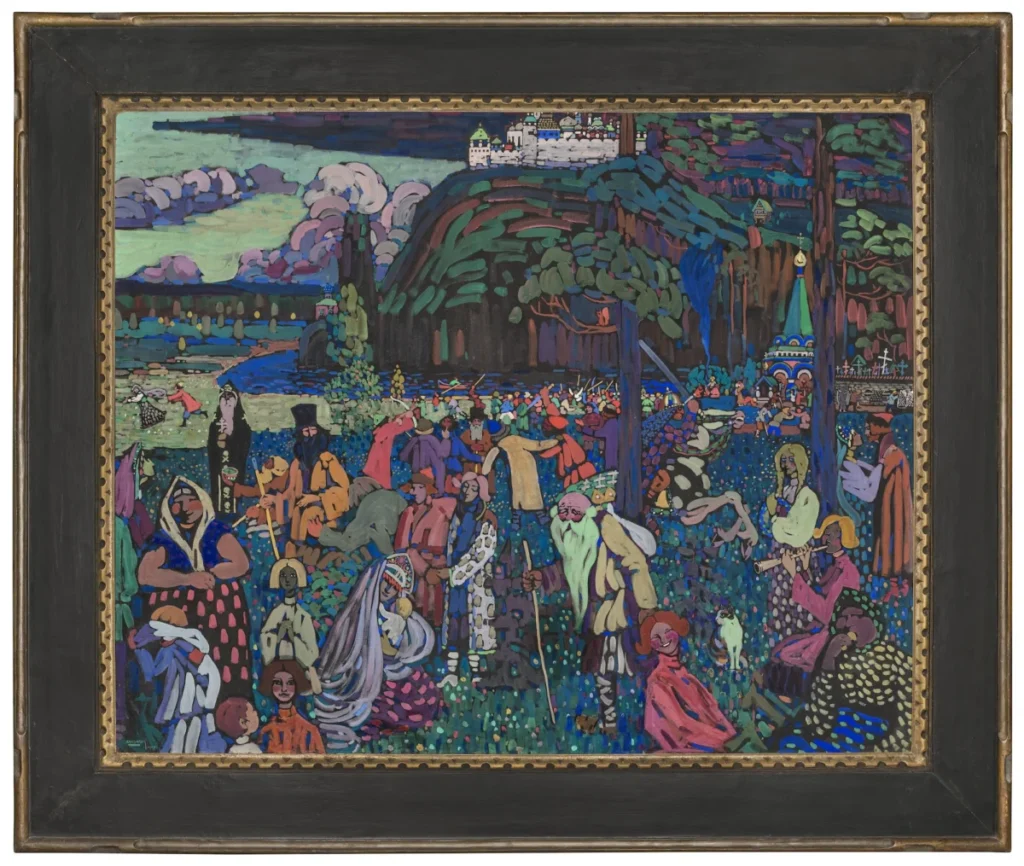
The international art world is bracing for a landmark event this autumn as one of the most significant works of early 20th-century modernism prepares to cross the auction block. Wassily Kandinsky’s Das bunte Leben (The Colorful Life, 1907), a painting that serves as both a vibrant tapestry of Russian folklore and a somber relic of the Nazi era’s cultural pillaging, will be the centerpiece of Christie’s London sale on October 14. Scheduled to coincide with the prestigious Frieze Week, the painting is expected to fetch in excess of $30 million.
The sale marks the final chapter in a decades-long saga of displacement, legal friction, and ultimate justice. Restituted to the heirs of a Jewish family in 2023 after a grueling six-year legal battle against a German state-backed institution, the work’s appearance at auction highlights the ongoing reckoning with Nazi-looted art and the soaring market value of masterpieces with restored provenance.
The Masterpiece: A Bridge to Abstraction
Measuring approximately four feet high by five feet wide, Das bunte Leben was, at the time of its creation, Kandinsky’s largest and most ambitious canvas. Painted in 1907, it represents a pivotal moment in the artist’s evolution, capturing him at the threshold of the radical abstraction that would later define his legacy.
The painting is a dense, kaleidoscopic vision of a pastoral landscape teeming with life. It features a diverse cast of characters—pilgrims, peasants, saints, nobles, and mothers with children—all rendered in a style that blends the decorative qualities of Art Nouveau with the spiritual depth of Russian religious traditions. Many of the figures are drawn from Russian legend and folklore, reflecting Kandinsky’s deep connection to his heritage during his years in Munich and Murnau.
Art historians often compare Das bunte Leben to other monumental "summa" paintings of the era, such as Henri Matisse’s Bonheur de vivre (1905–06) and André Derain’s La Danse (1906). Like his contemporaries, Kandinsky sought to encapsulate the "richness of life" in a single, overwhelming composition. However, Kandinsky’s approach was uniquely metaphysical.
"Kandinsky is no longer simply depicting the world around him, but beginning to imagine how painting might communicate something beyond the visible," noted Keith Gill, Vice Chairman of the 20th and 21st Century Art Department at Christie’s. "Color assumes an unprecedented expressive intensity, while the figures and landscape become part of a larger vision of human experience."
Chronology: From Amsterdam to Munich and Back
The history of Das bunte Leben is a mirror of the 20th century’s greatest tragedies. Its journey from a private collection in Amsterdam to a German museum, and finally back to the descendants of its rightful owners, spans nearly 120 years.
1907–1927: Early Years and Acquisition
After its completion, the painting was exhibited at the Salon d’Automne in Paris in 1907, where it stood as a testament to the burgeoning avant-garde. In 1927, it was purchased by Emanuel Albert Lewenstein, a wealthy Amsterdam sewing machine magnate, and his wife, Hedwig Lewenstein-Weyermann. The couple were prominent collectors who appreciated the innovative spirit of the Munich-based Blue Rider movement.
1940: The Nazi Occupation
The Lewenstein family’s peaceful existence was shattered in May 1940 when Nazi Germany invaded the Netherlands. Before fleeing the country to escape persecution, the family’s children, Robert and Wilhelmine, deposited the painting at the Stedelijk Museum in Amsterdam for safekeeping. However, the Nazi administration began a systematic confiscation of Jewish property. In October 1940, under circumstances of extreme duress, the family’s collection was dispersed. Das bunte Leben was sold at auction at the Frederik Muller & Co. house, where it was acquired by the collector Salomon B. Slijper.
1972–2023: The Munich Tenure
After Slijper’s death, the painting was acquired by the Bavarian State Bank (Bayerische Landesbank) in 1972. A year later, it was placed on long-term loan to the Städtische Galerie im Lenbachhaus in Munich. For over 50 years, the painting remained a crown jewel of the Lenbachhaus collection, seen by millions of visitors who were largely unaware of its contested history.
2017–2023: The Legal Battle
The heirs of the Lewenstein family, represented by the Mondex Corporation—a firm specializing in the recovery of looted assets—launched a formal claim for the painting in 2016. The initial reception was hostile. James Palmer, founder of Mondex, recalled that when they first approached the Bavarian State Bank, the response was dismissive and uncooperative.
The heirs filed a lawsuit in a Manhattan court in 2017, but the path to restitution ultimately led through the German Advisory Commission (the Limbach Commission). In early 2023, the commission issued a landmark recommendation, concluding that the 1940 sale was a direct result of Nazi persecution and that the painting should be returned to the Lewenstein-Weyermann heirs. The bank and the city of Munich subsequently agreed to honor the recommendation.
Supporting Data: The Value of Restituted Provenance
The $30 million-plus estimate for Das bunte Leben is not merely a reflection of its artistic merit, but also of a specific market trend where restituted works command a "moral premium."
In recent years, the highest prices for Kandinsky’s work have been achieved by paintings with similar histories. The current auction record for the artist was set in March 2023 at Sotheby’s London, when Murnau mit Kirche II (1910) sold for £37.2 million ($44.9 million). Like Das bunte Leben, Murnau mit Kirche II had been looted by the Nazis, spent decades in a museum (the Eindhoven Van Abbemuseum), and was only returned to the heirs of its original owners (Johanna Margarethe Stern and Siegbert Stern) shortly before the sale.
The market views these works as "fresh to the market" because they have been locked in institutional collections for decades. Furthermore, the clarity provided by a formal restitution process removes any "title risk" for the buyer, making the painting a safer and more prestigious investment for high-net-worth individuals and major museums.
Official Responses: A Moment of Cultural Transition
The announcement of the auction has drawn statements from key figures in the art world, emphasizing the painting’s role in the narrative of modern art.
Marc Porter, Chairman of Christie’s Americas, highlighted the transitional nature of the work. "Kandinsky’s Das bunte Leben is much more than an early masterpiece: it captures a moment when different influences were coming together in the artist’s practice, and points towards the radical move into abstraction that would follow," Porter stated.
For the heirs, the sale represents the conclusion of a quest that spanned generations. While the painting will leave the public view of the Lenbachhaus, the restitution serves as a formal acknowledgment of the Lewenstein family’s history and the injustices they suffered during the Holocaust.
Implications: The Future of Museum Collections
The restitution and subsequent sale of Das bunte Leben have profound implications for the global art community, particularly regarding the ethics of museum loans and the transparency of institutional provenance.
- Pressure on State Institutions: The fact that a state-owned bank held a contested work for five decades before being compelled to return it by an advisory commission puts other European institutions on notice. It reinforces the "Washington Principles on Nazi-Confiscated Art," which mandate that "just and fair solutions" be found for art lost during the Nazi era.
- The Role of Recovery Firms: The success of firms like Mondex Corporation demonstrates the increasing professionalization of art recovery. These organizations combine genealogical research, historical archives, and international legal expertise to challenge powerful institutions that were previously seen as untouchable.
- Market Dynamics: The sale confirms that the demand for "trophy" modernism remains resilient. As works of this caliber become increasingly rare in private hands, the emergence of a restituted masterpiece creates a high-stakes environment that can redefine artist records.
- Cultural Loss vs. Legal Justice: The departure of the painting from the Lenbachhaus is a loss for the Munich public, but art law experts argue it is a necessary cost for rectifying historical wrongs. The case highlights the tension between the desire for public access to art and the fundamental right of private ownership and historical justice.
As Das bunte Leben prepares to take the stage in London this October, it stands as a vibrant symbol of resilience. From the folklore of old Russia to the dark days of 1940s Amsterdam, and finally to the bright lights of a 21st-century auction room, the painting’s journey is as colorful and complex as the canvas itself. For the art world, it is a rare opportunity to acquire a piece of history; for the Lewenstein heirs, it is the long-awaited closing of a circle.