This November, the arid, sun-drenched horizon of Doha’s MIA Park will be redefined by a singular architectural event. The Doha Pavilion, a permanent structure envisioned by the legendary German artist Gerhard Richter, is set to open its doors, marking a profound intersection between Western contemporary abstraction and the deep-seated geometric traditions of Islamic art. Developed in collaboration with the renowned Selldorf Architects, the project is not merely an exhibition space; it is a conceptual sculpture—a "work of art" that serves as a permanent home for a specific, dialogue-driven body of Richter’s output.
The unveiling, scheduled for November 20, coincides with the launch of Rubaiya Qatar, a new quadrennial exhibition of contemporary art. As Qatar continues to cement its status as a global epicenter for high-level cultural curation, the Doha Pavilion stands as perhaps the most ambitious architectural intervention by an artist in the region to date.
The Vision: Architecture as a Manifestation of Process
At 92 years old, Gerhard Richter remains one of the most intellectually rigorous figures in the art world. His decision to create a bespoke, free-standing structure in Doha is the culmination of a decade-long internal evolution that began during a formative trip to the Qatari capital in 2013.
The Genesis of the Strip Paintings
To understand the Doha Pavilion, one must understand the Strip paintings. During the early 2010s, Richter began a process of digital division, taking photographs of his earlier abstract works, slicing them into vertical segments, and mirroring them until the original image dissolved into vibrant, linear energy. This process—the "Strip" series—represented a departure from the painterly gesture toward a mathematical, almost meditative repetition.
Richter has explicitly linked the pavilion’s inception to this period of his career. "My trip to Doha in 2013 came two years into developing my Strip paintings, and the city’s architecture and history sparked an idea for a pavilion that could unite the thematic threads of that body of work," the artist stated in a press release. The pavilion is, in effect, the physical realization of a digital inquiry into infinity.
Collaboration and Construction: The Selldorf Partnership
Bringing a vision of this technical complexity to life required an architect with a deep understanding of gallery space and a reverence for the artist’s intent. Annabelle Selldorf, principal of New York-based Selldorf Architects, was the natural choice. Selldorf, whose portfolio includes the masterful redesign of the Frick Collection and the expansion of the Art Gallery of Ontario, is celebrated for her "invisible" touch—her ability to create spaces that serve the art rather than compete with it.
Engineering the Geometry
The pavilion’s exterior is perhaps its most striking feature. Adorned with decorative tiles based on the Patterns that Richter developed as the precursor to his Strips, the building functions as a bridge between the artist’s digital logic and the historical aesthetic of the Middle East.
"The patterns on the outside walls, created by way of mathematically inclined digital processes, recall the carefully constructed geometries of Islamic art," notes Qatar Museums. The connection is intentional: where Islamic artists have used interlaced arabesques and tessellations for centuries to suggest the infinite nature of the divine, Richter uses the algorithm to explore the infinite nature of the image. The pavilion’s exterior is not merely a facade; it is an optical device designed to dazzle the eye and invite the viewer into a space of contemplation.
Chronology: A Decade in the Making
The journey toward the Doha Pavilion reflects the patient, long-term planning characteristic of the Qatari cultural sector.
- 2013: Gerhard Richter visits Doha. The encounter with the city’s synthesis of modern architecture and ancient patterns ignites the initial concept for a site-specific pavilion.
- 2014–2020: Richter continues to refine the Strip and Mirror series, with the vision for the pavilion becoming more concrete as his interest in the relationship between image, viewer, and space deepens.
- 2021–2023: Engagement with Selldorf Architects begins in earnest. The collaborative process focuses on material selection, lighting, and the integration of the building into the existing landscape of MIA Park.
- 2024 (November 20): Official opening of the Doha Pavilion as a cornerstone of the inaugural Rubaiya Qatar quadrennial.
- 2024–2027 (and beyond): The pavilion enters its permanent phase, serving as a landmark site for both local residents and international visitors to Rubaiya Qatar.
The Interior: Reflections on Painting and Image-Making
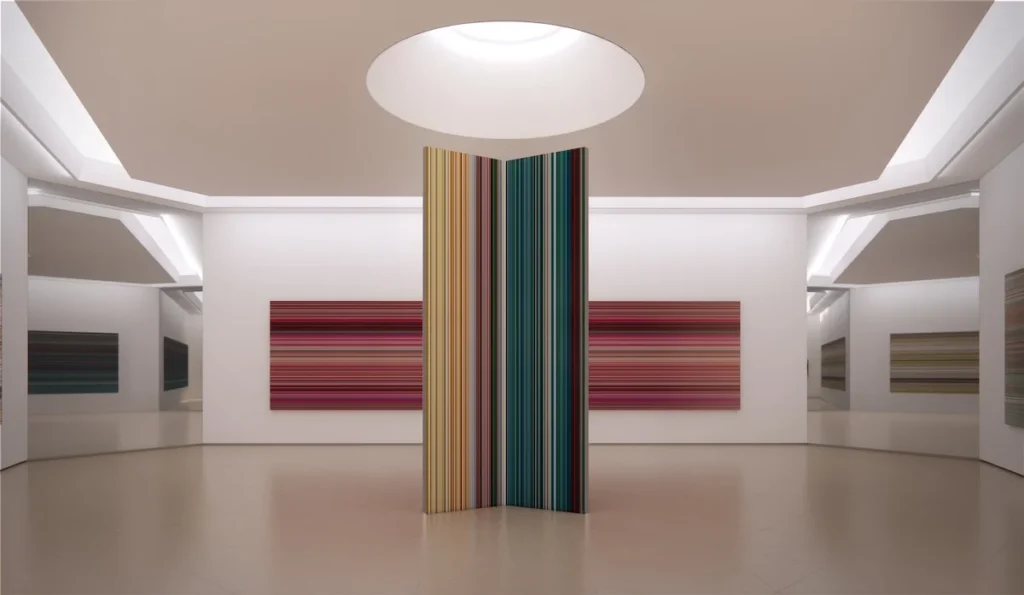
If the exterior of the pavilion is about the public encounter with pattern, the interior is about the private encounter with the self. Upon entering, visitors will find a curated selection of Richter’s Strip paintings, which serve as the primary focus. However, these are not placed in isolation.
Richter has installed two large Mirror works between the Strip paintings. These mirrors serve a dual purpose: they reflect the paintings themselves, creating an endless cycle of image production, and they reflect the viewers, forcing them into the frame of the art.
"The Mirrors offer a literal reflection, or meditation, on painting and image-making," according to project documentation. The addition of the Strip Tower—a vertical sculptural manifestation of the linear paintings—rounds out the experience, suggesting that in Richter’s world, the image is never static. It is always in a state of flux, shifting between the paint, the digital print, the reflection, and the physical architecture.
Supporting Data: Contextualizing Rubaiya Qatar
The opening of the Doha Pavilion is a significant highlight within the broader context of Rubaiya Qatar. This new quadrennial event is designed to shift the discourse of contemporary art away from Western-centric narratives.
- Scope: The inaugural edition features 25 new commissions and six public art installations.
- Duration: The event runs from November 21, 2024, through April 2027, signaling a multi-year commitment to cultural programming.
- Focus: With a specific mandate to highlight artists from outside the Western Hemisphere, the inclusion of a German master like Richter might seem contradictory at first glance. However, by positioning his work in dialogue with the history of the region—as the Doha Pavilion does—the quadrennial successfully avoids a simplistic "East vs. West" binary, instead favoring a synthesis of global perspectives.
Official Responses and Professional Perspectives
The project has been received with high praise from both the artistic and architectural communities.
Annabelle Selldorf’s Perspective:
Reflecting on the partnership, Selldorf remarked: "It is an uncommon honor to assist Gerhard Richter in realizing his vision for this project—a major addition to his endlessly probing and fascinating body of work—as well as a privilege to contribute to Doha’s extraordinary ensemble of contemporary architecture."
The Institutional View:
Qatar Museums, the driving force behind the development, views the pavilion as an essential evolution of its public art strategy. By inviting an artist to design their own space, the organization is pushing the boundaries of what a museum can be. It is no longer just a repository for history; it is a laboratory for future aesthetic encounters.
Implications: The Future of Artist-Led Architecture
The Doha Pavilion sets a new precedent for how major international artists can engage with host cities. Rather than providing a collection of works for a gallery to hang, Richter has created a permanent, self-contained universe.
A New Standard for Cultural Diplomacy
The choice of Doha as the site for this pavilion is a strategic win for the city. Richter’s declaration that "Doha is the right place and the only place for my Pavilion" serves as a powerful endorsement of Qatar’s cultural infrastructure. It suggests that the city has moved beyond the "collector" phase of development—where institutions simply buy existing work—into a "commissioner" phase, where they actively shape the creative output of the world’s most significant artists.
The Legacy of the Pavilion
As the Rubaiya Qatar quadrennial draws visitors from around the globe, the Doha Pavilion will likely become a pilgrimage site. It represents a rare moment where an artist’s late-career obsession with digital geometry finds a physical home that is historically and culturally resonant. For the visitor, the experience is designed to be transformative: walking from the bright, patterned exterior into the quiet, reflective, mirrored interior, one is forced to reconsider the very nature of what it means to look at a painting.
In the end, the pavilion is a testament to the idea that architecture and art are not distinct disciplines, but rather two sides of the same geometric coin. By collapsing the distance between the pattern on the wall and the reflection in the mirror, Gerhard Richter has ensured that his legacy in Doha will be as enduring as the desert sands that surround it.