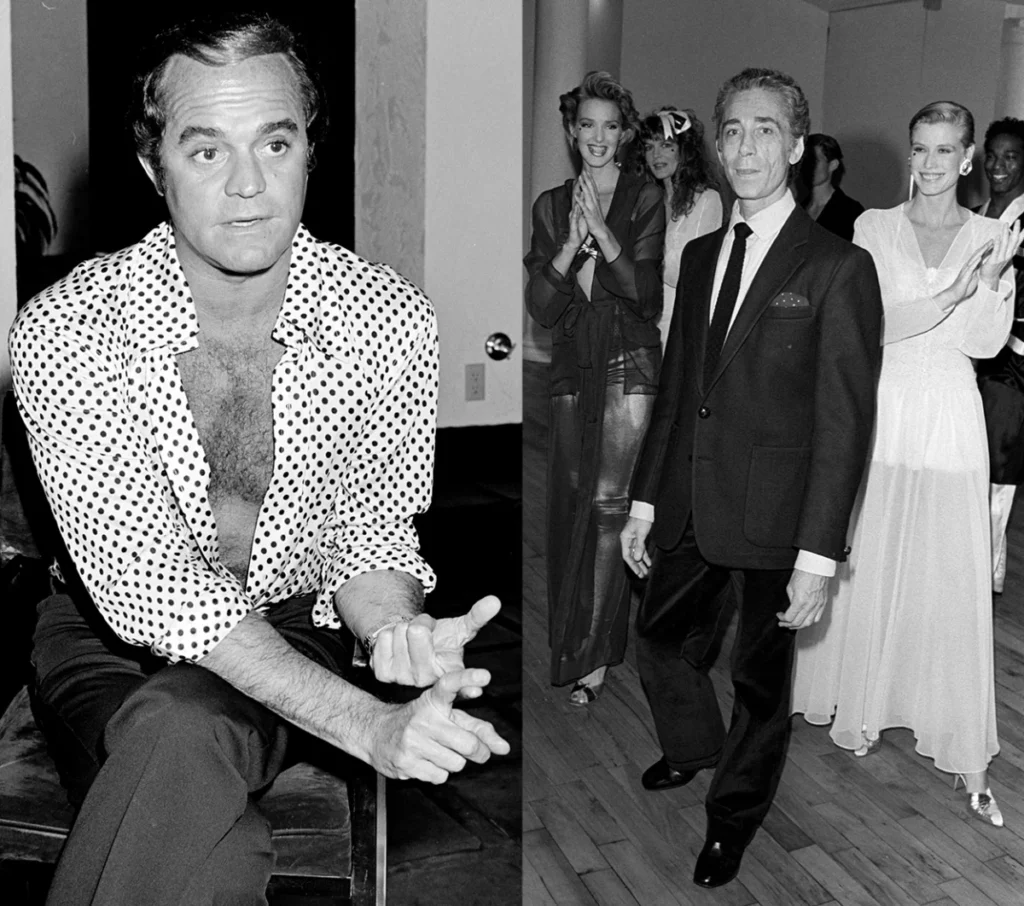
In the pantheon of American fashion, the contributions of Hispanic designers are often woven into the very fabric of the industry’s mid-century evolution. Among the most distinguished figures to shape this narrative were Luis Estévez and Fernando Sánchez. In 1990, the Hispanic Designers Inc. organization took a definitive step in cementing their historical standing, hosting its sixth annual gala and fashion show to bestow its highest honors upon the pair: the Lifetime Achievement Award for Estévez and the prestigious MODA award for Sánchez.
By the time they stood on that stage in Washington, D.C., both men had long since transcended their initial roles as designers, becoming cultural touchstones whose work defined the aesthetic sensibilities of New York and Los Angeles. Their journeys—marked by architectural precision, international training, and a profound understanding of the female silhouette—remain essential case studies in the development of American ready-to-wear and couture.
Luis Estévez: From Havana to the Hollywood Hills
The trajectory of Luis Estévez (1930–2014) was one of cosmopolitan reinvention. Born in Havana, Cuba, as the grandson of the formidable sugar tycoon Santiago Estévez, he was raised in an environment of privilege and structural discipline. His early interest in architecture proved to be the bedrock of his design philosophy; he viewed garments not merely as fabric, but as constructions that must inhabit space and respect the human form.

The Path to Seventh Avenue
Estévez’s arrival in New York in the late 1950s coincided with a golden age of retail. His transition into fashion was serendipitous—a summer position in the display department at Lord & Taylor, a store then synonymous with avant-garde retail practices. This exposure to the mechanics of luxury merchandising sparked a creative fire.
Driven by an ambition to master the craft, he ventured to Paris to train under the legendary Jean Patou. Patou, a titan of luxury ready-to-wear and the architect of the "sportswear" aesthetic, provided the rigorous foundation Estévez required. Upon his return to New York in the mid-1960s, he co-founded the label Grenelle-Estévez alongside Fred and Robert Greenberg and Ben Papell. By securing a showroom at 550 Seventh Avenue—the epicenter of the Garment Center and a crucible for legendary designers like Oscar de la Renta—Estévez positioned himself at the heart of the American fashion machine.
The L.A. Pivot: Chasing the Havana Light
In 1967, at the peak of his New York success, Estévez made the bold decision to migrate to Los Angeles. "I wanted the Havana of my youth," he famously noted to WWD. In California, his designs took on a sun-drenched, fluid quality that captivated the Hollywood elite. His roster of clients reads like a chronicle of mid-century glamour: Lana Turner, Zsa Zsa and Eva Gabor, Merle Oberon, and Princess Grace of Monaco.

Perhaps most notably, First Lady Betty Ford became a primary champion of his work. Estévez credited Ford’s public loyalty—she frequently wore his designs for official state functions—with providing the necessary visibility to scale his brand globally. His life in California was a total design project; he personally drafted the plans for his hilltop estate, La Vista, and curated a bespoke design studio in the picturesque enclave of Montecito.
Fernando Sánchez: The Alchemist of the Boudoir
If Estévez was the architect of structure, Fernando Sánchez (1935–2006) was the master of atmosphere. Born in Spain, Sánchez brought a European sensibility to New York that prioritized the sensory experience of clothing. His career began in the hallowed halls of Parisian couture, including stints at Maggy Rouff, Nina Ricci, and a formative period at Dior, encouraged by his close friend and mentor, Yves Saint Laurent.
Redefining Lingerie as High Fashion
Upon arriving in New York in the late 1960s, Sánchez found a market ripe for disruption. While he had "dabbled" in lingerie, he quickly realized that the category was being underserved by a lack of design ambition. He took the helm at Warners, where he did something unheard of at the time: he applied the standards of high-end couture to intimate apparel.

"I really am a dress designer—unconsciously, I make dresses," Sánchez once admitted. This distinction was his superpower. He treated lingerie as a legitimate component of a woman’s wardrobe, not merely as an undergarment. In 1973, he launched his eponymous label, eventually securing licensing deals with giants like Lily of France and Vanity Fair.
The Synthesis of Culture and Craft
Sánchez’s design language was a complex tapestry of his life experiences. As his former assistant, Tanya Wetenhall, recalled, his work was an amalgamation of "his mother’s style, his love of Morocco, iconic films like West Side Story, and the music of The Last Emperor."
He introduced a "razzmatazz" factor to the industry—incorporating leopard prints, metallic accents, and vibrant color palettes that challenged the muted, utilitarian aesthetic of the era. His signature "stay-at-home" puff coats and lacy slipdresses were designed with a dual-purpose philosophy, intended to be as comfortable in the bedroom as they were elegant at a dinner party. He emboldened women to reclaim the boudoir, essentially creating the "loungewear-as-eveningwear" trend that remains a staple of modern fashion cycles.

Chronology of Recognition
The careers of Estévez and Sánchez were marked by sustained professional validation, culminating in their 1990 Hispanic Designers Inc. recognition.
- 1950s: Luis Estévez arrives in New York; begins training under Jean Patou in Paris.
- 1960s: Estévez launches Grenelle-Estévez in the New York Garment District; Fernando Sánchez begins his tenure at Dior and later relocates to New York.
- 1967: Estévez moves to Los Angeles to establish his West Coast design presence.
- 1973: Sánchez launches his eponymous label, revolutionizing the lingerie and loungewear categories.
- 1976: Estévez defines his brand philosophy: "I associate fashion with the reality of the people I know… I don’t give a damn" about the whims of the "hip crowd."
- 1990: Hispanic Designers Inc. honors Estévez with a Lifetime Achievement Award and Sánchez with the MODA award.
- 1990s: Estévez retires from active design; Sánchez continues to influence the loungewear sector until his passing in 2006.
Implications for Modern Design
The significance of these two men extends beyond their individual collections. They were pioneers in proving that the American fashion industry was not a monolith, but a mosaic of international influences.
Estévez’s insistence on "the reality of the people" who wear his clothes foreshadowed the current industry focus on inclusivity and lifestyle-driven design. His transition from high-fashion couture to a broader, celebrity-focused lifestyle brand in Los Angeles paved the way for the modern "celebrity designer" model.

Similarly, Sánchez’s work anticipated the "athleisure" and "day-to-night" trends by decades. By treating lingerie with the same intellectual and technical rigor as evening gowns, he broke down the silos that had traditionally limited the scope of intimate apparel. His legacy lives on in every designer who treats loungewear as a form of self-expression rather than a mere utility.
Conclusion
Though the labels Grenelle-Estévez and Fernando Sánchez no longer grace the racks of major department stores, the ripples of their work are felt everywhere. They were men who understood that fashion is a language of identity. Whether through the structural integrity of a custom-fit gown or the sensual freedom of a lace slipdress, they helped define what it meant to be stylish, confident, and unapologetically oneself in the late 20th century. Their recognition at the 1990 gala was not just a celebration of past achievements; it was an acknowledgment of two careers that provided the blueprint for the modern, multi-faceted designer.