In the realm of high-end horology, complexity is often treated as a badge of honor, worn loudly on the dial. A typical multi-complication timepiece—featuring a chronograph, a second time zone, and a calendar—is usually a cluttered landscape of subdials, apertures, and overlapping hands. It is a design philosophy that prioritizes the display of data above the aesthetic harmony of the watch face.
H. Moser & Cie. has consistently rejected this convention, favoring a minimalist, almost ethereal approach to watchmaking. With the launch of the new Endeavour Flyback Chronograph Dual Time Date (Ref. 1730-1200), the independent Swiss manufacture has once again defied the industry’s status quo. By condensing three significant complications into a clean, sunburst dial, Moser has created a masterclass in functional elegance, proving that true mechanical sophistication need not come at the expense of visual serenity.
Main Facts: A Symphony of Functionality
The Endeavour Flyback Chronograph Dual Time Date is not merely a watch; it is a mechanical paradox. Encased in a 42mm stainless steel chassis that measures 13.2mm in height, the timepiece manages to house a flyback chronograph, a dual-time GMT function, and a date complication without overwhelming the wearer with information.
The visual centerpiece is the stunning turquoise fumé dial, which transitions from a vivid outer edge to a darker, sophisticated Blackor fumé central disc. Rather than crowding the dial with traditional chronograph registers, Moser has opted for a central display. A striking red hand tracks elapsed seconds, while a rhodium-plated hand manages elapsed minutes. The second time zone is integrated with similar discretion: a small white arrow with a Super-LumiNova tip emerges from the central disc, providing GMT functionality that effectively “hides in plain sight.”

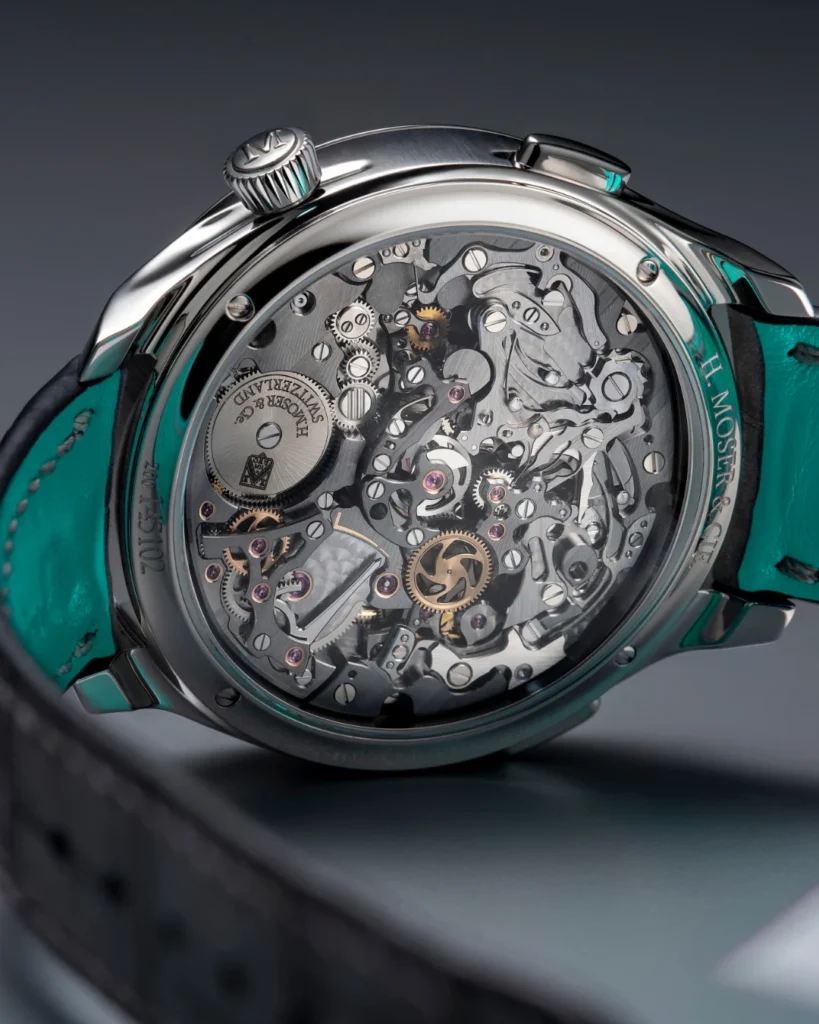
This watch is powered by the new HMC 730, a hand-wound caliber developed in collaboration with movement specialist Agenhor. By choosing a manual-wind architecture over an automatic one, the designers have stripped away the oscillating weight, allowing for a more intimate mechanical connection and providing the necessary real estate to house the complex gear trains required for the flyback and GMT functions.
Chronology of Development: The Evolution of the HMC 730
The journey of the HMC 730 began with the existing architecture of the HMC 902, a highly regarded automatic movement. However, for the Endeavour project, the mandate was to return to the tactile pleasure of manual winding while increasing the density of complications.
The Agenhor Collaboration
H. Moser & Cie. turned to Agenhor—a firm synonymous with avant-garde movement design—to reimagine the chronograph’s engagement. The resulting HMC 730 is a feat of engineering that utilizes a column-wheel chronograph system paired with Agenhor’s signature micro-tooth technology.
In traditional chronographs, the engagement of the gears can lead to a slight “jump” or stutter in the hands. The HMC 730’s horizontal clutch features a friction wheel with micro-teeth, which ensures a smooth, instantaneous engagement. This was a critical developmental hurdle, as the central display of both elapsed seconds and minutes requires a high degree of precision to ensure that the retrograde minute hand, driven by a snail cam, snaps to its new position with absolute accuracy.

Refinement and Testing
The transition from the automatic HMC 902 to the manual HMC 730 involved a year-long process of testing the gear train for energy efficiency. Because the watch features both a date and a dual-time function, the torque management of the mainspring was a significant concern. The team successfully integrated twin barrels, which provide a robust 72-hour power reserve, ensuring that the watch remains accurate even after three days of inactivity.
Supporting Data: Technical Specifications
To appreciate the Endeavour Flyback Chronograph Dual Time Date, one must look beyond the dial to the technical specifications that govern its operation:
- Caliber: HMC 730, manual-winding, developed with Agenhor.
- Frequency: 21,600 vibrations per hour (3Hz).
- Component Count: 383 individual components.
- Jewels: 49.
- Power Reserve: 72 hours (minimum) provided by dual barrels.
- Case Dimensions: 42mm diameter; 13.2mm thickness.
- Functions: Central flyback chronograph (seconds and minutes), dual time with hidden GMT hand, date (bidirectional adjustment), power reserve indicator (on the caseback side).
- Water Resistance: 3 ATM (30 meters).
- Strap: Hand-stitched grey alligator leather with a nubuck finish and engraved stainless steel pin buckle.
The bidirectional date adjustment is a particularly noteworthy inclusion for the modern traveler. Most mechanical watches risk damage if the date is adjusted while the movement is in its “changeover” period. The HMC 730, however, allows for both forward and backward adjustment, a practical feature that eliminates the stress of managing the calendar when crossing multiple time zones.
Official Responses and Philosophy
In a statement accompanying the launch, the leadership at H. Moser & Cie. emphasized that this watch was designed for the "conscious collector."

"We believe that a watch should serve its owner, not distract them," a brand spokesperson noted. "By moving the power reserve indicator to the caseback and opting for a central chronograph display, we have achieved a form of ‘silent complexity.’ The watch performs all the tasks of a high-complication tool, but it retains the refined, minimalist aesthetic that defines the Endeavour collection."
The decision to place the chronograph pushers at 10 and 2 o’clock, rather than the traditional 2 and 4, serves both an ergonomic and an aesthetic purpose. It keeps the profile of the case clean and suggests a historical nod to stopwatches, while simultaneously creating a distinct visual silhouette that separates the piece from mass-market chronographs.
Implications: The Future of the "Travel Watch"
The H. Moser & Cie. Endeavour Flyback Chronograph Dual Time Date signifies a shift in the high-end market. For years, the “travel watch” category has been dominated by bulky, aggressive designs characterized by heavy bezels and excessive dial text.
By introducing this model, Moser is effectively challenging the notion that a tool watch must look like a piece of industrial equipment. This timepiece is equally at home under a dress shirt cuff as it is in a cockpit or an airport lounge. It raises the bar for what collectors should expect from independent watchmaking: a marriage of extreme technical difficulty with an uncompromising commitment to design purity.

The Market Context
With a price point of CHF 59,000 (approximately $72,800 USD), the Endeavour is positioned firmly in the upper echelon of horology. It is not intended for the casual buyer; it is designed for the connoisseur who values the mechanical “secret” that the watch is a complex chronograph, despite its unassuming appearance.
This watch also highlights the growing influence of collaborative engineering. The partnership between H. Moser & Cie. and Agenhor is emblematic of a trend where smaller houses leverage the specialized expertise of independent developers to create movements that the larger conglomerates cannot—or will not—replicate.
Final Thoughts
The H. Moser & Cie. Endeavour Flyback Chronograph Dual Time Date is a profound statement on the nature of luxury. In a world that often demands we be constantly connected and constantly monitored, this watch offers a quiet sanctuary. It is a vessel of remarkable mechanical energy, yet it remains calm, composed, and undeniably beautiful.
For the traveler who appreciates the journey more than the destination, the Endeavour offers the perfect companion: a watch that does everything you need it to, without ever asking for more attention than it deserves. In the end, Moser has not just created a new watch; they have redefined the very language of complexity.