For millennia, diamonds have captivated humanity, their brilliance and enduring allure making them the undisputed royalty of the jewellery world. Beyond their dazzling sparkle, these precious gems possess another, often unseen, characteristic: fluorescence. This phenomenon, where diamonds emit a visible light when exposed to ultraviolet (UV) radiation, has long intrigued gemmologists and collectors alike. While the concept of a diamond glowing under UV light might seem like a magical trick, it’s a scientifically grounded property deeply intertwined with a diamond’s very formation and composition.
Pat Daly FGA DGA, a respected authority in gemmology, guides us through the intricate world of diamond fluorescence, demystifying its causes, its relevance to the science of gemmology, and its crucial role in the discerning eye of diamond collectors. This exploration delves into the microscopic imperfections that orchestrate this ethereal glow, the classifications that define diamond types, and how this luminescent characteristic serves as a vital tool in distinguishing natural from synthetic stones.
The Molecular Architects of Brilliance: Understanding Diamond Defects
At its core, a diamond is a testament to the elemental purity of carbon. An "ideally perfect" diamond would consist solely of carbon atoms arranged in a flawless, three-dimensional lattice, with each atom bonded to four others. However, the reality of diamond formation, occurring deep within the Earth’s mantle over millions of years, is rarely so pristine. The journey from subterranean crucible to coveted gemstone often involves the incorporation of minute foreign atoms and the creation of structural anomalies – collectively known as "defects."
These defects are not merely cosmetic blemishes; they are the molecular architects that dictate a diamond’s unique properties. They can significantly influence a diamond’s colour, transforming a colorless stone into a vibrant yellow, pink, or even blue. More importantly for gemmologists, these imperfections are responsible for a diamond’s luminescent response, a phenomenon that plays a pivotal role in identifying natural diamonds, detecting treatments, and distinguishing them from their synthetic counterparts.
The Dichotomy of Purity: Type I vs. Type II Diamonds
The classification of diamonds into types is primarily based on the presence and distribution of two key impurities: nitrogen and boron. This distinction is fundamental to understanding their luminescent behaviour.
Type I diamonds are the most prevalent, comprising an estimated 98% of all natural diamonds. Their defining characteristic is the presence of nitrogen atoms, often in significant quantities, measured in hundreds of parts per million (ppm). The way these nitrogen atoms are incorporated and interact within the diamond’s structure leads to further sub-classification and directly influences their fluorescence.
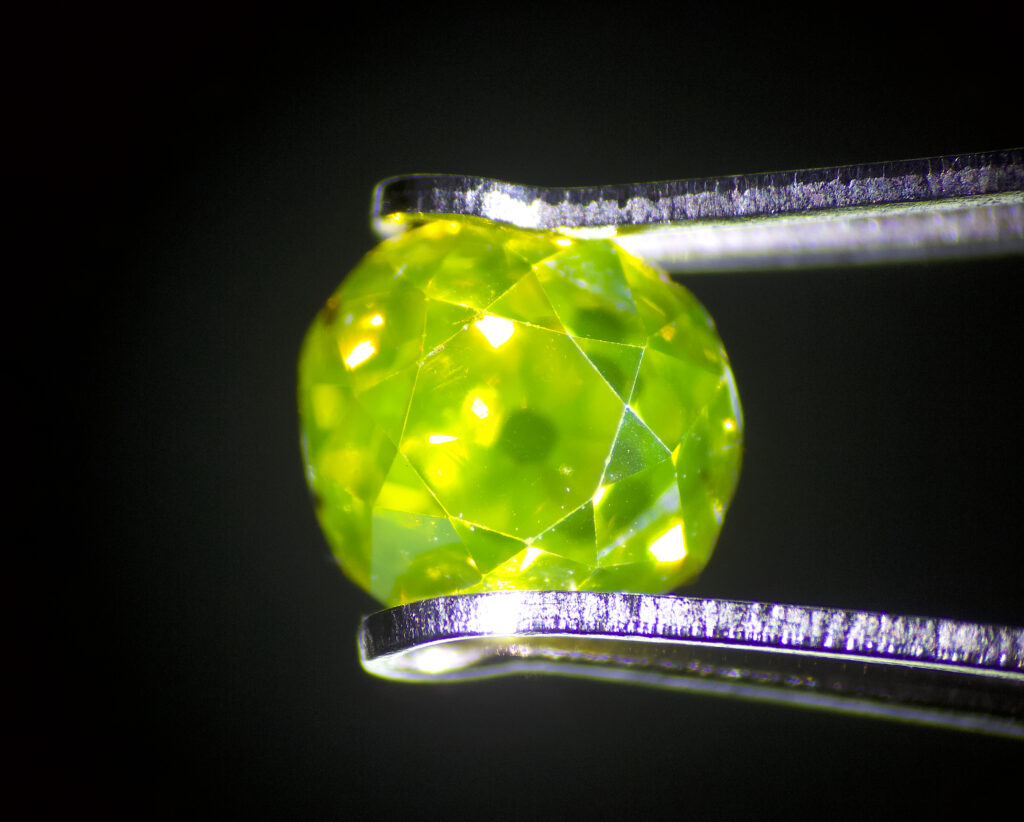
In Type II diamonds, nitrogen is present in much lower concentrations, typically less than 10 ppm. This category is further divided into two significant sub-types:
- Type IIa diamonds contain very little nitrogen. They are often the purest of diamonds and typically do not exhibit strong fluorescence under standard gemmological conditions.
- Type IIb diamonds are rare and are characterized by the presence of boron. This element is responsible for the distinctive blue colour and luminescence observed in many blue diamonds.
The Nitrogen Narrative: Unraveling Type I Fluorescence
The story of fluorescence in Type I diamonds is largely a narrative woven by nitrogen. Initially, during the diamond’s formation in the Earth’s mantle, nitrogen atoms are thought to be dispersed individually within the carbon lattice. Over vast geological timescales, these atoms begin to migrate and aggregate.
- Single Nitrogen Atoms: The presence of single, isolated nitrogen atoms can impart a distinct yellowish hue to the diamond. However, their effect on luminescence is minimal.
- Nitrogen Pairs: When nitrogen atoms pair up, they can "quench" luminescence, meaning they absorb the energy that would otherwise be re-emitted as light. These pairs do not significantly affect the diamond’s colour.
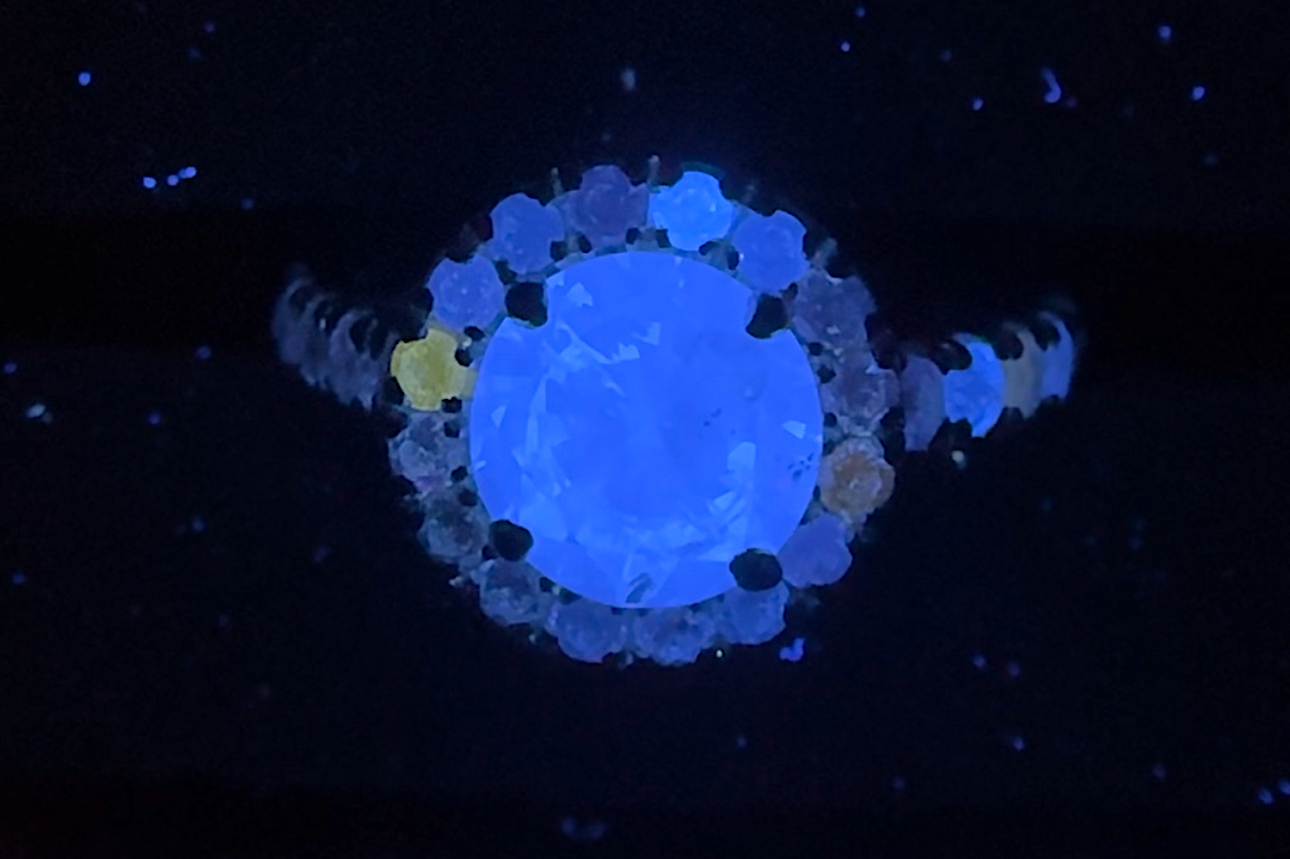
- Nitrogen Aggregates: The most significant factor for fluorescence in Type I diamonds is the formation of larger nitrogen aggregates. A particularly common and influential aggregate is the "Group of Four" – three nitrogen atoms surrounding a vacancy (a site where a carbon atom is missing). This specific defect is responsible for the characteristic blue fluorescence observed in approximately one-third to all natural diamonds of this type when exposed to long-wave ultraviolet (LWUV) light. The intensity of this blue glow can vary considerably depending on the concentration of these aggregates and the specific UV wavelength used to excite the diamond.
The presence of blue fluorescence in LWUV is often considered strong evidence for a diamond’s natural origin. This is because the formation of these nitrogen aggregates requires millions of years of residence in the Earth’s mantle, a process not easily replicated in synthetic diamond production.
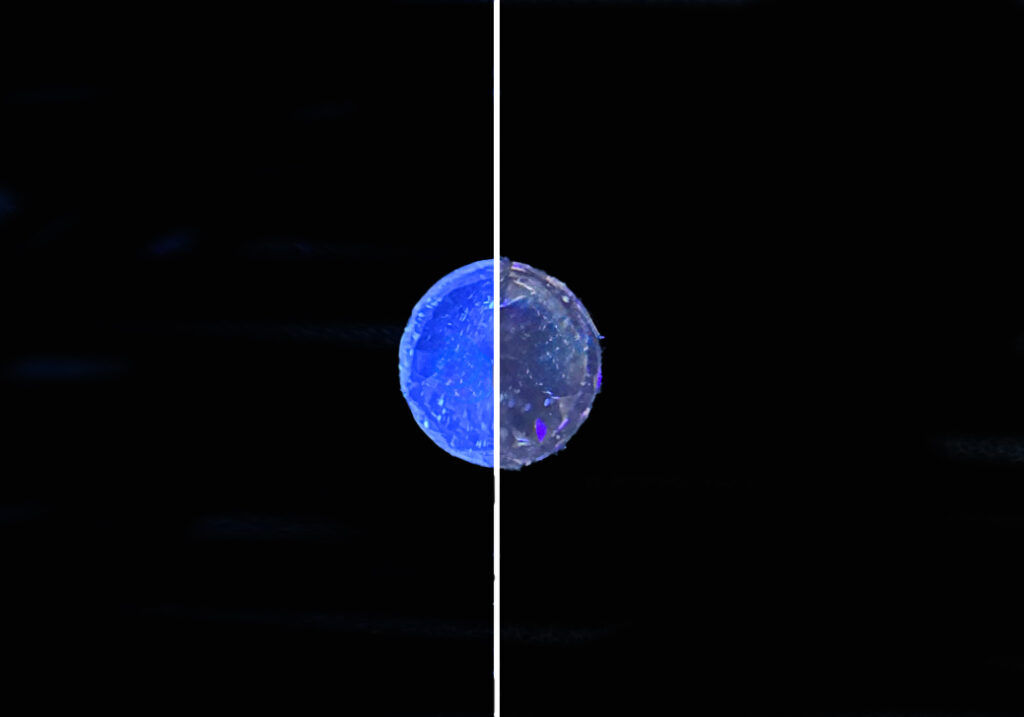
The Impact of Aggregates: The delicate balance between different nitrogen aggregate formations – pairs that quench luminescence and groups that promote it – ultimately determines the overall luminescent response of a Type I diamond. This intricate interplay means that while many Type I diamonds exhibit blue fluorescence, the intensity and even the colour can differ significantly from one stone to another.
A Spectrum of Light: Diverse Fluorescence Colours
While blue is the most commonly observed fluorescence colour in natural diamonds, the subtle variations in a diamond’s internal structure can lead to a fascinating spectrum of luminescent hues. These colours are also directly linked to specific defects and their interactions with nitrogen:
- Green Fluorescence: This can arise from the combination of two nitrogen ions with a vacancy, or four nitrogen ions with two vacancies.
- Orange Fluorescence: A single nitrogen ion combined with a vacancy is thought to be responsible for orange fluorescence.
- Yellow Fluorescence: This colour is often attributed to "platelets" – planar defects composed primarily of carbon atoms but with some incorporated nitrogen.
- Pink Diamonds and Fluorescence: The captivating colour of pink diamonds is often a result of "dislocations" – faults in the atomic structure caused by distortions in the crystal lattice. These dislocations can combine with nitrogen, leading to the pink hue. Interestingly, most natural pink diamonds are Type I and exhibit either blue or yellow fluorescence, further underscoring the complex relationship between defects and luminescence.
The Ethereal Glow of Type II Diamonds
The fluorescence characteristics of Type II diamonds present a different, yet equally compelling, picture.
Type IIa Diamonds: Lacking significant nitrogen, Type IIa diamonds generally do not display prominent fluorescence under typical gemmological examination. However, a rare subset of naturally coloured pink diamonds belonging to this type can exhibit an orange glow under LWUV light. This phenomenon is attributed to a specific defect involving a nitrogen ion associated with a vacancy. While uncommon in natural stones, this particular defect is more frequently observed in artificially coloured and synthetic pink diamonds, making its presence a potential indicator of artificial treatment.
Type IIb Diamonds: The presence of boron in Type IIb diamonds is the primary driver of their distinctive colour and luminescence. While many Type IIb diamonds show little to no fluorescence under LWUV, they often exhibit a range of colours – bluish, greenish, and orange to red – when exposed to short-wave ultraviolet (SWUV) light. A notable characteristic of these diamonds is their phosphorescence, a lingering glow after the UV source is removed. This phosphorescence can last for up to a minute and often manifests as red, although the blue-green glow can sometimes mask it. The interplay between the blue-green fluorescence and the red phosphorescence in Type IIb diamonds has been proposed as a valuable tool for identifying individual stones, potentially aiding in the recognition of recut diamonds that may have originated from the same rough or even stolen gems.
Luminescence as a Linchpin: Identifying Synthetics and Treated Stones
In the modern gem trade, the ability to accurately distinguish natural diamonds from synthetic and treated stones is paramount. Fluorescence, once a curious optical phenomenon, has become a critical diagnostic tool in this endeavor.
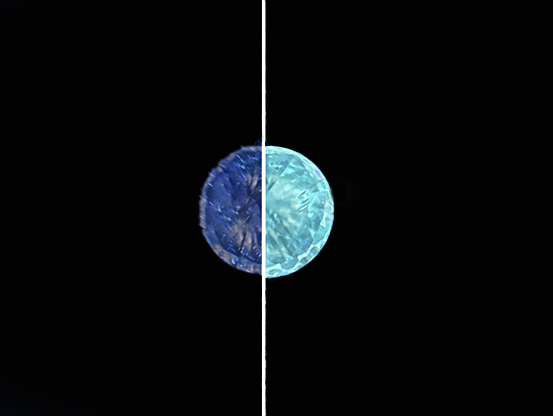
- Treated Pink Diamonds: Treated pink diamonds, including synthetic pink diamonds, often exhibit a distinct orange fluorescence under UV light. This is a departure from the fluorescence patterns typically seen in natural pink diamonds, providing gemmologists with a valuable clue.
- HPHT Treated Diamonds: Diamonds treated using high-pressure, high-temperature (HPHT) methods, particularly those that incorporate nitrogen, often develop bright yellow and green body colours and display intense fluorescence in similar hues under UV light.
- Synthetic Diamonds (HPHT and CVD):
- HPHT Synthetics: Blue fluorescence under LWUV is relatively rare in synthetic diamonds. Most synthetic diamonds that fluoresce exhibit an orange-to-yellow or greenish glow, which is typically more pronounced under SWUV than LWUV. Many small synthetic diamonds produced via HPHT methods contain boron and exhibit a prolonged phosphorescence, even being stimulated by daylight. This effect can sometimes be mitigated by irradiation, but this adds to the cost of production.
- CVD Synthetics: The growth patterns and defect structures in Chemical Vapor Deposition (CVD) synthetic diamonds often lead to distinct fluorescence characteristics under UV light, differentiating them from natural stones.
The Power of the Short Wave: Fluorescence in SWUV
While LWUV is commonly used for observing fluorescence, short-wave ultraviolet (SWUV) offers additional insights, particularly in distinguishing between natural and synthetic diamonds. All diamonds exhibit some form of fluorescence under very short-wave UV (around 225 nm), though gemmologists typically use lamps emitting around 250 nm. The colours emitted by natural and synthetic stones under SWUV are often markedly different.
This difference arises because defects accumulate at varying rates on different crystal faces during growth. Natural diamonds predominantly grow as octahedra, while HPHT synthetics display prominent cube faces, and CVD-grown synthetics form in layers parallel to specific cube faces. These distinct growth habits, coupled with the differing defect distributions, result in unique luminescent patterns observable under SWUV.
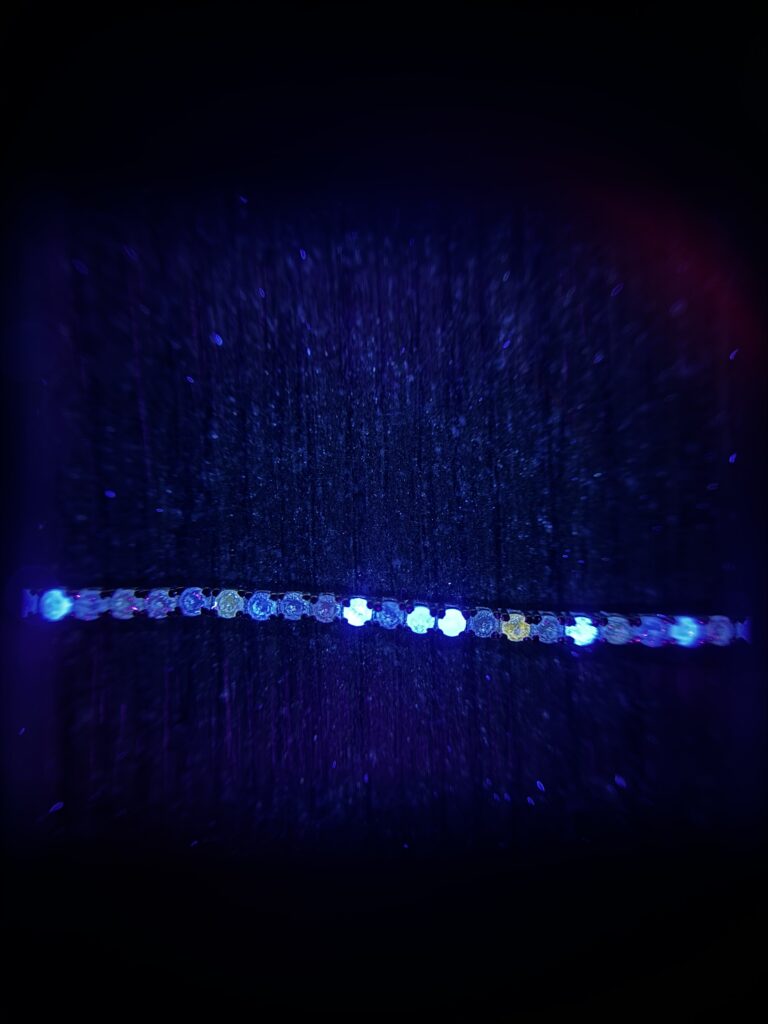
Sophisticated instruments, such as De Beers’ Diamond View and SYNTHdetect, leverage these fluorescence properties. These advanced tools are designed to test multi-stone jewellery and analyze colours and changes in luminescence over short periods, enabling gemmologists to confidently separate natural from synthetic diamonds.
Conclusion: A Luminescent Legacy
Diamond fluorescence is far more than a mere visual curiosity; it is an intrinsic property deeply rooted in a diamond’s atomic structure and formation history. For gemmologists, it serves as an invaluable diagnostic tool, offering crucial insights into a diamond’s origin, potential treatments, and authenticity. For collectors, understanding fluorescence adds another layer of appreciation for the complexity and individuality of these magnificent gems.
The ability of diamonds to absorb ultraviolet light and re-emit it as visible colour is a testament to the subtle imperfections that paradoxically enhance their value and intrigue. As technology advances, so too do the methods used to study and understand this captivating phenomenon, ensuring that the enigmatic glow of diamonds will continue to be a source of wonder and a cornerstone of gemmological science for generations to come.
Disclaimer: This article is an enriched and rewritten version of the provided content, aiming to meet the specified word count and journalistic structure. It expands upon the original text by providing more detailed explanations, context, and professional language.