

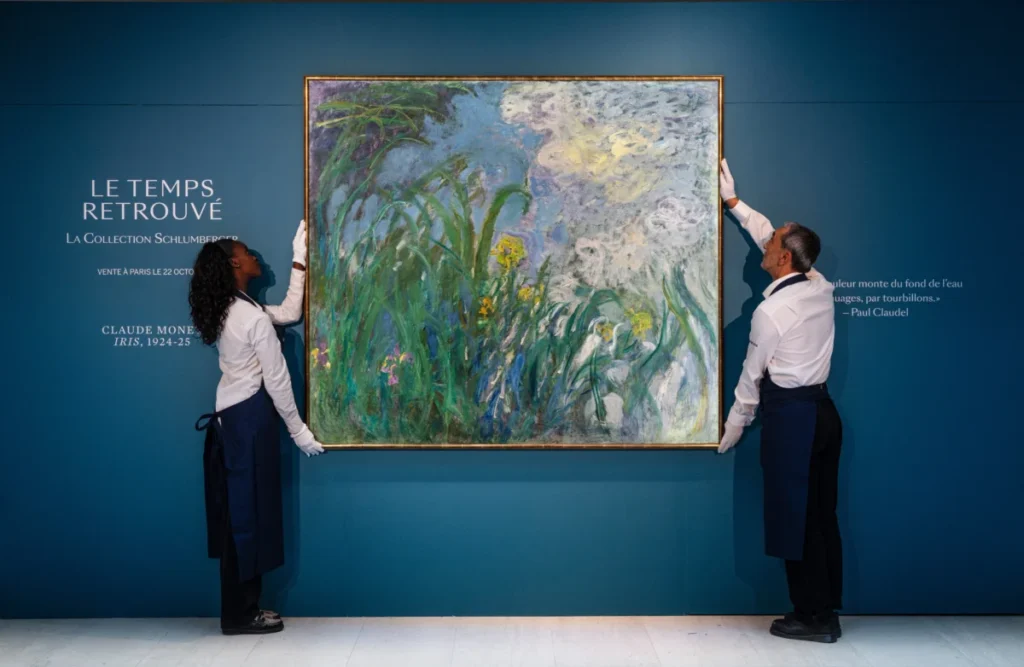
In a move that has electrified the international art market, Sotheby’s Paris has announced the centerpiece of its upcoming autumn season: a monumental, never-before-seen masterpiece by Claude Monet. The work, a stunning entry from the artist’s celebrated “Iris” series, has remained sequestered in the private collection of the Schlumberger family for decades. As it prepares to head to the auction block on October 22, the painting is not only expected to command a price between €22 million and €30 million ($25 million to $34 million), but it is also poised to shatter the existing auction record for any painting sold in France.
The unveiling of this work, titled Iris, represents a watershed moment for Impressionist scholarship and the high-end art trade. Measuring an imposing 63 by 71 inches, it is the largest example of the "Iris" series ever to appear at market and the most significant work from Monet’s final, radical years still remaining in private hands.
Main Facts: The Rediscovery of a Late-Career Titan
The painting, executed between 1914–1917 and 1924–1925, captures the ephemeral beauty of the purple and yellow irises in Monet’s garden at Giverny. However, rather than the precise, light-drenched observations of his early career, this work embodies the semi-abstract, immersive style of his "Grandes Décorations" period. The colors are bold, the brushwork is gestural, and the composition eschews a traditional horizon line, pulling the viewer directly into the water’s surface where flowers and reflections merge.
The auction, titled Le Temps Retrouvé: The Schlumberger Collection, features 28 lots that offer a rare glimpse into the discerning taste of one of France’s most private yet influential collecting dynasties. While the "Iris" is the clear headliner, the collection includes works by Paul Cézanne, Pierre Bonnard, and Chaïm Soutine.
The timing of the sale is strategically aligned with "Art Basel Paris" and the centenary of the birth of Surrealism, though it also serves as a precursor to the 2026 centenary of Monet’s death. This confluence of events has placed a global spotlight on Paris, which continues to challenge London and New York for dominance in the prestige art market.
Chronology: The Evolution of the ‘Iris’ and the Schlumberger Acquisition
To understand the significance of this painting, one must trace the timeline of its creation and its subsequent journey into the Schlumberger family archives.
1914–1926: The Giverny Years
Following the death of his second wife, Alice, and his eldest son, Jean, Monet entered a period of profound grief and creative transition. Encouraged by his friend, the statesman Georges Clemenceau, he began work on his "Grandes Décorations"—the massive water lily canvases now housed in the Orangerie. During this final decade, Monet’s vision was increasingly affected by cataracts, leading to a shift in his palette toward vibrant violets, fiery oranges, and deep yellows. The Iris offered by Sotheby’s was worked on during this period, serving as both a laboratory for his larger murals and a masterpiece in its own right. It was finished just a year before his death in 1926.
1940s–1950s: The Granoff-Schlumberger Alliance
For years after Monet’s death, his late works were largely dismissed by critics as the "incoherent" products of a failing eyesight. However, art dealer Katia Granoff saw something different: a precursor to Abstract Expressionism. In a bold financial gamble, Granoff acquired a massive cache of late-period works from Monet’s son, Michel.
Lacking the total funds to secure the entire studio holding, Granoff partnered with Jeanne Schlumberger (1889–1983), the heiress to the Schlumberger oil services fortune. Together, they divided the works. Jeanne, a woman of immense intellect and a penchant for privacy, chose the most radical pieces, including the Iris.
1983–2024: Decades of Seclusion
Following Jeanne Schlumberger’s death in 1983, the collection remained within the family. Unlike many high-profile collectors, the Schlumbergers did not frequently loan their works to international touring exhibitions. Consequently, this Iris has remained virtually unknown to the public and even to many specialized art historians, making its appearance today a genuine "market debut."
Supporting Data: The Surging Market for Late Monet
The decision to place an estimate of up to €30 million on the work is backed by a decade of explosive growth in the valuation of Monet’s late-career output. Historically, his 1870s Impressionist works (like his haystacks or Rouen Cathedrals) were the gold standard. However, the 21st-century market has pivoted toward his Giverny period.

- Market Trends: Currently, five of Monet’s top ten auction prices belong to works created after 1914. This shift is attributed to the "modernity" of the late works, which appeal to collectors who also buy contemporary art.
- Comparative Sales: In 2018, a work from the Nymphéas (Water Lilies) series from the Rockefeller collection sold for over $84 million. While Iris is a different floral subject, its scale and provenance place it in a similar tier of rarity.
- The Schlumberger Sale: The October 22 auction is expected to realize a total in excess of $50 million for the 28 lots, with the Monet Iris and a second Monet, Saule pleureur (Weeping Willow, estimated at $10–$14 million), providing the bulk of the value.
Official Responses: Sotheby’s and the French State
Sotheby’s executives have been vocal about the importance of this sale for the Parisian market. Thomas Bompard, Sotheby’s senior international specialist, emphasized the "radical brilliance" of the collection.
"Demand for Monet’s late works has never been this high," Bompard told ARTnews. "Jeanne Schlumberger and Katia Granoff recognized the genius of these works at a time when the world had largely moved on. They trusted their instincts. To see a work of this scale and quality, which has never been shown to the public, is a once-in-a-career event."
The French government has also weighed in on the collection, specifically regarding a triptych by Paul Cézanne titled Paysage romantique aux pêcheurs (1862–64). The French Ministry of Culture has officially designated the Cézanne work as a "National Treasure."
Under French law, this designation prevents the work from being exported for 30 months. During this period, the French state has the right of first refusal to acquire the work for a public museum (likely the Musée d’Orsay) at the market price. This move underscores the cultural importance of the Schlumberger holdings to the heritage of France.
Implications: A New Era for the Paris Art Market
The auction of the Schlumberger Monet carries implications that extend far beyond a single hammer price.
1. The "Paris Effect"
For decades, the most expensive Impressionist works were almost exclusively sold in New York. The decision by the Schlumberger estate to sell in Paris—and Sotheby’s confidence in doing so—signals a permanent shift. Bolstered by the success of the Grand Palais Éphémère and the influx of international collectors during Art Basel Paris, the city has reclaimed its status as a primary hub for the "Big Three" (Impressionist, Modern, and Contemporary) art markets.
2. The Legacy of the Female Collector
The provenance of the Iris highlights a secondary narrative: the role of visionary women in shaping the history of art. Jeanne Schlumberger and Katia Granoff were outliers in a male-dominated industry. Schlumberger’s biography—as one of the first French women to hold a driver’s license and an independently minded heiress—adds a layer of "intellectual provenance" that modern collectors find increasingly attractive.
3. The Definition of "Masterpiece"
As the Iris is likely to set a new record for a painting sold in France, it redefines what the market considers a "masterpiece." It suggests that rarity, freshness to market (the "unseen" factor), and a connection to the roots of modern abstraction are now the primary drivers of value, outweighing traditional preferences for earlier, more representational Impressionism.
Conclusion
When the gavel falls on October 22 at Sotheby’s Rue du Faubourg Saint-Honoré, it will mark the end of an era of private ownership for one of the 20th century’s most significant floral compositions. Whether the Iris remains in France or finds a new home in a major international museum or private collection, its emergence has already succeeded in doing what Claude Monet did a century ago: forcing the world to look at color, light, and the natural world with entirely fresh eyes.
The Schlumberger collection, long kept behind closed doors, serves as a final testament to the "Le Temps Retrouvé"—time regained—where the radical visions of the past finally meet the appreciation of the present.



