

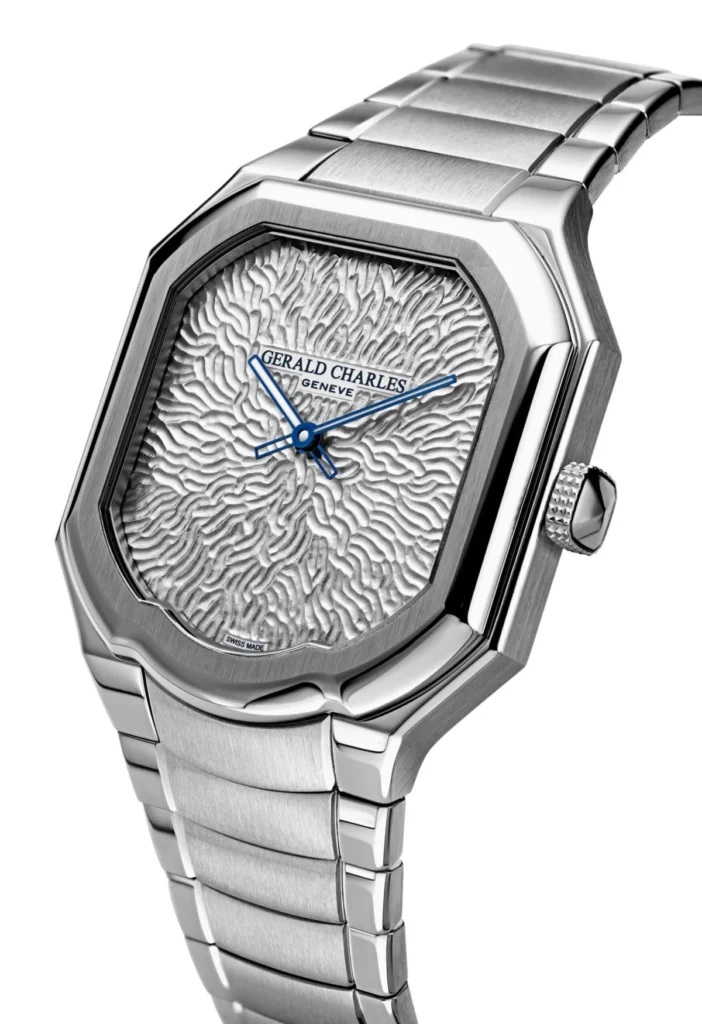
In the rarefied world of high-horology, the pursuit of perfection is often defined by robotic precision, laser-cut components, and sterile, clean-room assembly. Yet, with the release of the new Gerald Charles Masterlink Atelier Edition, the manufacture has chosen a diametrically opposite path: the deliberate, human-driven beauty of imperfection. By marrying a technically complex, ultra-slim integrated sports watch with a dial shaped entirely by hand-hammering, Gerald Charles is making a profound statement about the future of luxury watchmaking—that in an age of automation, the artisan’s strike is the ultimate commodity.
Main Facts: The Intersection of Engineering and Art
The Masterlink Atelier Edition represents a significant pivot for a model that was only introduced in 2024. While the base architecture of the Masterlink remains intact—a 38mm by 38mm stainless steel case with a wafer-thin profile of just 7.99mm—the "Atelier" treatment transforms the watch from a daily-wear sports piece into a wearable sculpture.
The headline feature is undoubtedly the dial. Crafted from Maillechort (nickel silver), a notoriously difficult alloy to machine, each dial is individually hand-hammered by artisans at the Gerald Charles Geneva atelier. This is not a stamped pattern designed to mimic a texture; it is the result of hundreds of manual, calculated strikes that create a unique topography of facets on every single unit.

Because of this intensive process, no two dials are identical. The light interaction is dynamic and multi-directional, scattering across the facets rather than reflecting off a flat surface. To ensure the texture remains the primary focus, the brand has taken the minimalist approach of removing all hour markers, leaving only the central hour and minute hands. This limited release is available in three distinct colorways—Golden Rose, Rhodium, and Golden Yellow—with production strictly capped at 25 pieces per color. At a retail price of $31,000 USD, the Atelier Edition positions itself firmly in the upper echelon of boutique watchmaking.
Chronological Evolution: From Genta’s Legacy to the Masterlink
To understand the weight of the Masterlink’s design, one must look back at the history of its namesake. Gérald Charles Genta, the legendary designer whose portfolio includes the most iconic watches of the 20th century, founded Gerald Charles over 25 years ago. His design philosophy—defined by the "smile" at the 6 o’clock position of the case—is the foundational DNA of the brand.
The Masterlink was introduced in 2024 as the brand’s first true integrated-bracelet watch. The challenge was immense: how to marry a soft, asymmetrical case shape with a rigid, geometric bracelet. The brand’s engineers had to develop a design that transitioned from the curved geometry of the "smile" at 6 o’clock to the sharper, more linear architecture at 12 o’clock.

The bracelet itself is a masterclass in hidden complexity. Drawing inspiration from a 2007 "Sarawak" prototype created by Genta for the Royal Family of Sarawak—a piece that remained shrouded in mystery until recently—the Masterlink bracelet features a butterfly clasp and release pushers entirely hidden within the links. There are no visible screws to break the aesthetic flow. The introduction of the Atelier Edition serves as the next logical step in this timeline: having perfected the case and the mechanical engineering, the brand is now elevating the artistic, human element of the watch.
Supporting Data: Technical Specifications and Materiality
The Masterlink Atelier Edition is as impressive under the hood as it is on the surface. Powering the timepiece is the Caliber GCA 1000, an automatic manufacture movement that highlights the brand’s prowess in ultra-thin engineering.
- Movement: Automatic Caliber GCA 1000.
- Thickness: 2.67mm (movement), 7.99mm (total case).
- Frequency: 21,600 vibrations per hour (3 Hz).
- Power Reserve: 50 hours.
- Jewels: 29.
- Components: 176 individual parts.
- Water Resistance: 100 meters (a feat for a watch of this slimness).
- Finishing: Snailing, Côtes de Genève, and circular graining, visible through the sapphire caseback.
The choice of Maillechort for the dial is a deliberate technical hurdle. Nickel silver is significantly harder than the brass used in standard dial production. The physical act of hammering this alloy requires specialized tooling and significantly longer production hours, as the material resists the deformation process. This material choice is a testament to the brand’s willingness to absorb higher manufacturing costs to achieve a specific aesthetic texture that simply cannot be replicated by CNC machines.

Official Responses: The Philosophy of "Hidden Complexity"
The leadership at Gerald Charles has been vocal about the strategic intent behind the Atelier Edition. CEO Federico Ziviani has characterized the design process as a "highwire act."
"Our aim was to let simplicity conceal complexity," Ziviani noted during the launch. "Designing a watch where you can feel everything, yet see nothing—now that’s truly a highwire act."
This ethos is echoed by the Gerald Charles Creative Team, who emphasized that the goal was to change the fundamental relationship between the watch and the light. By using the hand-hammered texture, they have successfully moved away from the traditional "sunray" finishes that dominate the industry. Instead, they have created a "living" surface. The brand’s official messaging highlights that while the Masterlink’s mechanical engineering is designed to be invisible and seamless, the dial is designed to be a proud, tactile display of the labor required to create it. It is a dialogue between the perfection of the machine and the beautiful, rugged imperfection of the human hand.

The Implications: Why the Atelier Edition Matters
The release of the Masterlink Atelier Edition signals a shift in how luxury collectors perceive value. In recent years, the market has been saturated with watches that emphasize technical specs—power reserves, chronometry, and material science. While these are critical, the "Atelier" model taps into a deeper desire for provenance and craftsmanship that bears the literal mark of the maker.
1. The Value of the "Unrepeatable"
By limiting the run to 25 pieces per color, Gerald Charles is betting on the allure of exclusivity. However, it is the hand-hammered nature of the dial that elevates the value. Because no two dials are the same, each owner is effectively purchasing a "one-of-one" piece of art. This adds a layer of emotional investment that a mass-produced, machine-finished dial cannot provide.
2. A Challenge to Minimalism
The Masterlink is often praised for its clean, unassuming look. By removing the hour markers, the brand is pushing the limits of minimalism. This creates a bold implication: the watch is no longer just a tool for telling time; it is a piece of jewelry that commands attention through its texture and light-play. It assumes that the wearer is confident enough in their style to prioritize beauty over immediate, second-by-second legibility.

3. The Future of the Integrated Sports Watch
The Masterlink has firmly established itself as a competitor to the industry’s heavyweights in the integrated-bracelet category. With this new iteration, Gerald Charles is demonstrating that they are not content to simply compete on engineering—they are competing on heritage and artistic soul. By successfully marrying Genta’s industrial design genius with a traditional, hand-crafted artisanal technique, the brand is cementing its position as a serious, creative force.
In conclusion, the Gerald Charles Masterlink Atelier Edition is more than just a watch; it is a physical manifestation of a brand that refuses to choose between the precision of the future and the artistry of the past. For the discerning collector, it offers a rare opportunity to own a timepiece that feels as much like an heirloom as it does a feat of modern engineering. As the brand continues to refine this model, the Atelier Edition will likely be remembered as the moment the Masterlink truly found its artistic voice.