
In the rarefied world of high-end watchmaking, Glashütte Original has long occupied a unique position. While its neighbors in the Saxon town of Glashütte often lean toward classical austerity or extreme complications, Glashütte Original has consistently balanced “under-the-radar” appeal with a level of mechanical build quality that rivals the very best of Switzerland. Today, the brand takes a bold step forward in the fiercely competitive integrated sports watch segment with the launch of the 2026 iteration of its 70s collection. By pivoting from its previously quirky, idiosyncratic roots toward a sharper, more architecturally defined aesthetic, the brand is signaling a clear intent to capture a wider, more design-conscious audience.
Main Facts: A Technical Rebirth
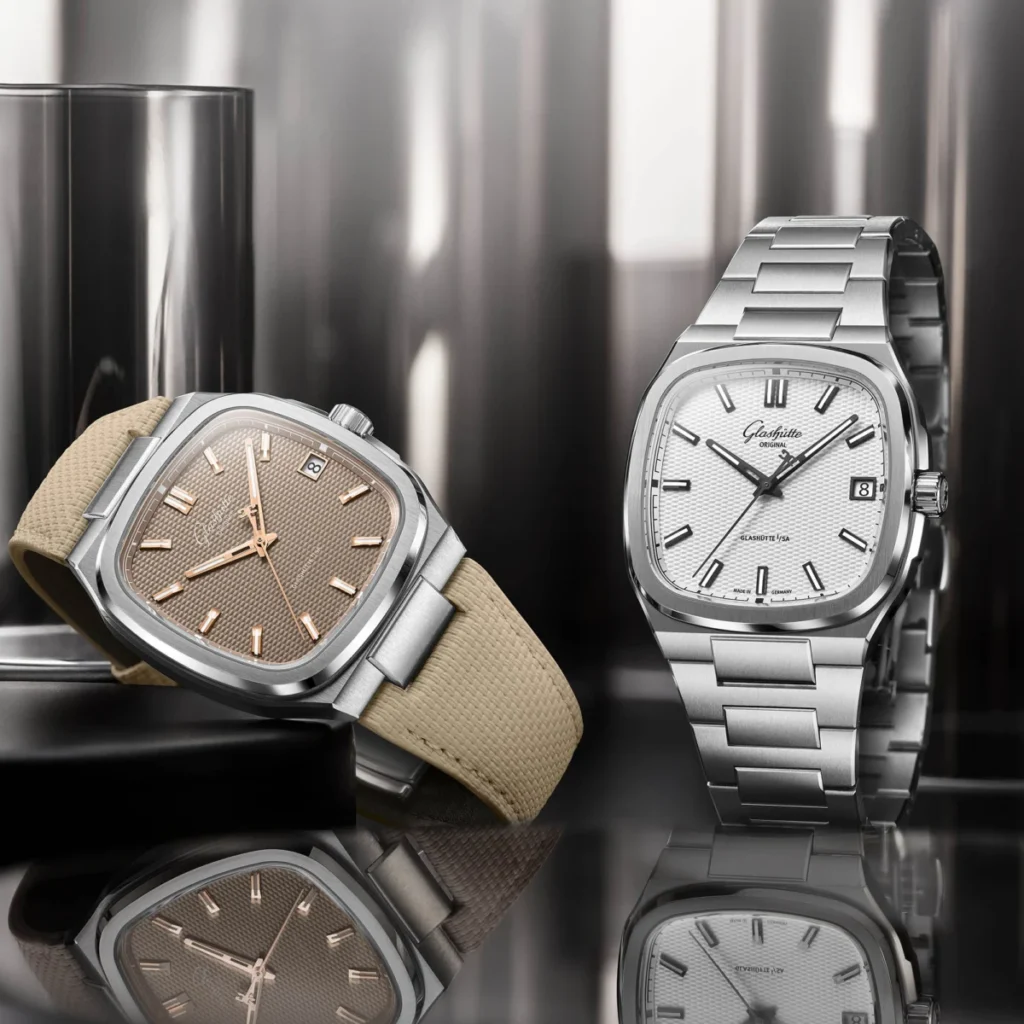
The 2026 Glashütte Original 70s collection is not merely a cosmetic update; it is a fundamental reimagining of the brand’s sport-chic identity. The most immediate change is the sizing. By downsizing the case to a sleek 39mm in diameter and a remarkably slim 9.6mm in height, the brand has achieved a profile that is far more versatile than its predecessor.
The stainless steel construction now eschews the soft, flowing lines of the past in favor of a “brutalist-inspired” angularity. The bezel, once a polished slope, is now a faceted, architectural element that plays with light through a combination of vertical brushing and sharp, polished chamfers. This structural rigor extends to the crown guards—now wide, rectangular, and faceted—giving the watch a mechanical, tool-like presence that feels both modern and deeply rooted in industrial design. Despite this slimmer, more refined profile, the watch maintains a robust 100-meter water resistance, ensuring that its “sport” credentials are not sacrificed for its new, elegant silhouette.

Chronology: From “Seventies” to the Modern “70s”
To understand the significance of this launch, one must look at the history of the line. Previously marketed as the “Seventies,” the collection served as the brand’s primary entry point into the integrated-bracelet market. Those earlier iterations were defined by their rounded-square geometry and a certain German quirkiness—often polarizing in its execution.
The 2026 update represents the first major departure from this design language. By dropping the “Seventies” moniker for the more streamlined “70s,” the brand is distancing itself from a literal retro interpretation. The design team has moved away from the soft curves that defined the 2010s output, shifting toward a design philosophy inspired by the golden age of high-fidelity audio equipment. This evolution tracks with the broader market trend of “sport-luxury” watches becoming more compact and geometrically complex, proving that Glashütte Original is paying close attention to the shifting tastes of the horological elite.
Supporting Data: The “Hexagrid” and the Caliber 36
The centerpiece of the new collection is the “Hexagrid” dial—an embossed texture that represents a distinct departure from the traditional sunburst finishes of the brand’s past. Drawing inspiration from vintage speaker grilles, the pattern offers a level of depth and light play that feels distinctly tactile.

The Audio-Inspired Palette
Glashütte Original has structured the launch around three distinct colorways, each paying homage to the aesthetics of classic sound systems:
- Tweed Amp: A warm, golden-brown dial paired with red gold hardware. This variant offers a vintage warmth that softens the otherwise rigid architecture of the case.
- Stereo Panel: A bright, futuristic galvanized silver dial with white gold indices, designed to emphasize the technical nature of the watch.
- Vinyl Record: A limited-edition, semi-matte black dial that serves as the “purist” choice, offering a moody, monochromatic look that highlights the dial’s texture.
The Powerhouse: Caliber 36
Under the hood, the 70s remains powered by the formidable in-house Caliber 36. This movement is a masterpiece of German engineering. It boasts an impressive 100-hour power reserve, driven by a single barrel, and oscillates at a frequency of 28,800 vibrations per hour. The finishing is, in typical Glashütte fashion, exemplary. Featuring a partially skeletonized three-quarter plate, striped decoration, blued screws, and a gold-inlaid balance cock, the movement is a visual feast visible through the sapphire display back.
Official Perspectives: Navigating Change
The transition in the date display has been the most debated aspect of the new design. By moving away from the iconic “Panorama Date”—a double-wheel, large-format date display that has become a brand signature—in favor of a conventional, framed 3 o’clock date window, Glashütte Original is making a clear concession to market preferences.

Industry analysts suggest this is a strategic move to appeal to collectors who prioritize symmetry and ease of reading. While some purists have expressed concern regarding the dilution of the brand’s “Germanic” identity, the company’s internal messaging emphasizes that the 70s collection is intended to be a more accessible, everyday companion. The inclusion of a new H-link bracelet with a polished chamfer and a quick-release rubber strap system further underscores this intent to prioritize user-centric design.
Implications: Where Does the 70s Sit in the Market?
The release of the 70s collection places Glashütte Original in a very strong position. The integrated sports watch segment is currently dominated by a few behemoths; however, the “dark horse” status of the 70s is its greatest asset. It offers an alternative for the buyer who is fatigued by the ubiquitous designs of the Swiss integrated-bracelet giants.
A New Contingent of Fans
The combination of the 39mm case size and the 100-hour power reserve creates a compelling value proposition. The watch is objectively smaller, thinner, and more wearable than its predecessors, making it an ideal choice for a wider range of wrist sizes. Furthermore, by offering both a high-end metal bracelet and a sophisticated rubber strap, the brand is acknowledging the modern wearer’s desire for versatility.

The Road Ahead
The implications for the brand’s future are clear: Glashütte Original is no longer content to be a niche manufacturer for the German-watch aficionado. With the 70s, they are gunning for the “daily driver” spot in the watch boxes of international collectors. Whether it is the textured “Hexagrid” dial, the brutalist architecture of the case, or the sheer mechanical reliability of the Caliber 36, the 70s is a testament to the fact that heritage brands can evolve without losing their souls.
As the watch industry continues to grapple with the tension between tradition and modernity, the 70s collection stands as a beacon of balanced design. It is a watch that respects the past—through its nods to audio gear and its meticulous movement finishing—while firmly placing its feet in the future of contemporary watchmaking. For those seeking a blend of Teutonic precision and modern, sharp aesthetics, the 70s is not just a watch; it is a statement of intent from one of the most capable manufacturers in the world.
The market response in the coming months will be the ultimate arbiter, but early indicators suggest that Glashütte Original has successfully navigated the difficult task of reinventing an icon, ensuring its relevance for a new generation of collectors.