
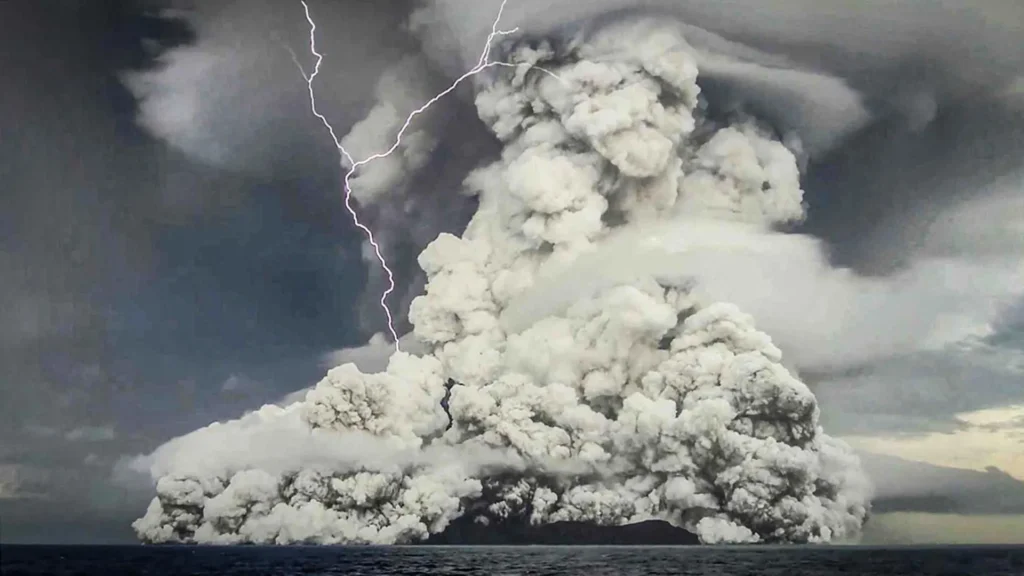
In January 2022, the South Pacific witnessed an explosion of near-mythic proportions. The eruption of the Hunga Tonga-Hunga Ha’apai volcano was one of the most powerful volcanic events in the modern era, sending shockwaves around the globe and injecting a gargantuan plume of ash, gas, and seawater deep into the stratosphere. While initial coverage focused on the devastating tsunami and the physical destruction, a team of international scientists has since uncovered a silver lining hidden within that atmospheric chaos: the volcanic plume acted as a massive, natural chemical reactor, actively scrubbing methane—a potent greenhouse gas—from the atmosphere.
This discovery, published in the journal Nature Communications, offers more than just an explanation for a strange chemical signature; it provides a potential blueprint for future climate intervention. By demonstrating how nature can neutralize methane, researchers are now contemplating whether this mechanism could be harnessed to "pull the emergency brake" on global warming.
Main Facts: The Chemical Fingerprint of Methane Destruction
The core of the discovery lies in the detection of formaldehyde within the volcanic plume. Formaldehyde acts as a transient, short-lived chemical "fingerprint." In the complex chemistry of the atmosphere, formaldehyde is produced as a byproduct when methane molecules are broken apart. Because it survives for only a few hours before degrading, its presence in high concentrations acts as definitive proof that methane destruction is actively occurring in real-time.
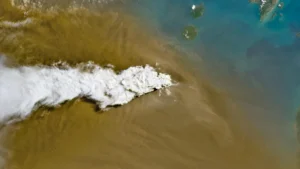
Researchers analyzing data from the European Space Agency’s Sentinel-5P satellite were stunned to see a record-breaking concentration of formaldehyde trailing the Hunga Tonga plume for over 10 days, stretching all the way to South America. This confirmed that the volcano was not merely a source of pollution, but a localized "cleanup" site where methane was being continuously neutralized at an extraordinary scale.
Chronology of the Event and Discovery
The Eruption (January 2022)
When the underwater volcano erupted, it did something unique: it injected massive quantities of salty seawater, volcanic ash, and sulfur into the stratosphere. Unlike terrestrial volcanoes, which primarily spew gas and ash, the submarine nature of Hunga Tonga created a high-pressure, high-salinity environment in the upper atmosphere.
The Satellite Observation Phase
In the weeks following the eruption, the TROPOMI instrument—a high-tech sensor aboard the Sentinel-5P satellite—began capturing data that seemed anomalous. Monitoring the stratosphere, the instrument picked up intense levels of formaldehyde. Initially, the team struggled to reconcile this data with standard atmospheric models, as such high concentrations were previously thought impossible at that altitude.
Verification and Peer Review (2023–2024)
It took months of painstaking calibration to confirm the findings. Scientists had to correct for the satellite’s sensitivity and filter out interference from the massive sulfur dioxide levels also present in the plume. Once the data was validated, it became clear: they were witnessing a large-scale chemical reaction that had never been documented in the stratosphere before.
Supporting Data: By the Numbers
The scale of the phenomenon was massive, providing a rare quantitative look at atmospheric chemistry.
- Total Methane Output: The eruption released approximately 300 gigagrams (Gg) of methane. To put this into perspective, that is roughly the annual output of two million cows.
- The Destruction Rate: Simultaneously, the plume was estimated to be destroying methane at a rate of 900 megagrams (Mg) per day.
- The Comparison: This means the volcanic cloud was effectively neutralizing the equivalent of the daily emissions of two million cows every single day it persisted in the atmosphere.
This creates a "net-zero" dynamic within the plume itself, where the volcano’s own emissions were partially mitigated by the very ash and sea salt it ejected.
The Mechanism: Salt, Sunlight, and Chlorine
How did the volcano achieve what takes the atmosphere years to do naturally? The explanation lies in a chemistry process identified just a year prior.
In 2023, researchers discovered that Saharan dust, when mixed with sea salt from ocean waves, creates "iron salt aerosols." When sunlight hits these microscopic particles, it triggers a release of chlorine atoms. Chlorine is highly reactive and acts like a molecular "predator," latching onto methane and breaking its chemical bonds, effectively destroying it.
Professor Matthew Johnson of the University of Copenhagen, a key contributor to both the 2023 dust study and the current volcano study, explains: "What is new—and completely surprising—is that the same mechanism appears to occur in a volcanic plume high up in the stratosphere, where the physical conditions are entirely different."
In the case of Hunga Tonga, the "ingredients"—volcanic ash and sea salt—were launched into the stratosphere, where intense sunlight acted as the catalyst. This combination created a high-altitude chemical reactor that accelerated the breakdown of methane far faster than typical background processes.
Implications for the Global Methane Budget
The findings necessitate a revision of how we calculate the "global methane budget." The budget is the essential accounting system used by climate scientists to track methane sources (like wetlands, agriculture, and fossil fuels) against the "sinks" (processes that remove it).
"We now know that atmospheric dust—for example from a volcanic eruption—impacts the methane budget," says Professor Johnson. "Because dust has not previously been taken into account, it is important that we correct the data on which these estimates are based."
If mineral dust from volcanoes and other natural sources accelerates methane destruction, our current models may be underestimating the earth’s natural ability to self-regulate, or alternatively, failing to account for how changes in global weather patterns (which carry dust) affect our climate future.
Official Responses and Scientific Perspective
The scientific community has reacted to the study with a mix of excitement and caution. Dr. Maarten van Herpen, the study’s lead author, emphasized the novelty of the finding: "It is known that volcanoes emit methane during eruptions, but until now it was not known that volcanic ash is also capable of partially cleaning up this pollution."
Senior author Dr. Jos de Laat of the Royal Netherlands Meteorological Institute highlighted the importance of satellite verification. "How do you prove that methane has been removed from the atmosphere? How do you know your method works? It’s very difficult. But here we address that problem by showing that methane breakdown can in fact be observed using satellites."
The research, supported by Spark Climate Solutions, has opened a new door in climate science. By proving that we can monitor methane destruction from space, scientists now have a "yardstick" to measure the effectiveness of potential climate intervention technologies.
Why Methane Matters: The "Emergency Brake"
Methane is a critical target for climate policy. While carbon dioxide (CO2) is the primary driver of long-term warming, methane is a potent short-term threat. It is roughly 80 times more efficient at trapping heat than CO2 over a 20-year period. However, it also has a much shorter atmospheric lifetime—roughly 10 years, compared to centuries for CO2.
This short lifespan makes methane the "emergency brake" of climate change. If we can accelerate the removal of existing methane, we could theoretically see a measurable cooling effect within a decade.
Is Artificial Methane Removal Possible?
The Hunga Tonga event has naturally sparked interest in whether humans could replicate this process. The idea of "atmospheric methane removal" is a growing field of study. Could we deploy aerosol particles into the atmosphere to mimic the iron-salt reaction observed in the volcanic plume?
The research team is careful to note the dangers of such an approach. "It’s an obvious idea for industry to try to replicate this natural phenomenon—but only if it can be proven to be safe and effective," says Professor Johnson. Any attempt to manipulate atmospheric chemistry on a global scale carries the risk of unintended consequences, such as altering ozone layer stability or changing regional rainfall patterns.
However, the path forward is clear: the first step is monitoring. By using the satellite-based methods refined during the Hunga Tonga analysis, scientists can begin to map the efficacy of potential removal strategies without immediately resorting to large-scale deployment.
Conclusion: A Blueprint for the Future
The Hunga Tonga-Hunga Ha’apai eruption was a tragedy for the local environment, but its legacy in the scientific world may be a profound lesson in planetary resilience. By revealing that the atmosphere possesses hidden, accelerated mechanisms for self-cleaning, the study provides a new lens through which to view our climate crisis.
While this natural process is not a "silver bullet"—and certainly not a substitute for the urgent need to transition away from fossil fuels—it serves as a powerful reminder that the Earth’s systems are interconnected in ways we are only beginning to understand. As we look toward an uncertain climate future, the ability to monitor, understand, and perhaps eventually influence these chemical processes may prove to be one of our most valuable tools in the fight to stabilize our planet’s temperature.