
In a stunning revelation that has upended decades of marine biological assumptions, researchers have confirmed the existence of a vibrant, living coral ecosystem off the coast of Benin—a site that had been written off by the scientific community as dead for more than sixty years. The discovery not only challenges historical records but also suggests that the continental shelf of the Gulf of Guinea may be a vast, undocumented frontier for marine biodiversity.
The findings, recently published in the journal Frontiers in Marine Science, provide a rare, triumphant narrative in an era often defined by reports of environmental decline. By utilizing a combination of historical archives, advanced sonar technology, and deep-sea imaging, an international team has successfully bridged a six-decade gap in oceanographic knowledge, proving that nature is often more resilient—and more mysterious—than our records suggest.
A Legacy of Misinterpretation: The 1960s Surveys
To understand the significance of this discovery, one must look back to the early 1960s. During this period, marine researchers were conducting widespread surveys of the West African coastline. The primary objective of these expeditions was not ecological conservation, but rather the identification of productive fishing grounds to bolster the local economy.
During these cruises, sonar technology—which was in its relative infancy compared to modern standards—detected significant structural anomalies on the seafloor at depths exceeding 50 meters. The data indicated the presence of extensive rocky or calcified formations. At the time, researchers analyzed the acoustic signatures and concluded that these structures were likely "dead" coral reefs, remnants of a bygone geological era. For over half a century, this assessment became the standard academic consensus, and the site was largely forgotten by the global scientific community.
Chronology of a Modern Scientific Quest
The path to rediscovery began when a team led by Gérard Zinzindohoué of the Institut de Recherches Halieutiques et Océanologiques du Bénin (IRHOB) decided to revisit the historical data. Armed with modern skepticism and cutting-edge technology, the team initiated a grueling field campaign characterized by technical hurdles and the immense pressure of working in uncharted waters.
"It was not an easy field campaign," Zinzindohoué noted in the wake of the expedition. "It was a mix of long days at sea, technical problems, and a lot of uncertainty."
The team’s approach was methodical:
- The Planning Phase: Researchers digitized and re-examined the 1960s survey records, looking for coordinates that suggested reef-like signatures.
- Acoustic Scanning: The team scanned approximately 11.5 kilometers of the seafloor using advanced multibeam sonar. The process was slow and fraught with anxiety, as the team sought to distinguish modern geological features from the ghost data of the past.
- The Breakthrough: After days of searching, the sonar picked up two distinct areas that mirrored the potential reef signatures noted in the 1960s.
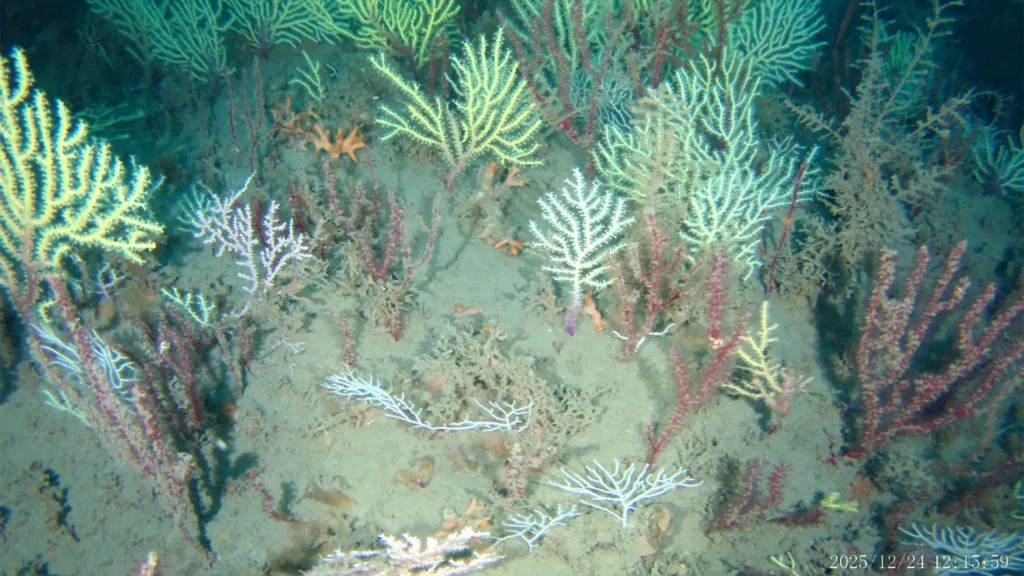
- Visual Confirmation: Using an underwater drone and the National Geographic Exploration Technology Lab’s Deep Sea Camera System, the team finally achieved visual contact with the seafloor. What they found was not the graveyard of coral they had expected, but a thriving, complex, and active mesophotic ecosystem.
The Mesophotic Enigma: Understanding the Habitat
The team’s primary hypothesis, which they successfully tested, was that the site contained a "mesophotic coral ecosystem" (MCE). Unlike the brightly colored, shallow-water reefs that tourists often associate with tropical vacations, mesophotic reefs exist in the "twilight zone"—depths where light is significantly attenuated.
"A mesophotic coral ecosystem lives deeper than the usual shallow coral reefs, in zones where light is much more limited," Zinzindohoué explained. "Unlike typical shallow reefs, it does not always form a single continuous reef structure. Instead, it can appear as patchy or scattered coral communities spread across the seafloor."
This adaptation is crucial. Because these corals exist in a low-light environment, they have evolved to utilize different energy-gathering strategies than their surface-dwelling counterparts. They do not form the iconic, monolithic walls of shallow reefs; instead, they colonize rocky outcrops and hard substrates where current flow and nutrient availability are optimal. This patchy distribution explains why the 1960s researchers, who lacked high-resolution visual tools, may have mischaracterized the reef as "dead" or structurally barren.
Biodiversity and the Ecosystem Web
The expedition’s visual survey revealed a staggering level of activity. The camera system captured eight distinct types of coral, serving as a vital foundation for a diverse array of marine life. Scientists identified eight specific fish species currently utilizing the reef for shelter, mating, and foraging, including:
- Golden African snappers: A staple of the region’s marine ecology.
- Blackbar soldierfish and Guinean angelfish: Colorful residents indicating a stable food web.
- West African goatfish and Monrovia doctorfish: Key species that contribute to the maintenance of the reef’s health.
- Three-banded butterflyfish and two species of damselfish: Further evidence of a balanced, self-sustaining community.
The presence of these species suggests that the reef is not merely a collection of isolated coral patches but a functional, thriving hub of biological activity. The reef provides critical vertical structure in an otherwise relatively flat sandy seabed, acting as an oasis for biodiversity in the Gulf of Guinea.
Implications for Marine Science and Policy
The discovery has sent ripples through the marine biology community, raising the question: If we were so wrong about this site, what else have we missed?
The "Forgotten" Coast
Zinzindohoué believes this finding is likely the tip of the iceberg. "To our knowledge, this is the first confirmed record of a living mesophotic coral ecosystem on the Gulf of Guinea continental shelf," he said. "However, I think what we found is probably not an exception. It is more likely a reflection of how little we still know about coastal regions in West Africa and elsewhere."
The potential for further discoveries is immense. Historical records for the entire West African coast are dotted with references to "anomalous seafloor structures." Scientists now suggest that a concerted effort is needed to map these areas systematically.
The Question of History
A significant scientific debate has now emerged regarding the history of the site: Did the reef actually die and recover, or was it simply misidentified in the 1960s? While the team has not yet collected physical samples for carbon dating or genetic analysis, the possibility of a "Lazarus effect"—where a degraded reef recovers over decades—remains a tantalizing hypothesis. Conversely, the more conservative view is that the original survey equipment was simply incapable of detecting deep-water, low-profile coral communities.
Future Research: Expanding the Horizon
The team acknowledges that their current findings represent only a preliminary glimpse. With the original historical reports suggesting that the reef could extend across a 40-kilometer barrier parallel to the coast, the current survey covers only a fraction of the potential habitat.
The next steps for the research team include:
- Scientific Diving and Sampling: Physical collection of coral fragments is essential to confirm the species identification and assess the health of the coral via genetic sequencing.
- Long-term Monitoring: Establishing a permanent monitoring station to track changes in water temperature, salinity, and biodiversity.
- Regional Collaboration: Encouraging neighboring countries along the Gulf of Guinea to utilize the Benin team’s methodology to scan their own coastal waters.
"If I had all the grant money in the world, the first thing I would do is return to the site with a proper scientific diving and sampling program," Zinzindohoué remarked. "For me, the most exciting part is about understanding the reef’s history, and what it can tell us about how the ocean in this region has changed over time. It feels like we have only just started to read an archive that has been there for a very long time."
Conclusion
The rediscovery of the Benin coral reef serves as a powerful reminder of the limits of human knowledge. In our rush to map and categorize the world, we have often relied on the limitations of our past tools to define the boundaries of what is possible. By revisiting a "dead" site with the eyes of the 21st century, the research team has not only brought a forgotten ecosystem back to life but has also highlighted the urgent need for further exploration. As climate change continues to stress our oceans, these deep-water sanctuaries may prove to be the most vital reservoirs of biodiversity, holding the secrets to survival for many of the ocean’s most vulnerable species.