
In early September 2026, the Sunda Strait—a vital maritime artery between the Indonesian islands of Java and Sumatra—became the epicenter of a dramatic geological awakening. Anak Krakatau, the "Child of Krakatoa," entered a prolonged and violent explosive phase that lasted over 24 hours. The eruption sent towering plumes of volcanic ash and toxic gases into the upper atmosphere, triggering a cascade of regional disruptions that shuttered international airports, compromised air quality for millions, and reignited concerns regarding the unpredictable nature of this highly active volcanic cone.
The Anatomy of the Eruption: A Chronology of Chaos
The seismic activity began in earnest as September dawned. While Anak Krakatau is known for its persistent, modest "Strombolian" activity—periodic bursts of lava and ash—the event that unfolded on September 5, 2026, was of a significantly higher magnitude.
September 5: The Sky Turns Dark
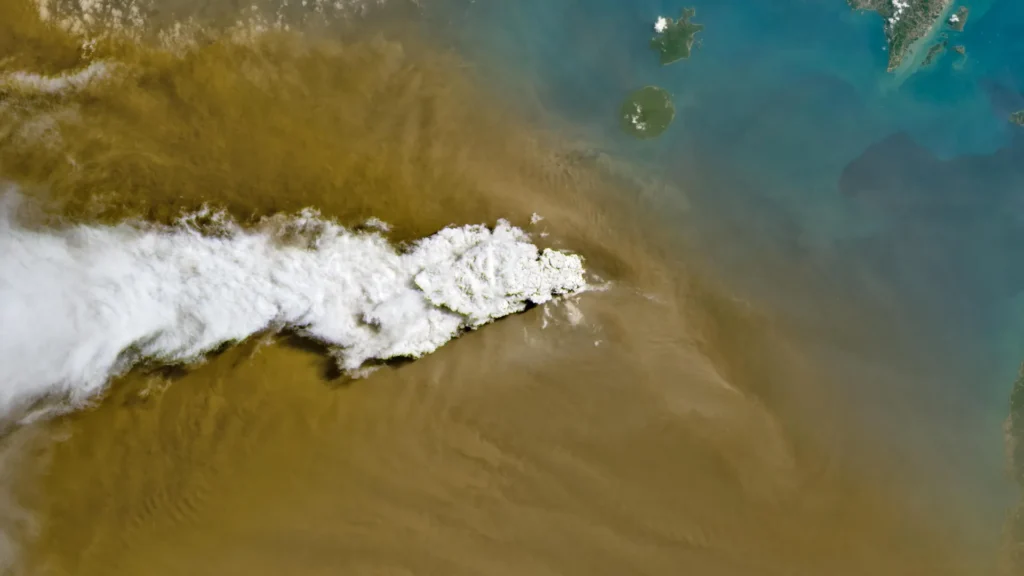
By the early morning of September 5, the volcano’s activity escalated from localized rumbles to a sustained explosive phase. Witnesses described a darkened horizon as massive columns of gas and particulate matter pierced the clouds. Satellite observations, specifically those from the NASA-USGS Landsat 8 satellite, captured a striking visual: a bright white plume of volcanic gas surging upward, piercing through a thick, ominous blanket of brown ash.
As the day progressed, the intensity of the eruption increased. The Suomi NPP satellite, utilizing the Visible Infrared Imaging Radiometer Suite (VIIRS), provided a broader, more alarming view. The imagery revealed that the volcanic material was not merely contained to the immediate vicinity of the volcano but was spreading across a vast swathe of the Indonesian archipelago.
September 6: Atmospheric Penetration
The situation reached a critical peak on September 6. Data from Indonesia’s meteorological agency confirmed that the ash plume had achieved unprecedented vertical penetration. To the east of the crater, ash reached altitudes of 6,000 meters (20,000 feet), while the western trajectory saw particles ejected as high as 15,000 meters (50,000 feet). At these altitudes, the ash enters the domain of commercial jetliners, creating a lethal environment for turbine engines, which can ingest the fine, glass-like particles and suffer total failure.
September 7-8: De-escalation and Recovery
By September 7, the sustained, high-intensity explosive phase began to wane, shifting back toward a more conventional Strombolian rhythm. While the volcano continued to rumble and emit sporadic bursts of material, the immediate atmospheric threat began to subside. By September 8, authorities deemed it safe enough to begin the slow process of reopening the regional airports that had been silenced by the ash.
Satellite Surveillance: Eyes in the Sky
The 2026 eruption provided a masterclass in modern geological monitoring. The ability of global space agencies to provide real-time data proved essential for disaster management.
NASA’s Earth Observatory, in collaboration with the U.S. Geological Survey (USGS) and NASA EOSDIS LANCE, provided the critical imagery that allowed ground-based emergency teams to track the ash cloud’s trajectory. The use of the Operational Land Imager (OLI) allowed scientists to distinguish between the cooling volcanic gases and the heavier, darker ash clouds, providing data that helped authorities predict which regions would face the most severe fallout.
These satellite assets are not merely academic; they act as the first line of defense for the aviation industry. Without the precise mapping of the ash plume’s density and height, the decision-making process for grounding thousands of flights would have been significantly more delayed, potentially putting thousands of passengers at risk.
The Aviation Crisis: 3,000 Flights Grounded
The most immediate and tangible impact of the Anak Krakatau eruption was the total disruption of the Indonesian aviation network. The fine, abrasive nature of volcanic ash makes it a nightmare for aviation; the particulate matter melts inside jet engines, creating a glass-like coating on internal components that leads to engine stalls.
In response to the drifting clouds, Indonesian aviation authorities ordered the immediate closure of eight major airports across Java and Sumatra. This decision, while necessary for safety, sent shockwaves through the regional economy. News reports confirmed that nearly 3,000 flights—ranging from domestic hops to international long-haul connections—were cancelled, diverted, or delayed.
The economic fallout of such a shutdown is immense. Beyond the logistical nightmare of rebooking thousands of passengers, the interruption of supply chains, the loss of tourism revenue, and the operational costs incurred by airlines forced to reroute aircraft represent a multi-million dollar blow to the Indonesian economy. While airports resumed operations by September 8, the "ripple effect" of the cancellations lasted for nearly a week.
Public Health and the "Ash vs. Haze" Dilemma
As the ash cloud settled over densely populated areas, including the capital city of Jakarta and the western regions of Java, the public health sector was forced into action. The Indonesian Humanitarian Coordination Platform (IHCP) issued urgent bulletins, warning residents to stay indoors and utilize protective masks.
A critical challenge for health officials was educating the public on the difference between the volcanic ash and the recurring peatland fire haze that plagues the region.
- Volcanic Ash: Composed of pulverized rock, minerals, and glass, volcanic ash is jagged and highly abrasive. It poses an immediate risk to the respiratory system, causing inflammation of the airways, and is known to cause severe eye irritation and skin abrasions.
- Peatland Smoke: Primarily organic, this smoke consists of carbon and fine particulate matter (PM2.5). While both are hazardous, they require different medical responses and filtration systems.
The IHCP emphasized that the chemical composition of the Anak Krakatau ash was significantly different from the wildfire smoke that locals were accustomed to, requiring a heightened level of caution, particularly for those with pre-existing conditions such as asthma or cardiovascular disease.
Geological Context: A Legacy of Violence
To understand the 2026 eruption, one must look at the history of the site. Anak Krakatau emerged from the caldera of the legendary 1883 eruption of Krakatoa, which remains one of the deadliest volcanic events in recorded history.
Since its birth in 1927, Anak Krakatau has been in a state of near-constant growth and destruction. Its current "Level II" alert status, which has been in effect since July 2026, serves as a permanent reminder of its volatility. The volcano sits on a precarious tectonic boundary where the Indo-Australian plate subducts beneath the Eurasian plate, a region of high seismic stress.
Geologists warn that because Anak Krakatau is essentially a "volcano on a volcano," it is prone to structural instability. Massive eruptions are not just events of ash and fire; they carry the risk of underwater landslides, which in the past have triggered devastating tsunamis. This geological reality is why the Indonesian government maintains such strict monitoring protocols and why, even as the sky cleared in September 2026, the volcano remained under the watchful eye of the Center for Volcanology and Geological Hazard Mitigation (PVMBG).
Conclusion: Living in the Shadow of the Volcano
The events of September 2026 were a stark reminder of the limitations of human infrastructure when faced with the raw power of the earth. While the aviation sector was able to recover within days and the immediate health crisis was managed through effective communication, the vulnerability of the region remains unchanged.
As Anak Krakatau continues its Strombolian activity, it serves as a persistent, low-level threat. The integration of satellite technology, rapid inter-agency communication, and public awareness programs remains the best defense against a repeat of the September chaos. For the people of Indonesia, the "Child of Krakatoa" remains a symbol of the islands’ origins—a place of beauty, fertility, and sudden, life-altering volatility. The 2026 eruption was not an end, but a reminder: in the Sunda Strait, the earth is always waiting for the next opportunity to speak.