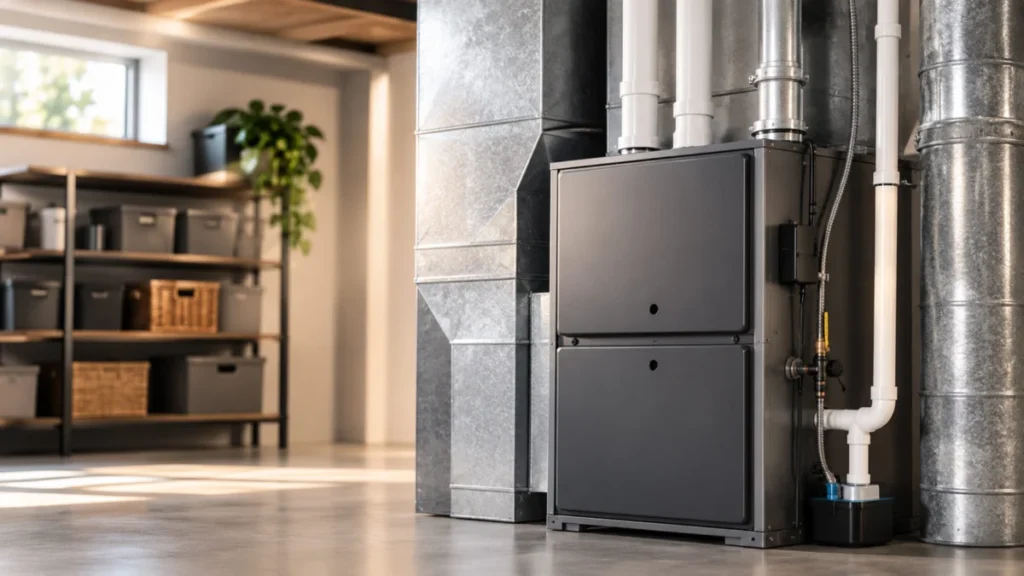
For most homeowners, the furnace is an "out of sight, out of mind" utility. It hums along in the basement or utility closet, reliably tempering the winter chill until the day it suddenly stops. When that silence occurs—often during the first sub-zero snap of the season—the immediate pressure to restore heat can lead to impulsive, expensive decisions.
Deciding whether to repair or replace your HVAC system is one of the most significant financial commitments a homeowner faces. It is not merely a question of fixing a broken part; it is a strategic decision that affects your utility bills, your home’s safety, and your long-term comfort for the next two decades.
Main Facts: The Economic Threshold of HVAC Maintenance
The core of the repair-vs-replace debate lies in the "Age-and-Repair-Cost Formula." Industry professionals often rely on a simple calculation: multiply the age of your furnace by the estimated repair cost. If the resulting figure exceeds $5,000, the unit has likely reached the end of its economic life.
While this formula is a heuristic rather than a rigid law, it provides a vital reality check. An older furnace—typically defined as one nearing its 15th to 20th year of service—is a vessel of diminishing returns. Investing $1,200 into a 16-year-old furnace yields a result of $19,200, signaling that the system is a "sunk cost" trap. Conversely, the same repair on a 6-year-old unit ($7,200) suggests that the repair is a rational investment to preserve a machine that still has years of reliable performance ahead.
Chronology: The Lifecycle of a Modern Furnace
Understanding the trajectory of your heating system is essential for proactive management.
- Years 1–5 (The Warranty Phase): During this period, most components are covered by manufacturer warranties. Issues are generally isolated, and the focus should be on biannual maintenance to ensure factory-spec efficiency.
- Years 6–12 (The Maintenance Phase): The furnace is in its prime, but internal components—such as capacitors, flame sensors, and igniters—begin to show signs of wear. Annual professional tune-ups are non-negotiable here to prevent premature failure.
- Years 13–18 (The Assessment Phase): This is the "danger zone." Parts may become harder to source, and the efficiency gap between your system and current technology widens. Contractors will start to note signs of "metal fatigue" in the heat exchanger.
- Years 19–25+ (The End-of-Life Phase): At this stage, the furnace is operating on borrowed time. Efficiency has plummeted, and the safety risks associated with aging heat exchangers become statistically significant.
Supporting Data: Efficiency and Financial Implications
The evolution of HVAC technology has been dramatic. Furnaces manufactured prior to 2012 were often built to an 80% AFUE (Annual Fuel Utilization Efficiency) standard. This means that for every dollar spent on gas, 20 cents literally goes up the flue as waste.
Modern high-efficiency condensing furnaces frequently achieve 96% to 98% AFUE. By transitioning from an older, standard-efficiency unit to a modern high-efficiency model, homeowners can see a 15% to 20% reduction in annual heating costs. Over a 15-year service life, these cumulative savings can essentially subsidize a significant portion of the installation cost.
Beyond operational costs, there is the "safety premium." As furnaces age, the metal heat exchanger—the component that separates combustion exhaust from your home’s air supply—can develop microscopic cracks. These cracks are often invisible to the naked eye but can leak carbon monoxide into your living space. Replacing a furnace is not just a financial decision; it is a life-safety upgrade.
Official Responses and Industry Standards
HVAC technicians and safety organizations like the Air Conditioning Contractors of America (ACCA) emphasize that a "swap-out" is never as simple as it looks. A professional installation requires a "Manual J" load calculation. This process determines the exact heating capacity (in BTUs) required for your home based on current insulation levels, window efficiency, and local climate data.
When asked about the industry’s stance on "patching" older units, experts warn against the "band-aid" approach. "We see homeowners spend $800 on a blower motor, only to have the circuit board fail two months later," notes one industry consultant. "The cumulative cost of these small repairs often eclipses the cost of a new, warrantied system that comes with the peace of mind of a fresh service life."
Implications: The Broader Landscape of Homeownership
The Hidden Costs of Poor Installation
If you decide to replace your unit, the installation process is as critical as the hardware itself. Improperly sized units lead to "short-cycling"—where the furnace turns on and off too frequently. This causes unnecessary wear on the blower motor and leads to uncomfortable temperature swings. Furthermore, high-efficiency furnaces require specialized PVC venting. A contractor cutting corners on the venting or gas-line retrofitting can turn a premium furnace into a liability.
Leveraging Incentives
The financial barrier to entry is lower today than in previous decades. Under the Inflation Reduction Act, homeowners in the United States may be eligible for a 30% tax credit (capped at $600) for qualifying high-efficiency equipment. When paired with local utility rebates—which are often tiered based on the system’s efficiency rating—the "sticker price" of a new furnace is rarely what the homeowner actually pays.
Preventive Maintenance as a Hedge
Regardless of your decision, the importance of the air filter cannot be overstated. A clogged filter is the single most common cause of premature furnace failure. It creates backpressure that forces the blower motor to work harder, generating excess heat that shortens the life of the heat exchanger. Changing your filter every 30 to 90 days is the cheapest insurance policy you can buy for your HVAC system.
Frequently Asked Questions
Is it better to replace the AC and the Furnace together?
If your air conditioner is more than 10 years old, replacing it alongside the furnace is often the most logical move. Because the furnace and the AC share the same blower motor and ductwork, pairing them ensures the systems are "matched" for optimal efficiency. Furthermore, the labor costs are significantly lower when the technician performs the work in one visit rather than two separate deployments.
How do I know if my furnace is actually unsafe?
Beyond the "cracked heat exchanger" diagnosis, warning signs include a yellow or flickering burner flame—which indicates incomplete combustion—and the smell of soot or exhaust in your home. If your carbon monoxide detectors are triggering, shut the system down immediately and call a professional.
What should I look for in a contractor?
Always verify that your contractor is licensed, bonded, and insured. Ask specifically if they provide a load calculation (Manual J) and if they will pull the required building permits. A contractor who skips the permit process is often bypassing the safety inspections that protect you as the homeowner.
Conclusion: Making the Right Move
Deciding to replace a furnace is an investment in the long-term health of your home. While the repair option may seem attractive in the short term, the "repair-or-replace" threshold is designed to protect you from the compounding costs of maintaining an obsolete machine. By focusing on the unit’s age, the frequency of repairs, and the potential for efficiency gains through modern technology, you can navigate the winter months with confidence.
If your furnace is approaching the 15-year mark, do not wait for the first blizzard to start your research. Consult with a qualified professional, explore the current federal and local tax incentives, and view the replacement as an opportunity to improve the safety and energy efficiency of your living environment. A proactive approach is the difference between a panicked emergency and a planned, cost-effective upgrade.