

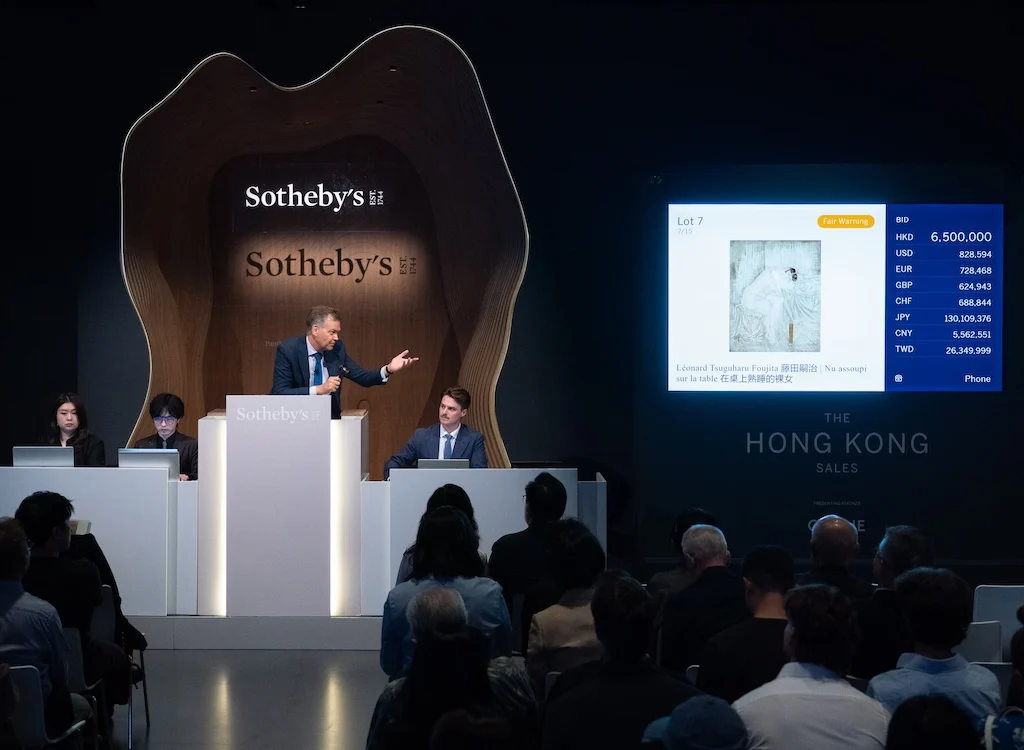
The New York fall auction season, long considered the ultimate bellwether for the global art market’s health, has opened with a series of sales that suggest a definitive shift in collector psychology. After several years of navigating high-interest rates, geopolitical instability, and a cooling of the "ultra-contemporary" speculative bubble, the early results from Sotheby’s, Christie’s, and Phillips offer a nuanced picture: the market is not in freefall, but it has become rigorously, almost ruthlessly, selective.
While total sales figures across the houses show a stabilization, the narrative of the season thus far is one of a "flight to quality." Bidders are no longer chasing the latest trends with reckless abandon; instead, they are retreating to the safety of established blue-chip names, recognizable aesthetics, and works with ironclad provenance. The era of the "guaranteed flip" for young artists appears to be over, replaced by a market that rewards patience, historical significance, and conservative pricing.
Main Facts: A Season of High Stakes and Strategic Bidding
The initial wave of sales in New York has generated over $72 million in aggregate across the three major houses’ mid-season and curated auctions. Sotheby’s led the charge with its highest-ever total for a "Contemporary Curated" sale, ringing up $38.6 million on October 7. This success was bolstered by a mix of celebrity curation—featuring selections from NBA All-Star Karl-Anthony Towns and socialite Jordyn Woods—and the prestigious single-owner collection of the late architect Robert A.M. Stern.
Christie’s followed with a solid, if more restrained, performance. Their "Post-War to Present" sale on October 1 brought in $28 million, achieving 86% of its aggregate low estimate. Phillips, focusing on a more accessible but high-quality segment, totaled $6.15 million in its September 26 sale, maintaining a healthy 80% sell-through rate.
Across all three houses, several key trends emerged:
- The Resurgence of the Masters: Artists like Wayne Thiebaud, Andy Warhol, and Helen Frankenthaler saw intense bidding, often doubling their low estimates.
- The Cooling of the "Ultra-Contemporary": Works by younger artists that saw astronomical price hikes in 2021 and 2022 are now facing significant corrections, in some cases losing nearly 90% of their previous auction value.
- The "Museum Effect": Artists currently featured in major institutional retrospectives, such as Roy Lichtenstein (Whitney Museum) and Judy Chicago, outperformed the broader market.
Chronology of the Fall Openers
Late September: Phillips Sets the Tone
The season began at Phillips on September 26. The house’s Modern & Contemporary Art sale acted as an appetizer for the season, focusing on works with estimates primarily in the mid-six-figure range. The top lot, Tom Wesselmann’s Drawing After Bedroom Painting #6 (1969), sold for $348,300, signaling that Pop Art remains a stable pillar for collectors. The sale also highlighted a burgeoning interest in Fairfield Porter, whose Flowers on a Bank (1969) soared past its $70,000 high estimate to settle at $148,350.
October 1: Christie’s Focuses on Provenance
Christie’s "Post-War to Present" auction focused on mid-market entries from heavy hitters. The sale was headlined by Wayne Thiebaud’s Coastal Farms (1997), which fetched $1.86 million against an $800,000 low estimate. This result underscored the market’s current preference for "safe" investments—artists with decades of secondary market history and significant museum representation. The sale also saw strong results for the estate of Barbara Jakobson, proving that fresh-to-market material from respected collectors still commands a premium.
October 7: Sotheby’s Breaks Records
Sotheby’s "Contemporary Curated" sale was the standout event of the early season. By blending the "lifestyle" appeal of celebrity curators with the scholarly weight of the Robert A.M. Stern collection, the house managed to create a sense of urgency that has been missing from recent seasons. The Stern selection alone accounted for $8.7 million of the total, with 90% of the lots sold. The highlight was Andy Warhol’s Flowers, which achieved $6.3 million, proving that even in a "down" market, top-tier Warhol remains the gold standard of liquidity.

Supporting Data: Winners, Losers, and Price Discovery
The data from these sales provides a stark contrast between different sectors of the market. To understand the current climate, one must look at the "spread" between the established blue-chip artists and the volatile contemporary segment.
The Blue-Chip Rally
| Artist | Work | Sale Price | Low Estimate | Performance |
|---|---|---|---|---|
| Wayne Thiebaud | Coastal Farms | $1,860,000 | $800,000 | +132% |
| Helen Frankenthaler | Return and Exit | $3,000,000 | $1,500,000 | +100% |
| Josef Albers | Homage to the Square | $960,000 | $400,000 | +140% |
| Andy Warhol | Flowers | $6,300,000 | $5,000,000 | +26% |
These figures suggest that for "The Right Material"—works that are quintessential examples of an artist’s style—there is still a deep pool of capital ready to compete.
The Correction of the "Hype" Market
The most discussed result of the season involves Avery Singer, a darling of the 2021–2022 market. Her painting Kundry (2018) serves as a cautionary tale of the current correction. In 2022, the work sold for $2.1 million. In the recent Sotheby’s sale, it carried a low estimate of $600,000 but ultimately hammer-dropped at a mere $243,200. This represents an nearly 88% decline in value in just two years.
This result is not an isolated incident but part of a broader trend where "wet paint" artists (those whose work is barely dry before hitting the secondary market) are seeing their valuations slashed as collectors prioritize long-term historical value over short-term social media buzz.
Official Responses and Market Sentiment
While auction houses generally project a facade of unwavering confidence, the commentary following these sales has been uncharacteristically pragmatic. Sotheby’s noted that the success of the "Contemporary Curated" sale was driven by "intelligent pricing" and "strategic sourcing." The house acknowledged that the market is currently "price-sensitive," meaning that if an estimate is even slightly too aggressive, the work will likely go unsold or be withdrawn.
Market analysts suggest that the "celebrity curation" model is a direct response to a more cautious buying public. By involving figures like Karl-Anthony Towns, Sotheby’s is attempting to expand the top of the funnel, bringing in younger, affluent buyers who may not have a background in art history but respond to the cultural cachet of the curators.
At Christie’s, the sentiment was one of "stability over spectacle." The fact that 86% of the low estimate was met suggests that the house was successful in managing consignor expectations. "We are seeing a return to a ‘collector’s market’ rather than an ‘investor’s market,’" noted one senior specialist. "People are buying what they want to live with, and they are doing so at prices that make sense in a higher-interest-rate environment."
Implications: What This Means for the Future
The results of the early fall season carry significant implications for the major "Marquee" sales scheduled for November and for the art market in 2025.

1. The End of Speculative Flipping
The Avery Singer result is a "shot across the bow" for speculators. The era of buying a work at a primary gallery for $50,000 and hoping to flip it at auction for $1 million six months later is largely over. Collectors are now demanding "shelf life." They want artists who have survived multiple market cycles. This will likely lead to a cooling of primary market prices for younger artists as galleries struggle to justify high entry points without the promise of secondary market growth.
2. Institutional Influence is King
The success of Roy Lichtenstein and Judy Chicago highlights the "Institutional Premium." As the Whitney Museum’s Lichtenstein retrospective draws crowds, the auction market for his "Reflections" series (which brought in $8.5 million at Sotheby’s) has solidified. For sellers, the lesson is clear: timing a sale to coincide with a major museum show is the best way to mitigate market volatility.
3. "Freshness" Over Everything
The Robert A.M. Stern collection’s 90% sell-through rate proves that "estate fresh" material is the market’s favorite drug. Collectors are tired of "recycled" works that appear at auction every three years. Collections that have been off the market for decades provide a sense of discovery and "purity" that allows for aggressive bidding even in a lean economy.
4. Conservative Estimates as a Strategy
The works that performed the best this season were those with "room to run." By setting low estimates that seemed like "bargains," auction houses successfully sparked bidding wars. This psychological tactic is essential in a nervous market; it creates the illusion of a deal, which eventually leads to a price that exceeds the original high estimate.
Conclusion
The first sales of the New York fall season have provided the art world with a much-needed reality check. The market is neither dead nor booming; it is maturing. The "froth" of the pandemic era has been skimmed off, leaving behind a landscape where historical importance, provenance, and sensible pricing are the new North Stars.
For an art market that has spent much of the last two years searching for a bottom, these results suggest that a floor has finally been found. It is a floor built on the backs of the 20th-century masters and the disciplined collectors who value them. As we move toward the high-stakes November auctions, the message to the world is clear: the buyers are back, but they are no longer buying the hype—they are buying the art.



