

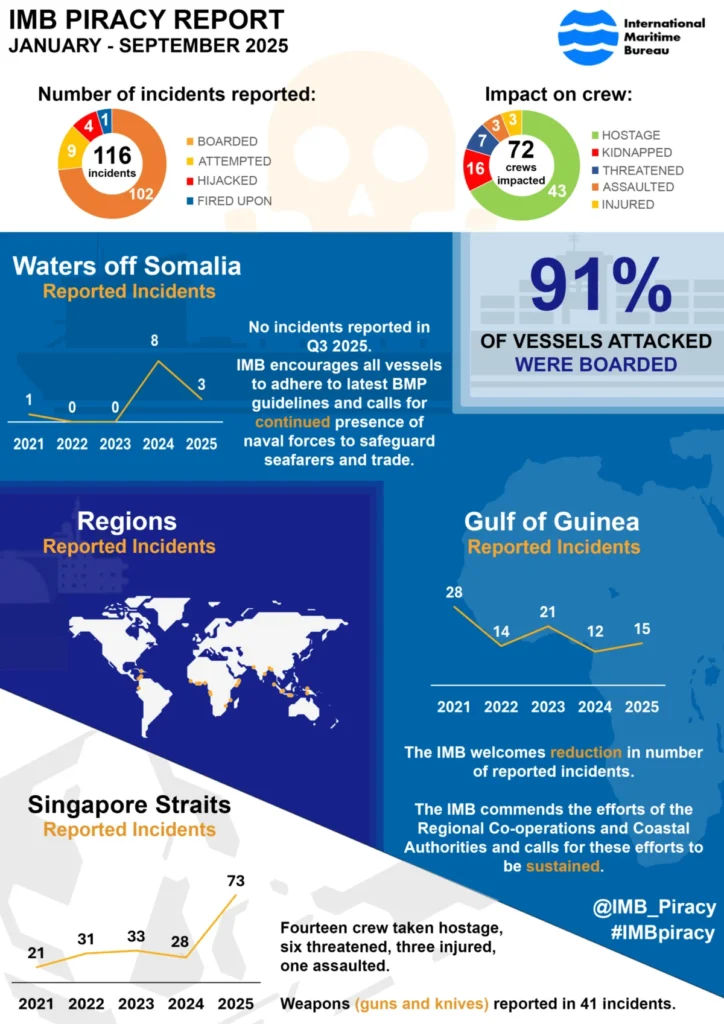
Introduction: The Invisible Shield of Global Trade
The global economy is underpinned by a vast, invisible network of maritime trade routes. More than 80% of the world’s goods travel by sea, traversing oceans that, while essential for commerce, remain fraught with age-old dangers. Among these, piracy and armed robbery against ships stand as persistent threats to the lives of seafarers and the stability of global supply chains. Since 1991, the International Chamber of Commerce (ICC) International Maritime Bureau (IMB) Piracy Reporting Centre (PRC) has stood as the primary sentry against this scourge. Operating as a 24-hour, 365-day global hub, the PRC serves as the critical bridge between ships in distress and the international authorities tasked with their protection.
In an era of increasing geopolitical instability and technological advancement, the role of the IMB PRC has evolved from a simple reporting office into a sophisticated intelligence-gathering and crisis-coordination nerve center. This article examines the vital function of the IMB PRC, the historical context of its operations, and why its data-driven approach remains the most potent tool in the fight for maritime security.
The Main Facts: Defining the IMB Piracy Reporting Centre
The IMB Piracy Reporting Centre is not merely a monitoring station; it is a tactical response unit designed to mitigate risk in real-time. Based in London, the PRC operates as a single point of contact for shipmasters, owners, and operators worldwide. When a vessel falls victim to—or encounters suspicious activity related to—piracy or armed robbery, the PRC acts as the immediate intermediary.
The Centre’s mandate is threefold:
- Immediate Response: Upon receiving a distress signal, the PRC coordinates with local and regional law enforcement and naval response agencies to facilitate rapid intervention.
- Information Dissemination: The Centre issues immediate warning broadcasts and email alerts to vessels navigating in or near high-risk zones, allowing captains to adjust routes or heighten security measures before an incident occurs.
- Data Synthesis: By documenting every reported incident, the IMB creates a longitudinal database that identifies patterns, emerging hotspots, and shifts in criminal methodology. This data is the foundation upon which governments and international bodies formulate maritime security policy.
Chronology: Three Decades of Combating Maritime Crime
The establishment of the IMB Piracy Reporting Centre in 1991 was a watershed moment for maritime security. In the early 1990s, the international community was beginning to realize that the end of the Cold War had shifted the nature of threats at sea. Piracy was becoming more organized, increasingly violent, and less confined to local waters.
1991–2000: The Foundation
When the PRC was launched, its primary challenge was the lack of reliable data. Piracy was notoriously underreported, often due to the perceived bureaucratic burden on shipmasters or fears of increased insurance premiums. The PRC worked tirelessly to build trust with the shipping industry, emphasizing that transparency was the only path toward securing governmental support.
2001–2015: The Rise of Global Hotspots
The turn of the millennium saw the emergence of the Somali piracy crisis, which threatened to strangle trade through the Suez Canal. During this period, the IMB PRC became the primary source of intelligence for the international navies that eventually formed coalitions to patrol the Gulf of Aden. The PRC’s role shifted toward high-level coordination, acting as the eyes and ears for task forces that were often operating in the dark.
2016–2025: The Digital and Asymmetric Era
Today, the PRC faces a complex landscape. While high-seas hijackings have fluctuated, "armed robbery" in territorial waters has become a persistent nuisance. Moreover, the integration of satellite tracking and digital reporting has allowed the PRC to provide a near-real-time picture of maritime security, enabling vessels to navigate through "low-profile" risks before they escalate into full-scale attacks. The release of the January to September 2025 Piracy and Armed Robbery Against Ships report marks the latest chapter in this ongoing struggle, highlighting that while the nature of the threat changes, the need for constant vigilance remains paramount.
Supporting Data: The Value of Intelligence
Data is the currency of the IMB Piracy Reporting Centre. Without accurate, granular, and timely data, authorities cannot allocate resources efficiently. The IMB’s reports are widely regarded as the "gold standard" for maritime security assessments, used by insurance companies, shipping conglomerates, and naval command centers alike.
Key Metrics and Analysis
The 2025 report serves as a diagnostic tool for the industry. By analyzing variables such as the time of day, the proximity to the coast, the type of vessel targeted, and the weapons used, the PRC identifies "risk profiles." For example, the data often reveals that a surge in incidents in a specific strait correlates with seasonal shifts or economic instability in coastal communities.
The IMB encourages all stakeholders to contribute to this data set. Reporting an incident is not a bureaucratic hurdle; it is a critical step in a chain of events that leads to naval patrols, drone surveillance, and diplomatic pressure on regional governments to clean up their territorial waters. Owners who fail to report incidents are, in effect, starving the international community of the intelligence needed to protect the next ship in line.
Official Responses: The Voice of Leadership
Michael Howlett, Director of the ICC International Maritime Bureau, has consistently advocated for a collaborative, multi-stakeholder approach to maritime security. In his view, the fight against piracy is not solely the responsibility of the shipping industry or the local coast guard, but a shared global obligation.
"The work of the PRC is about more than just numbers," Howlett has noted in various forums. "It is about the safety of the men and women who keep our global economy moving. When a shipmaster reports an incident to us, they aren’t just filing a form; they are sounding an alarm that helps protect the next vessel passing through those waters."
The ICC’s position is clear: Transparency is the ultimate deterrent. When pirates and armed robbers realize that their activities are being tracked, mapped, and broadcast to the world, the cost-benefit analysis of their criminal enterprises changes. Official responses from international maritime organizations, such as the International Maritime Organization (IMO), often cite the IMB’s data as the primary justification for new security regulations and regional cooperation agreements.
Implications: The Future of Maritime Security
The implications of the IMB Piracy Reporting Centre’s work extend far beyond the immediate protection of ships.
Economic Stability
Piracy is an "invisible tax" on global trade. When ships are forced to divert, carry armed guards, or pay higher insurance premiums, the cost of the goods they carry—from fuel to food—rises. By reducing the frequency and impact of attacks, the IMB PRC effectively helps keep consumer prices stable.
Legal and Policy Development
The data provided by the PRC is instrumental in shaping international maritime law. It provides the evidence base required for the United Nations to pass resolutions, for regional blocs to sign anti-piracy treaties, and for individual nations to justify the deployment of their naval assets.
The Human Element
Perhaps most importantly, the PRC represents the human dimension of shipping. The psychological toll on crews who have faced armed robbery or been held hostage is immense. By providing 24/7 support and ensuring that their experiences are documented and addressed, the PRC acknowledges the dignity and rights of seafarers.
Conclusion: A Call to Action
The January to September 2025 report is a stark reminder that the seas are not self-policing. While technological progress has made ships safer, human ingenuity for criminal enterprise has kept pace. The IMB Piracy Reporting Centre remains the cornerstone of the maritime community’s defense.
For shipmasters, owners, and operators, the instruction remains simple but vital: Report every incident. Whether it is a full-scale boarding or a suspicious approach, the data you provide is the fuel that powers the international response. By contributing to the IMB’s global intelligence, you are not just protecting your own vessel; you are contributing to a safer, more stable maritime environment for everyone.
To learn more about the current state of maritime safety and to access the latest findings, industry stakeholders are encouraged to download the January to September 2025 Piracy and Armed Robbery Against Ships report at the ICC-CCS website.
For further inquiries or to report an incident, please contact:
Michael Howlett
Director, ICC International Maritime Bureau
Tel: +44 207 423 6960
Email: [email protected]
The safety of the high seas depends on the vigilance of those who sail them, and the coordination of those who watch over them. Through the work of the IMB Piracy Reporting Centre, that watch never ends.



