By Science Editorial Staff
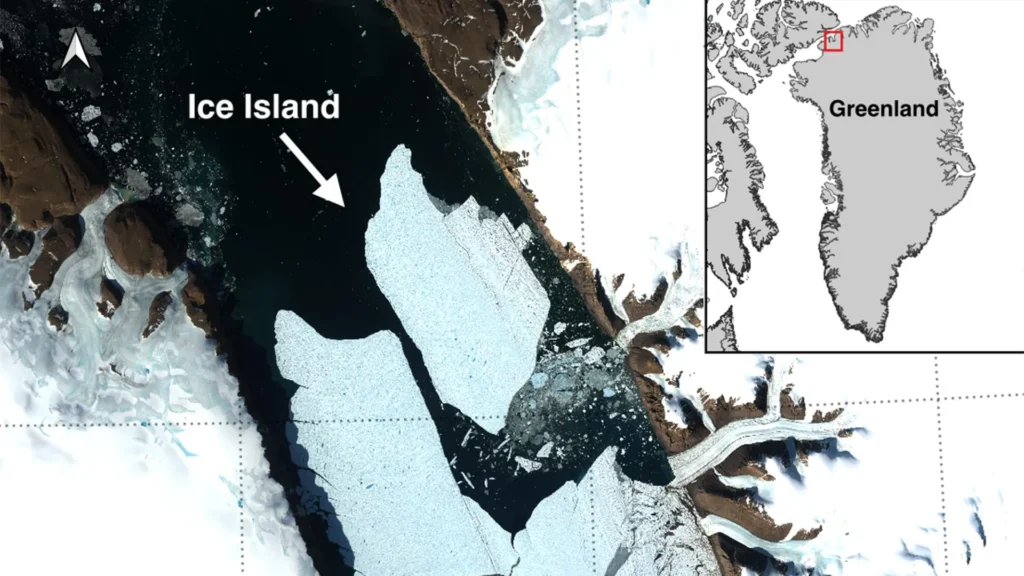
In a landmark event for Arctic glaciology, the Petermann Glacier in northwest Greenland has undergone a significant transformation. On August 4, 2026, the glacier’s floating ice tongue—one of the largest and most critical remaining in the Northern Hemisphere—shed a colossal tabular iceberg measuring 76.4 square kilometers. This event, confirmed by an international consortium of researchers led in part by the University of Ottawa, marks the most substantial loss of floating ice from Petermann since 2012 and the largest Arctic calving incident recorded since 2020.
The newly formed ice island, with a surface area roughly equivalent to that of Manhattan, is estimated to be up to 150 meters thick. Its breakaway represents not just a singular dramatic moment, but a climactic point in years of intensifying structural instability. As the massive slab begins its slow, hazardous drift through the Arctic waters, it offers scientists an unprecedented, albeit concerning, window into the rapidly evolving dynamics of the cryosphere.
The Chronology of a Collapse: From Rifts to Rupture
The detachment of this ice island was not an overnight occurrence; rather, it was the culmination of a multi-year degradation process meticulously tracked by the scientific community.
The Years of Growing Instability
Since 2019, the Petermann Glacier has been under constant surveillance by a coalition of institutions, including the University of Ottawa, the University of Stirling, Environment and Climate Change Canada (ECCC), Lancaster University, and the University of Leeds. Using long-term satellite observations, researchers monitored the "floating ice tongue"—a vast protrusion of glacial ice extending into the ocean—as it developed an intricate web of fractures.
Adam Garbo, a PhD student in glaciology at the University of Ottawa’s Department of Geography, Environment and Geomatics, served as the lead analyst who identified the final separation. "Petermann Glacier has long been one of Greenland’s largest remaining ice tongues," Garbo noted. "We have been anticipating this break for years, and seeing it finally come to fruition is both a remarkable scientific milestone and a sobering indicator of current climate trajectories."
The Final Hours
The terminal phase of the event began in early August 2026. Data from the European Space Agency’s (ESA) Sentinel-1 mission provided the high-resolution imagery necessary to observe the final structural failure. On August 3, clear evidence of deterioration appeared along the centerline of the ice tongue, signaling that the structural integrity of the ice was nearing a breaking point. By 20:00 UTC on August 4, the connection between the eastern side of the tongue and the main glacier had severed completely, liberating the 76.4 km² island into the open sea.
Supporting Data: Understanding the Scale of Loss
To understand the magnitude of this calving event, one must look at the physical dimensions and the broader context of Arctic ice shelf health. The 76.4 km² iceberg is a behemoth, yet researchers suggest this is only the beginning of a larger structural decline.
A Forecast of Future Fragmentation
Glaciologists are already looking toward the next stages of the Petermann Glacier’s retreat. Current satellite data indicates two additional massive sections of the floating ice tongue are under extreme tension. Rifts that have been expanding for several years are cutting through the remaining structure with increasing speed.
Projections suggest that two upcoming calving events could result in the loss of 94 km² and 84 km² respectively. Should these sections detach as predicted, the cumulative impact would be the removal of approximately 254 km² of ice from the Petermann tongue. This would represent a staggering 22 percent reduction in the total surface area of the ice tongue in a single short-term cycle.
Comparative Glaciology: Arctic vs. Antarctic
While massive tabular icebergs are a relatively common occurrence in the Southern Ocean surrounding Antarctica, they are significantly rarer in the Arctic. The rarity of these events provides a unique scientific opportunity.
Dr. Anna Crawford of the University of Stirling, a key collaborator in the study, explains the importance of this distinction: "While large, tabular icebergs are characteristic of the Antarctic Ice Sheet, they are far less common in the North. By studying the lifecycle, movement, and eventual fragmentation of this specific Arctic ice island, we gain data that is globally significant. The knowledge we extract here can be transferred across polar regions, helping us refine our models for how ice shelves respond to warming ocean temperatures."
Implications: Hazards, Shipping, and Global Climate
Beyond the scientific interest, the presence of such a massive, drifting ice structure presents tangible challenges for modern Arctic navigation and resource management.
Risks to Marine Safety and Infrastructure
As the ice island drifts, it will undergo a process of slow attrition. Massive blocks of this caliber can remain intact for years, but as they collide with ocean currents and warmer waters, they inevitably break into smaller, more erratic sections. These smaller icebergs, often referred to as "growlers" or "bergy bits," are notoriously difficult to track via standard radar, creating significant hazards for vessels and offshore infrastructure.
Dr. Abigail Dalton of the Canadian Ice Service at Environment and Climate Change Canada emphasized the urgency of monitoring these movements. "These are thick, dense blocks of ice that possess incredible momentum," Dr. Dalton stated. "As they fracture over time, they become harder to monitor. This poses a direct risk to commercial shipping lanes, research vessels, and any offshore resource operations that might be active in the region."
Monitoring the Drift
Environment and Climate Change Canada has mobilized resources to track the ice island’s trajectory, utilizing a combination of satellite imagery and aerial reconnaissance. This effort mirrors protocols established during previous Arctic calving events. The data gathered from this monitoring serves a dual purpose: protecting human activity in the region and deepening our understanding of how these massive ice structures influence ocean circulation patterns as they melt.
Official Responses and the Future of Research
The collaboration between the University of Ottawa and its international partners represents a concerted effort to synthesize "big data" from space with ground-level environmental monitoring. The project is part of a wider, global investigation into the mechanisms driving the retreat of Arctic ice shelves.
The Human Element in Glaciology
For researchers like Adam Garbo, the event is a career-defining moment that underscores the necessity of continuous, long-term monitoring. "Our plan moving forward is to continue tracking the aftermath," Garbo explained. "We are synthesizing satellite imagery, aerial observations, and buoy tracking data to build a complete narrative of this event."
This work is essential for policy makers and climate scientists alike. By documenting the exact processes of the Petermann calving, the team is providing the raw data needed to refine global climate models, which currently struggle to predict the exact speed at which Arctic ice shelves will diminish.
A Call for Continued Vigilance
The 2026 Petermann event is not merely an isolated geographic curiosity; it is a sentinel event for the Arctic. As global temperatures continue to rise, the stability of Greenland’s remaining ice tongues is increasingly precarious.
The international team remains committed to the ongoing study of the region, emphasizing that while the calving event itself is complete, the scientific process is ongoing. Through this collaborative effort, the scientific community hopes to provide the world with a clearer, more accurate picture of the Arctic’s future—a future that is increasingly defined by the loss of the ice that has historically anchored the polar landscape.
As the 76.4 km² ice island continues its silent, cold journey into the North Atlantic, it carries with it the data that will define the next decade of climate science. For the residents of the Arctic, for the shipping industries navigating these waters, and for the global community concerned with the pace of environmental change, the Petermann Glacier remains a focal point of intense, critical, and necessary observation.