Introduction: Correcting a Systemic Disparity
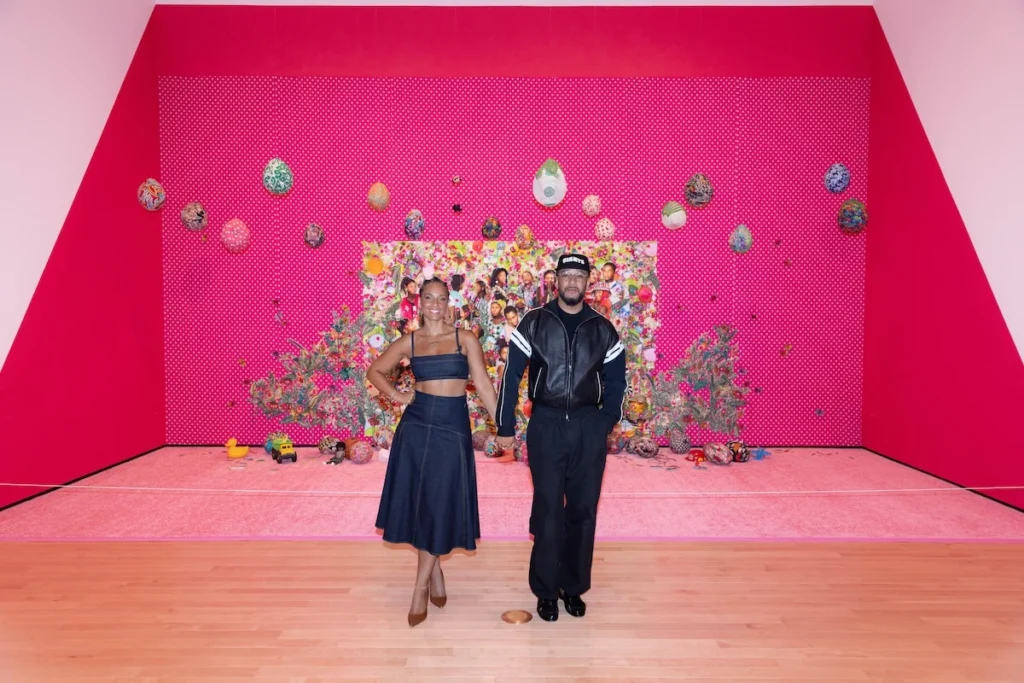
In May 2018, a seismic shift occurred in the contemporary art world when Kerry James Marshall’s monumental 1997 painting, Past Times, was hammered down at Sotheby’s for a staggering $21 million. The sale set a record for a living African American artist, a milestone celebrated by critics and historians alike as a long-overdue recognition of Marshall’s genius. However, amidst the champagne toasts and headlines, two prominent collectors—Kasseem "Swizz Beatz" Dean and Alicia Keys—observed a glaring injustice: despite the massive appreciation in the work’s value, the artist himself did not receive a single cent from the secondary market transaction.
“We thought being a part of a milestone like that would be so advantageous to the artist who created the work,” the Deans shared in a statement. “But it wasn’t.”
This realization sparked a seven-year quest to reform the financial architecture of the American art market. Today, that journey culminates in the formal announcement of "The Deans’ Choice with Bonhams." This initiative, a first-of-its-kind partnership between a major international auction house and private collectors, introduces a voluntary resale royalty system for living artists in the United States. By bridging the gap between the primary and secondary markets, the program seeks to ensure that creators finally share in the "fruits of their labor" as their works escalate in value over time.
Main Facts: How "The Deans’ Choice" Operates
The core of "The Deans’ Choice" is what Bonhams describes as an "elective sale royalty." While mandatory resale royalties (often called droit de suite) are common in Europe and dozens of other nations, they have remained legally elusive in the United States. This program bypasses legislative gridlock by creating a contractual mechanism for wealth redistribution within the auction process.
The Mechanism of the Royalty
The program is designed as a collaborative contribution between the seller (consignor) and the auction house. It operates on a matching principle:
- Consignor Contribution: When a collector chooses to sell a work by a living artist through Bonhams, they can opt to commit a percentage of the hammer price to the artist. The minimum opt-in amount is 1 percent of the hammer price or $500, whichever is greater.
- Bonhams’ Match: In a show of corporate responsibility, Bonhams commits to matching the consignor’s chosen percentage. This match is calculated based on the buyer’s premium—the additional fee paid by the purchaser on top of the hammer price.
- The Payout: The combined funds are then distributed directly to the artist, providing them with a liquidity event that has traditionally been reserved solely for collectors and dealers.
Participation and Eligibility
The program officially launches in November 2024, coinciding with Bonhams’ high-profile 20th- and 21st-century art auctions in the United States. To participate, living artists must proactively opt-in via a dedicated landing page on the Bonhams website. This "opt-in" requirement ensures that artists are aware of the secondary market movement of their work and establishes a direct line of communication between the creator and the auction house.
Chronology: A Seven-Year Journey to Reform
The path from the 2018 Sotheby’s sale to the 2024 launch was marked by the Deans’ persistence in finding a partner willing to challenge the status quo.
- May 2018: The sale of Kerry James Marshall’s Past Times for $21 million serves as the catalyst. The Deans begin discussing the need for a "royalty" system for visual artists, similar to the one they navigate in the music industry.
- 2018–2023: The Deans approach various stakeholders in the art world. The challenge is significant: auction houses are traditionally wary of any mechanism that might decrease a consignor’s net profit or add administrative complexity.
- Late 2023: A breakthrough occurs when the Deans find a "like-minded collaborator" in Bonhams. CEO Seth Johnson recognizes the ethical and brand value of the initiative and tasks his U.S. team with the logistical implementation.
- Early 2024: The project moves into a rigorous legal and operational phase. Spearheaded by Bonhams’ General Counsel Patricia Pernes, the team navigates the complexities of tax law, contractual obligations, and financial disbursements across different jurisdictions.
- May 2024: A "soft" proof of concept is observed during the sale of Jadé Fadojutimi’s Ribbon of Thought, providing a data point for how the royalties would be calculated in a real-world scenario.
- November 2024: The program formally launches for the autumn auction season.
Supporting Data: The Financial Impact
To understand the tangible benefits of "The Deans’ Choice," one must look at the numbers. The art market has long been criticized for its opacity, but the math behind this initiative is transparent.
The Case of Jadé Fadojutimi
Bonhams points to the recent sale of 33-year-old Jadé Fadojutimi’s Ribbon of Thought (2020) as a prime example. The painting sold in May 2024 for a hammer price of $220,000. With the buyer’s premium and fees, the total price was $279,900.
Under the new program, if the consignor had opted into a 5 percent royalty rate:
- From the Consignor: $11,000 (5% of the $220,000 hammer price).
- From Bonhams: $2,995 (5% of the $59,900 buyer’s premium).
- Total to the Artist: $13,995.
While $14,000 may seem modest compared to a $220,000 sale, for a young artist, such "passive" income from work sold years ago can fund studio space, health insurance, or the production of new, ambitious projects. In the case of the $21 million Kerry James Marshall sale, a 5% royalty would have resulted in a million-dollar payout—a life-changing sum even for an established master.
The Global Context
The United States is currently an outlier in the global art market. Over 80 countries have enacted national resale royalty laws. Under the Berne Convention for the Protection of Literary and Artistic Works, many European countries mandate royalties for the lifetime of the artist plus 70 years. In the EU, these royalties are typically capped (often at €12,500), but they ensure that artists are not entirely decoupled from the financial success of their work. The Bonhams initiative represents a private-sector attempt to bring the U.S. in line with these international standards.
Official Responses: Industry Leaders Weigh In
The reaction to "The Deans’ Choice" has been a mix of celebration and a call for even deeper reform.
The Visionaries: Swizz Beatz and Alicia Keys
For the Deans, the initiative is about more than money; it is about the fundamental definition of a "creative work."
“In music, when we write a song, we receive royalties for the song,” they noted. “It lasts our whole life, and it’s even something we can leave to our children. Music and art are brother and sister, so why are the rules different when it comes to ongoing compensation in the art space?”
The Corporate Perspective: Seth Johnson, CEO of Bonhams
Seth Johnson has positioned Bonhams as a pioneer in corporate responsibility within the auction sector. “There should be a mechanism whereby an artist can participate in the fruits of their labor during their lifetime,” Johnson stated. His commitment involved mobilizing the legal and financial departments to ensure the program was robust enough to withstand the scrutiny of the highly regulated auction industry.
The Artist’s Voice: Allison Zuckerman
Artist Allison Zuckerman, who has been an outspoken advocate for artist rights after seeing her own works circulate rapidly in the secondary market, praised the move. “It begins to establish an important new norm,” Zuckerman said. She highlighted that the program recognizes the “enduring connection” artists have to their creations, even after they have left the studio.
The Skeptical Optimist: Artists Rights Society (ARS)
Theodore Feder, founder and president of ARS, which represents over 200,000 visual artists, offered a more nuanced view. While he congratulated Bonhams for taking a “vital first step,” he noted that the voluntary nature of the program is a limitation. “As proposed, the resale royalty only applies if the seller gives his or her consent thereto,” Feder wrote. “It should apply to all eligible work and should not be restricted to the lifetime of the artist.”
Implications: A Catalyst for Legislative and Cultural Change
The launch of "The Deans’ Choice" arrives at a critical moment for American art law. For years, lawmakers have attempted to pass the American Royalties Too (ART) Act. Most recently updated in 2025 as H.R.4017 by Representative Jerrold Nadler of New York, the bill seeks to mandate a 5 percent royalty on secondary market sales over $5,000, capped at $50,000.
Breaking the Lobbying Deadlock
Historically, major auction houses have been among the most vocal opponents of the ART Act, arguing that it would drive the art market away from New York and toward less regulated jurisdictions. By voluntarily implementing a royalty system, Bonhams has effectively dismantled the argument that such a system is administratively impossible or commercially ruinous. If Bonhams can maintain its market share while offering these royalties, it puts immense pressure on rivals like Christie’s and Sotheby’s to follow suit.
Shifting Consignor Psychology
Perhaps the most significant implication is the shift in collector behavior. "The Deans’ Choice" appeals to a new generation of "conscious collectors" who view their acquisitions as a partnership with the artist rather than a mere commodity. By making the royalty elective, Bonhams is betting that many collectors will choose to participate to bolster their reputations as patrons of the arts, potentially gaining favor with artists and primary-market galleries who are often protective of where their works are placed.
Conclusion: A New Industry Standard?
As the first auctions featuring "The Deans’ Choice" approach this November, the art world will be watching closely. The success of the program will be measured not just in the dollars distributed to artists, but in whether it triggers a domino effect across the industry.
For Kasseem Dean and Alicia Keys, the goal remains clear: a future where the visual arts operate with the same fairness as the music industry. As they concluded in their statement to ARTnews: “We’re hoping living artists getting compensated from resale becomes the industry norm.” With Bonhams taking the first leap, that norm may finally be within reach.