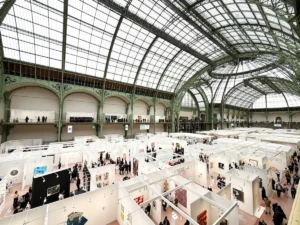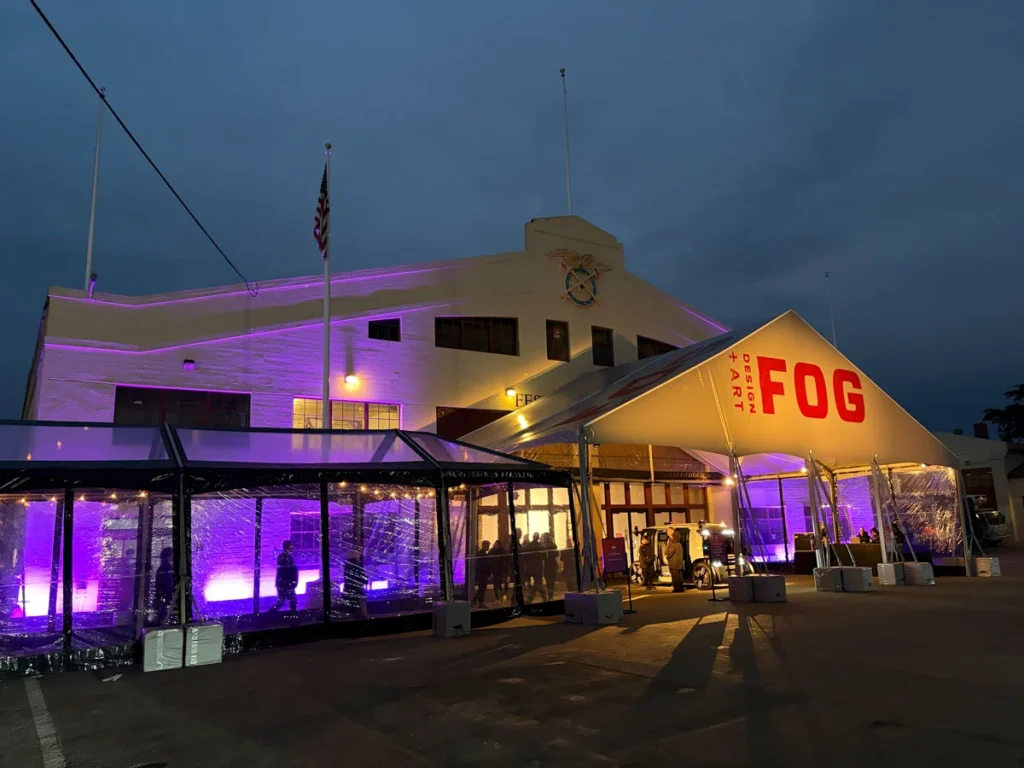
The FOG Design+Art fair, San Francisco’s premier intersection of contemporary art and modern design, has officially announced its exhibitor lineup for the 2027 edition. Set to take place from January 21–24 at the historic Fort Mason Center for the Arts & Culture, the upcoming fair represents a significant milestone in the event’s history. With a roster of 76 exhibitors—a 20 percent increase from the previous year—the fair is positioning itself as a central pillar in the narrative of San Francisco’s cultural and economic recovery.
The 2027 edition arrives at a critical juncture for the Bay Area. While the city has faced headlines regarding retail vacancies and a shifting corporate landscape, the art market appears to be moving in the opposite direction. The expansion of FOG, spearheaded by Director Sydney Blumenkranz, serves as a robust rebuttal to the "doom loop" narrative, suggesting that the appetite for high-caliber art and design among the region’s affluent population is not only stable but growing.
Main Facts: A Fair Reaching New Heights
The 2027 iteration of FOG Design+Art will be the largest to date. By increasing the exhibitor count to 76, the fair has necessitated a comprehensive revision of its physical layout within Fort Mason’s piers. This growth is driven by a staggering 30 percent increase in applications from galleries worldwide, following a 20 percent increase the year prior.
Key Dates and Venue
- Preview Gala: Wednesday, January 20, 2027 (Benefiting the San Francisco Museum of Modern Art).
- Public Fair Dates: January 21–24, 2027.
- Location: Fort Mason Center for the Arts & Culture (Piers 2 and 3), San Francisco.
Exhibitor Composition
The fair continues its tradition of blending "blue-chip" international powerhouses with cutting-edge local galleries. Notable returning heavyweights include David Zwirner, Lisson Gallery, Marian Goodman Gallery, Mendes Wood DM, and Hauser & Wirth. Notably, Hauser & Wirth remains the only "mega-gallery" with a permanent physical footprint in the Bay Area (located in Palo Alto), reinforcing its commitment to the regional collector base.
The 2027 edition also marks the return of several prestigious galleries that had taken brief or extended hiatuses. White Cube, Sprüth Magers, and Tanya Bonakdar Gallery are returning after several years away, while Michael Rosenfeld Gallery, Commonwealth and Council, and Chris Sharp Gallery return after skipping the 2026 edition.
Fifteen galleries will make their FOG debut in 2027, including Thomas Dane Gallery, VeneKlasen, P.P.O.W, Matthew Brown, and Mariposa. This influx of new blood indicates that the fair is successfully attracting diverse perspectives, ranging from established London-based dealers to emerging Los Angeles spaces.
Chronology: From Resilience to Resurgence (2025–2027)
The path to the 2027 expansion began in the post-pandemic years, a period during which San Francisco’s reputation underwent intense scrutiny.
2025: The Inflection Point
In late 2025, the local art scene felt a tremor as two mainstay galleries—Altman Siegel and Rena Bransten—announced their closures. These departures raised concerns about the sustainability of a traditional gallery model in a city with soaring real estate costs and a tech-heavy economy. Simultaneously, the California College of the Arts (CCA) announced it would close its historic campus by 2027, eventually selling the site to Vanderbilt University.
2026: The Momentum Shifts
Despite the closure of local brick-and-mortar spaces, the 2026 edition of FOG Design+Art proved to be a resounding success. Director Sydney Blumenkranz noted "super-high energy" and strong sales, with multiple works crossing the six-figure threshold. This success catalyzed a 30 percent surge in applications for the 2027 fair, as international dealers recognized that while the local gallery scene was shifting, the buying power of the local audience remained unmatched.
2027: The Planned Expansion
To accommodate the unprecedented demand, the 2027 fair will expand into previously underutilized spaces. The FOG Focus pavilion, dedicated to younger galleries and curated presentations, will expand to the second floor of the pier for the first time. Additionally, the FOG Talks program—a cornerstone of the fair’s educational mission—will move from a makeshift space at the back of the pier to the Cowell Theater, a dedicated 437-seat venue. This move effectively doubles the capacity for public programming.
Supporting Data: Quantifying Growth and Market Depth
The 20 percent increase in fair size is supported by several key metrics provided by fair leadership:
- Exhibitor Volume: 76 exhibitors in 2027 vs. 63 in 2026.
- Application Growth: A cumulative 50 percent increase in gallery applications over a two-year period (20 percent in 2025, 30 percent in 2026).
- Physical Footprint: Seven additional booths added to the historic pier and the activation of the second-floor Focus pavilion.
- Philanthropic Impact: The Preview Gala remains a primary fundraiser for SFMOMA, consistently drawing the city’s elite. The 2027 gala will be chaired by high-profile figures: Instagram co-founder Mike Krieger and his wife Kaitlyn, alongside NFL legend Joe Montana and his wife Jennifer.
The demographic data of collectors is also shifting. Blumenkranz highlights a "new swath" of emerging collectors, primarily from the tech sector, who are beginning to transition from casual interest to serious acquisition. This "new generation" is supplementing the established "Old Guard" of San Francisco collectors who have traditionally supported institutions like SFMOMA and the Fine Arts Museums of San Francisco.
Official Responses: Leadership and Vision
Sydney Blumenkranz, the Director of FOG, has been vocal about the fair’s responsibility to the city. In an interview with ARTnews, she addressed the "down and out" narrative that has plagued San Francisco in recent years.
"I think the success of the fair last year has a lot to do with the resurgence of interest in San Francisco in general," Blumenkranz stated. "There has definitely been this narrative that San Francisco was a bit down and out in the past few years, but that narrative has really turned around."
Regarding the expansion, Blumenkranz framed it as a "duty" to the local arts community. "What we’re seeing in terms of exhibitor interest in FOG is absolutely huge… We felt like we had a real duty to FOG and to the arts community here to expand the fair."
She also addressed the perennial question of whether the tech industry’s "nouveau riche" can be converted into lifelong art patrons. Blumenkranz rebuffed historical claims that tech wealth is "allergic" to the art world. "I think San Francisco might be the only city in the world right now that can offer up an entirely new swath of collectors to these blue-chip galleries. There’s this entirely new group of emerging collectors who are interested in art, want to buy art, and have the capacity to. They are looking for ways to get involved in the art world, and the answer is FOG first and foremost."
Implications: A Gateway to a Global Stage
The expansion of FOG Design+Art 2027 carries profound implications for the local and global art markets.
The Bridge Between Local and Global
FOG’s strategy is built on a delicate balance: providing a platform for local galleries (such as Fraenkel Gallery, Jessica Silverman, and Berggruen Gallery) to stand alongside international titans like White Cube or Perrotin. For local galleries, FOG provides international visibility without the travel costs of Basel or London. For international galleries, FOG provides a "gateway" to the elusive Silicon Valley billionaire class.
Institutional Shifts
The fair’s growth contrasts sharply with the physical contraction of other local institutions. The sale of the CCA campus to Vanderbilt University—and its subsequent renaming after NVIDIA billionaire Jen-Hsun "Jensen" Huang following a $75 million gift—suggests a pivot toward tech-integrated education and research. As traditional art schools and galleries close or move, FOG is becoming the "temporary town square" for the arts in San Francisco, a concentrated four-day event that fills the void left by year-round closures.
Inclusivity and Accessibility
By moving the FOG Talks to the Cowell Theater, the fair is signaling a move toward greater inclusivity. Previously, high demand meant turning visitors away from popular panels. The increased capacity suggests that FOG is no longer just a marketplace for the 1 percent, but an educational hub for a broader public curious about the intersection of design, technology, and aesthetics.
The "FOG Effect"
If FOG 2027 meets its sales expectations, it could trigger a new wave of gallery openings in the city. Dealers who have been hesitant to commit to long-term leases in San Francisco may see the fair’s success as proof of concept. The presence of honorary chairs like Mike Krieger and Joe Montana further cements the fair’s status as a "must-attend" social and cultural event, blending the worlds of venture capital, professional sports, and high art.
As the city prepares for January 2027, the message from FOG is clear: San Francisco is not just back; it is evolving. The "fog" may be a permanent fixture of the city’s climate, but the future of its art market has rarely looked clearer.
Full Exhibitor List for FOG 2027
FOG Pavilion (Main Floor)
- AGO Projects (Mexico City)
- Andrew Kreps Gallery (New York)
- Anthony Meier (Mill Valley)
- Berggruen Gallery (San Francisco)
- Commonwealth and Council / Hoffman Donahue (Los Angeles; New York)
- Crèvecœur / GALERIE 1900-2000 (Paris)
- David Kordansky Gallery (Los Angeles, New York)
- David Zwirner (Global)
- Fair Warning (New York)
- Fraenkel Gallery (San Francisco)
- François Ghebaly (Los Angeles, New York)
- Galerie Chantal Crousel (Paris)
- Galerie Maria Wettergren (Paris)
- Gallery FUMI (London)
- Gallery Wendi Norris (San Francisco)
- Gladstone (New York, Brussels, Seoul)
- Hauser & Wirth (Global)
- Herald St (London, Bologna)
- Hosfelt Gallery (San Francisco)
- Hostler Burrows (New York, Los Angeles)
- Jessica Silverman (San Francisco)
- Karma (New York, Los Angeles)
- kurimanzutto (Mexico City, New York)
- LEBRETON (Monaco)
- Lehmann Maupin (New York, Seoul, London)
- Lisson (London, New York, Shanghai, Los Angeles)
- LUHRING AUGUSTINE / Thomas Dane Gallery (New York; London)
- Marc Selwyn Fine Art (Beverly Hills)
- Marian Goodman Gallery (New York)
- Mendes Wood DM (New York, São Paulo, Brussels, Paris)
- Michael Rosenfeld Gallery (New York)
- Moderne Gallery (Philadelphia)
- Nonaka Hill (Los Angeles, Kyoto)
- Norr Cohan (New York)
- OMR (Mexico City)
- Ortuzar (New York)
- Perrotin (Global)
- Salon 94 | S94D (New York)
- Sarah Myerscough Gallery (London)
- Sprüth Magers (Berlin, Los Angeles, New York, London)
- Taka Ishii Gallery (Tokyo, Kyoto)
- Tanya Bonakdar Gallery (New York)
- The Modern Institute (Glasgow)
- Tina Kim Gallery (New York, Seoul)
- VeneKlasen (New York, London)
- White Cube (New York)
- Xavier Hufkens (Brussels)
FOG Focus (Emerging/Curated)
- Anat Ebgi (Los Angeles, New York)
- ATLA (Los Angeles)
- Casemore Gallery (San Francisco)
- Catharine Clark Gallery (San Francisco)
- Charles Moffett (New York)
- Chris Sharp Gallery (Los Angeles)
- Crown Point Press (San Francisco)
- DEN Los Angeles (Los Angeles)
- Dominique Porter Gallery (Los Angeles)
- Haines (San Francisco)
- Johansson Projects (Oakland)
- LAMB (London)
- Mariposa (Los Angeles)
- Marta (Los Angeles)
- Matthew Brown (Los Angeles, New York)
- Megan Mulrooney (Los Angeles)
- Morgann Trumbull Projects (Palo Alto)
- Municipal Bonds (San Francisco)
- Night Gallery (Los Angeles)
- NINO MIER GALLERY (New York, Brussels)
- Parker Gallery (Los Angeles)
- Patrick Parrish Studio (Brooklyn)
- P.P.O.W (New York)
- Rebecca Camacho Presents (San Francisco)
- Yutaka Kikutake Gallery (Tokyo)