

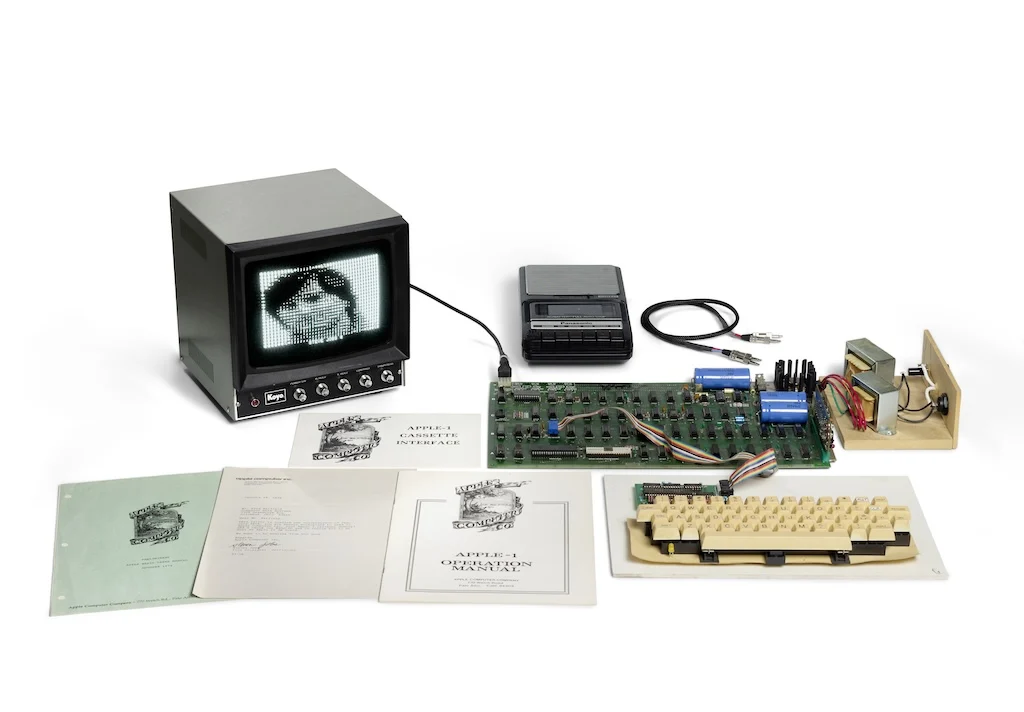
In the pantheon of industrial design and technological innovation, few artifacts carry the weight of the original Apple-1 computer. It is the physical manifestation of a shift in human history—the moment the computer transitioned from a room-sized monolith reserved for governments and corporations into a tool for the individual. This October, one of the most storied and well-preserved examples of this revolution, known as the "Hatfield" Apple-1, will be offered at auction by Bonhams in New York.
Expected to command a price between $500,000 and $800,000, the Hatfield Apple-1 is not merely a piece of hardware; it is a document of the early friction and eventual triumph of the Apple Computer Company. Signed by co-founder Steve Wozniak and accompanied by a rare 1978 letter from Steve Jobs, the machine represents a unique intersection of the two men’s distinct legacies: Wozniak’s engineering genius and Jobs’s relentless drive to push the industry forward.
Main Facts: The "Hatfield" Apple-1 and the Bonhams Sale
The upcoming auction, titled History of Science, Technology & Computing, is scheduled to run online from October 4 through October 14, 2024. While the sale features a wide array of historical scientific instruments and rare manuscripts, the Hatfield Apple-1 is undoubtedly the crown jewel of the event.
A Rare, Operational Specimen
Of the approximately 200 Apple-1 units originally produced in 1976, it is estimated that fewer than 75 survive today. Even rarer are those that remain in working condition. The Hatfield unit is listed as No. 48 on the official Apple-1 Registry, a database maintained by historians to track the provenance and condition of these machines. Its operational status significantly inflates its value, as many surviving units have succumbed to "bit rot" or physical degradation over the last five decades.
The Double Signature
What distinguishes this lot from other Apple-1s that have surfaced in recent years is the presence of signatures from both Apple co-founders. The motherboard itself bears the signature of Steve Wozniak, the man who single-handedly designed and hand-wired the original prototypes. Complementing this is a 1978 letter signed by Steve Jobs, addressed to the computer’s original owner, Fred Hatfield.
The Auction Context
The sale coincides with the 50th anniversary year of Apple’s founding (1976–2026), a period that has seen a surge in interest in early "Silicon Valley" collectibles. Alongside the Apple-1, Bonhams will offer several other significant pieces of hardware that trace the company’s evolution:
- An Apple Lisa 1: Estimated at $50,000–$80,000.
- An Apple Paladin Prototype: An unreleased all-in-one computer/fax/phone prototype, estimated at $40,000–$60,000.
- A Macintosh Portable Prototype: A rare clear-plastic version of Apple’s first "laptop," estimated at $10,000–$15,000.
Chronology: From a Palo Alto Garage to the Auction Block
To understand the significance of the Hatfield Apple-1, one must trace the timeline of its creation and the specific journey of unit No. 48.
1976: The Birth of a Revolution
In 1976, Steve Wozniak and Steve Jobs founded Apple in the garage of Jobs’s parents’ home in Los Altos, California. Wozniak had designed a circuit board that was significantly more advanced than the popular Altair 8800. While the Altair required users to toggle switches and read LED lights, Wozniak’s machine was designed to interface with a keyboard and a television screen.
The Apple-1 was sold as a bare motherboard. Users had to provide their own case, power supply, keyboard, and monitor. Despite this "hobbyist" approach, it was the first pre-assembled motherboard sold to the public, primarily through the Byte Shop in Mountain View, California, for the famously eccentric price of $666.66.
1977–1978: The Hatfield Acquisition and the Jobs Letter
Fred Hatfield, an employee at Computer Data Systems, was one of the early adopters who recognized the potential of Wozniak’s design. However, as the industry moved at a breakneck pace, the Apple-1 was quickly overshadowed by its successor, the Apple II, which featured a plastic case and color graphics.
By 1978, Hatfield found himself frustrated by the lack of software support for the original Apple-1. He wrote to Apple to express his concerns. In a response that has now become a central part of this auction lot, Steve Jobs personally wrote to Hatfield. In the letter, Jobs offered Hatfield a trade-in: Hatfield could return his Apple-1 and receive a credit toward the purchase of the new Apple II.
In a decision that would eventually net him or his estate hundreds of thousands of dollars, Hatfield declined the offer. He chose to keep the original machine, effectively preserving a piece of history that Jobs himself was eager to phase out.
The Modern Era: Authentication and Recognition
Years later, the machine was authenticated and added to the Apple-1 Registry. During a later meeting, Steve Wozniak signed the motherboard, cementing the unit’s status as a dual-authenticated relic of the company’s origins. The machine has since been meticulously maintained, ensuring that it remains a "living" piece of technology rather than a static museum piece.
Supporting Data: The Market for "Tech-Antiques"
The valuation of the Hatfield Apple-1 at $500,000 to $800,000 is based on a decade of escalating prices for early computing hardware. As the generation that grew up during the PC revolution reaches peak investment age, these machines have transitioned from "old junk" to "blue-chip assets."
Historical Auction Benchmarks
The market for Apple-1s has seen several high-profile sales over the last decade:
- 2014: An Apple-1 sold at Bonhams for a record-breaking $905,000, purchased by the Henry Ford Museum.
- 2016: The "Celebration" Apple-1, a rare pre-production board, sold for $815,000.
- 2020: A fully functional Apple-1 in its original box sold for $458,711.
- 2021: An Apple-1 housed in a rare Koa wood case fetched $500,000.
Rarity and Survival Rates
The high price point is driven by extreme scarcity. Unlike the Apple II, which was mass-produced in the millions, the Apple-1 was a boutique product. When Apple released the Apple II, they encouraged users to trade in their Apple-1s, many of which were subsequently destroyed by the company. This "culling" of the original stock makes surviving units like the Hatfield example incredibly rare.
Official Responses: Insights from the Experts
The significance of the sale has been highlighted by specialists at Bonhams, who view the Apple-1 not just as a computer, but as a milestone in human record-keeping and processing.
Ian Ehling, Bonhams’ Director of Fine Books & Manuscripts in North America, emphasized the emotional and historical weight of the Hatfield example. "The Apple-1 stands among the most important milestones in computing history," Ehling stated. "The ‘Hatfield’ example is among the most compelling surviving examples because of its provenance and the fact that it carries the story of the transition from the Apple-1 to the Apple II."
Collectors and historians often point out that the Apple-1 represents the last time a single individual (Wozniak) could design the entirety of a computer’s hardware and software. Today’s machines are the product of thousands of engineers; the Apple-1 is the product of a singular vision.
Implications: The Cultural Legacy of Apple
The auction of the Hatfield Apple-1 serves as a reminder of the cultural shift that Silicon Valley initiated in the late 1970s. The implications of this sale reach beyond the auction house and into the realms of history, investment, and technology.
The "Artification" of Technology
We are witnessing the "artification" of technology. Just as a Stradivarius violin or a Gutenberg Bible is valued for its role in cultural history, the Apple-1 is being treated as a foundational text of the digital age. Investors are increasingly diversifying their portfolios with "historical tech," viewing these items as more stable than volatile digital assets like cryptocurrency.
Apple’s 50-Year Legacy
As Apple approaches its 50th anniversary, the company has transformed from a two-man operation in a garage to a multi-trillion-dollar global entity. The Hatfield Apple-1 is a physical reminder of those humble beginnings. The 1978 letter from Jobs is particularly telling of his character; even then, he was focused on the future (the Apple II) and viewed the past (the Apple-1) as something to be traded in and moved beyond.
The Preservation of Digital Heritage
The sale also highlights the difficulty of preserving digital heritage. Unlike a painting, which requires only climate control, a computer requires functional components that are no longer manufactured. The fact that the Hatfield machine still works is a testament to the durability of Wozniak’s original design and the dedication of the collectors who have maintained it.
Conclusion
When the hammer falls at Bonhams this October, the price paid for the Hatfield Apple-1 will be a reflection of the world’s respect for the dawn of the information age. From Fred Hatfield’s refusal to trade in his "obsolete" machine to Steve Wozniak’s final signature on the board, every element of this lot tells a story of foresight, innovation, and the enduring power of the personal computer. It is a rare opportunity for a collector to own the very spark that ignited the modern world.



