

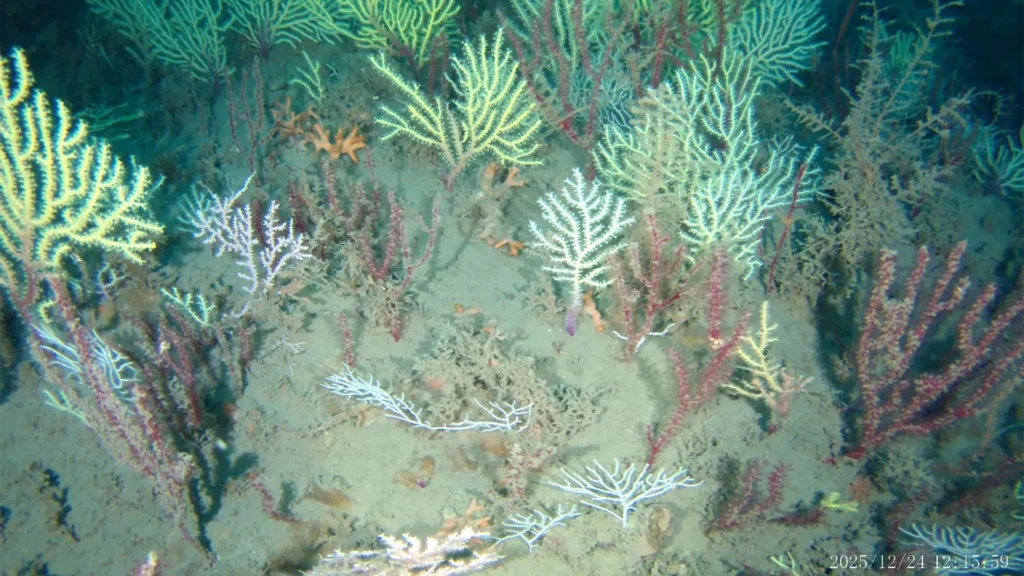
In a remarkable convergence of historical records and modern technological prowess, a team of marine scientists has confirmed the existence of a thriving coral ecosystem off the coast of Benin—a site that had been dismissed by the scientific community as a graveyard for over half a century.
What was once recorded in the 1960s as a collection of lifeless, deep-water structures has been revealed to be a vibrant, functioning "mesophotic" coral ecosystem. This discovery not only challenges our understanding of West African marine biodiversity but also highlights the vast, uncharted frontiers that remain hidden beneath the waves of the Gulf of Guinea.
The Chronology of a Lost Ecosystem
The story of this reef began in the mid-1960s, an era when marine exploration was focused primarily on identifying productive fishing grounds to support the region’s growing blue economy. During these initial surveys, researchers identified anomalous rocky structures at depths exceeding 50 meters. Given the limitations of the era’s sensing technology and the lack of biological sampling, the conclusion was swift and, as it turns out, incorrect: the structures were deemed "dead" coral reefs.
For over 60 years, that label stuck. The reef faded into the archives of oceanographic history, serving as a minor footnote in regional reports. It was not until the recent efforts of the Institut de Recherches Halieutiques et Océanologiques du Bénin (IRHOB) that the site was revisited.
Armed with high-resolution sonar and the Deep Sea Camera System—provided by the National Geographic Exploration Technology Lab—the modern team set out to verify the historical data. The campaign was far from simple. Lead researcher Gérard Zinzindohoué described the expedition as a grueling test of patience, marred by unpredictable technical challenges and the vast, daunting uncertainty of the open sea. However, as the sonar began to return signatures that mimicked the characteristics of a living reef, the team’s skepticism turned to cautious optimism. The deployment of an underwater drone and the camera system eventually provided the visual evidence that would rewrite the local marine history books.
Technical Methodology and Data Insights
The scientific rigor applied to this rediscovery involved a multi-staged survey process. The researchers scanned approximately 11.5 kilometers of the seafloor, focusing on coordinates derived from the 1960s archives. The sonar phase acted as the "scout," narrowing down 11.5 kilometers of potential habitat into two high-probability zones.
The Deep Sea Camera System, which functions with the precision of a terrestrial trail camera, was then deployed to these zones. Unlike shallow-water reefs that form singular, sprawling ramparts, this ecosystem is "mesophotic"—a term derived from the Greek for "middle light." These systems exist in the twilight zone of the ocean, where sunlight is scarce. Consequently, they do not grow in a uniform wall but rather in patchy, scattered communities across rocky seabed outcrops where the current and nutrient levels are optimal.
The visual data captured by the team was both surprising and rich. The cameras recorded:
- Coral Diversity: Eight distinct types of coral were identified, demonstrating a level of ecological complexity that suggests a long-term, stable environment rather than a recent colonization.
- Faunal Associations: The reef acts as a crucial refuge for at least eight species of fish, including golden African snappers, blackbar soldierfish, Guinean angelfish, West African goatfish, the Monrovia doctorfish, three-banded butterflyfish, and two specific species of damselfish.
This presence of fish is a key indicator of a "healthy" ecosystem, as these species rely on the reef for both shelter from predators and as a reliable feeding ground.
Official Perspectives and Scientific Caution
Gérard Zinzindohoué, the lead author of the study published in Frontiers in Marine Science, remains measured in his excitement. While the discovery is a landmark for the Gulf of Guinea, he emphasizes the importance of distinguishing between observation and confirmation.
"To our knowledge, this is the first confirmed record of a living mesophotic coral ecosystem on the Gulf of Guinea continental shelf," Zinzindohoué noted. "But we must be careful. We haven’t collected physical samples yet. Our identifications are based on visual footage, and while the imagery is high quality, physical collection and DNA sequencing are the next steps required to fully map the biodiversity of this site."
The researchers also addressed the "resurrection" narrative. There is currently no definitive way to determine if the corals were truly dead in the 1960s and subsequently recovered, or if the original researchers simply misread the sonar of that era. The lack of historical biological samples makes it impossible to know if the current coral community is the direct descendant of a reef that has been there for centuries or a more recent successional community that took hold on old, dead structures.
Implications for Global Marine Conservation
The rediscovery of the Benin reef has profound implications for how we approach marine conservation in West Africa. It serves as a stark reminder of the "blind spots" in our global ocean mapping.
1. Re-evaluating the "Forgotten" Sites
If one reef can be misidentified for 60 years, how many more exist along the West African coast? Zinzindohoué posits that this discovery is likely not an anomaly, but rather a reflection of how little we truly understand about the continental shelves of this region. "If we were able to find this reef again after 60 years," he asks, "how many others are still undocumented or simply forgotten?"
2. The 40-Kilometer Mystery
The historical records from the 1960s hinted at a potential coral barrier extending nearly 40 kilometers parallel to the coast. The current team only surveyed a fraction of this distance. If the entire 40-kilometer stretch were found to be part of a connected, functioning ecosystem, it would necessitate an immediate re-evaluation of the region’s environmental protection status. Such a structure would be a vital carbon sink, a nursery for commercial fish stocks, and a high-value site for biodiversity conservation.
3. The Need for Sustained Funding
The research team acknowledges that their current findings are only the "initial exploration." The ambition is to launch a full-scale scientific diving and sampling program, though this is contingent on securing future funding. As Zinzindohoué stated, "Every additional piece of information matters. For me, the most exciting part is about understanding the reef’s history, and what it can tell us about how the ocean in this region has changed over time."
Conclusion: An Archive Beneath the Waves
The rediscovery of the Benin coral reef is more than just a win for biodiversity; it is a lesson in humility. It demonstrates that the ocean remains a vast, complex archive of life that we have only just begun to read.
As the scientific community moves forward, the focus will shift from simple discovery to detailed analysis. Questions regarding the reef’s age, its resilience to climate change, and its role in the broader Atlantic ecosystem are now on the table. For the people of Benin and the international scientific community, the reef is no longer a ghost of the past—it is a living, breathing component of the future, waiting to tell the story of the ocean’s resilience. The challenge now lies in ensuring that these "forgotten" ecosystems are given the protection and study they deserve before they are lost to time, or human impact, once again.



