

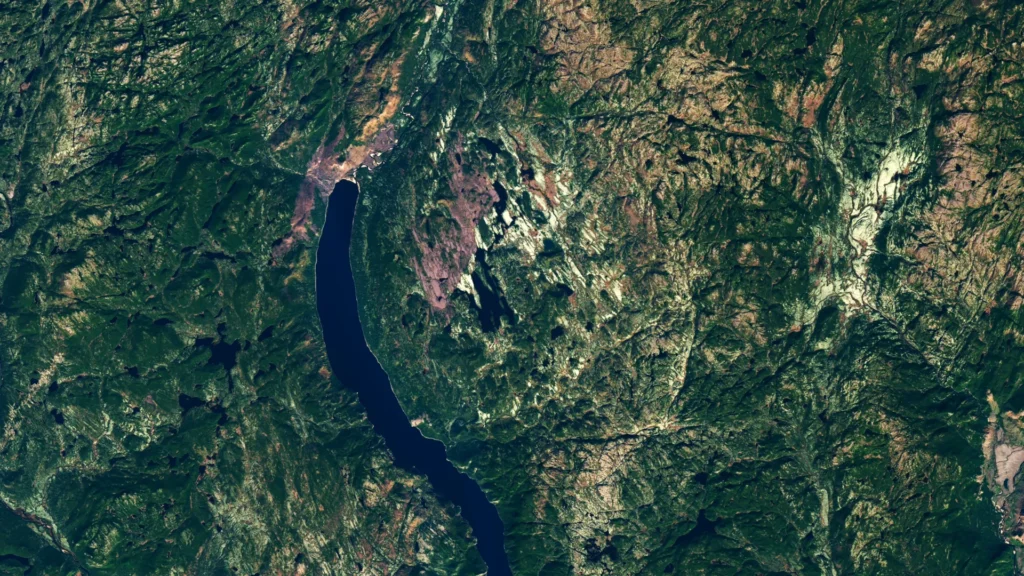
In the remote, rugged wilderness of Quebec’s Côte-Nord region, a geological titan has been hiding in plain sight for nearly 400 million years. What was once dismissed by geologists as a volcanic anomaly has now been reclassified as one of the most significant impact structures ever discovered on North American soil. The identification of the "Uhackatik" crater—a massive 25-kilometer (16-mile) scar on the Earth’s crust—represents a triumph of modern citizen science and a testament to the fact that, even in an age of advanced satellite imagery and AI, the human eye remains an unparalleled tool for discovery.
The Serendipity of Exploration: A Chronology of Discovery
The story of Uhackatik began not in a laboratory, but on a computer screen in 2024. Joël Lapointe, an amateur astronomer with a penchant for exploration, was meticulously combing through online satellite imagery while planning a camping trip to the isolated forests of Quebec. His goal was simple: to find a scenic and accessible location for a wilderness getaway.
However, as he navigated the topographical maps near Lake Marsal, a perfectly circular feature caught his attention. The geometry of the landscape was too precise to be a natural formation of standard glacial or tectonic origin. Recognizing that circular depressions in such environments are often the hallmarks of ancient asteroid impacts, Lapointe documented his findings. Instead of dismissing the observation as a quirk of cartography, he reached out to experts in both North America and Europe.
His inquiry acted as a catalyst. A team of French researchers, intrigued by the imagery, presented the data at the 2024 meeting of the Meteoritical Society, identifying the area as a potential candidate for an impact structure. This caught the attention of Gordon Osinski, a preeminent planetary geologist at Western University and the director of the Impact Earth database. While initially skeptical—geological formations are often misidentified as craters—Osinski recognized that the sheer scale of the feature warranted a closer look.
By October 2025, Osinski had organized an ambitious, high-stakes expedition into the heart of the Quebec wilderness to verify the site. What followed was a grueling test of endurance that solidified the crater’s place in the history of planetary science.
The Gauntlet of the Canadian Shield: A Logistical Challenge
Reaching the Uhackatik site proved to be an ordeal that rivaled the scientific difficulty of the task itself. The team traveled to the site via floatplane, but the rugged, untamed nature of the terrain forced the aircraft to land well away from the intended shore. The scientists were required to haul their specialized geological equipment through 50 meters (165 feet) of treacherous, knee-deep water before finally stepping onto the landscape.
Once ashore, the situation did not improve. The area was characterized by dense, "twisty, gnarly" vegetation and swampy ground that made every step a labor. Osinski, a veteran of fieldwork across six continents, noted that the region was among the most challenging environments he had ever navigated.
For years, previous geological surveys of the region had labeled the local breccia—a rock composed of broken fragments of minerals or rock cemented together—as evidence of a "diatreme," or a volcanic pipe. These structures are formed by the explosive escape of volcanic gases. However, by the second day of the expedition, the team’s findings began to dismantle that theory entirely.
The Smoking Gun: Shatter Cones and Geological Proof
The definitive evidence for the impact origin of the site arrived in the form of "shatter cones." These are rare, cone-shaped rock fractures that feature radiating, fan-like striations. They are created exclusively by the passage of a high-velocity shockwave through a rock mass—the kind of pressure generated only by the kinetic energy of a massive asteroid striking the Earth’s surface.
"It’s the only unequivocal evidence of an impact event that you can see in the field with the naked eye," Osinski explained.
Unlike the volcanic diatreme theory, which would have required specific magma activity that was nowhere to be found, the shatter cones confirmed that the bedrock had been subjected to the immense, instantaneous pressure of a cosmic collision. Further structural analysis revealed a central uplift—a common feature in complex craters where the earth rebounds after the initial compression—and high cliffs featuring columnar jointing.
The scale of this discovery is immense. A 25-kilometer-wide crater suggests a bolide of significant mass. Had this impact occurred in modern-day Quebec, the resulting explosion would have triggered regional devastation, obliterating major population centers and injecting enough debris into the atmosphere to cause global climate instability.
A Window into the Deep Past: The 390-Million-Year Timeline
Analysis of the rock samples suggests that the Uhackatik crater was formed approximately 390 million years ago, during the Devonian period. This era was a time of significant evolution on Earth, with terrestrial plants and forests beginning to flourish and early amphibians making their way onto land.
Interestingly, this date places the formation of the crater roughly 100 million years before a known, major spike in asteroid cratering that scientists believe may have been caused by a massive collision event within the asteroid belt. The discovery of Uhackatik provides a new data point in the ongoing effort to map the history of bombardment in our solar system.
In a move of cultural and historical significance, the research team consulted with the Innu Council of Ekuanitshit. Following these discussions, the site has been named Uhackatik. While the Meteoritical Society is expected to provide formal, bureaucratic recognition at their next meeting, the scientific community has already largely accepted the crater as a confirmed, monumental discovery—the largest such find since the 31-kilometer Hiawatha crater was identified in 2018.
Implications for Future Research and Training
The discovery has reignited discussions about how we study Earth’s impact history. Gordon Osinski, who also serves on NASA’s Artemis Geology Team, uses his expertise to train astronauts for upcoming lunar missions. While one might assume a site as significant as Uhackatik would become a training ground for future Moon-walkers, Osinski is pragmatic about its utility.
"The site is simply too remote," he noted. Compared to the more accessible Kameshtashtan (Mistastin Lake) crater in Labrador—which has already been used for astronaut training—Uhackatik remains a logistical nightmare for large-scale operations. However, its value lies in its pristine condition, offering a relatively untouched record of a prehistoric catastrophe.
The Power of the Amateur: A Call to Action
For Joël Lapointe, the journey from a curious camper to a contributor to planetary science has been profound. "I was ‘over the Moon’ when they confirmed it," he told CityNews. His message to the public is one of encouragement: "I encourage everyone to not ignore intuition or an observation, even if it isn’t part of your field of expertise."
The discovery of Uhackatik is a reminder that the era of the "citizen scientist" is not over; in fact, it is more vital than ever. As our digital archives of the Earth grow—via satellite, radar, and lidar—the sheer volume of data exceeds what any single research institute can process.
NASA and other space agencies have recognized this, launching various programs to harness the collective power of the public. The Daily Minor Planet project, for instance, invites volunteers to help identify asteroids and comets that may threaten our planet. The Impact Flash program encourages citizens to monitor the lunar surface for the telltale glimmers of meteorite strikes. Meanwhile, the Exoasteroids project pushes the frontier further, asking participants to look for the signatures of rocky debris in distant solar systems.
As we look toward the stars and study the craters beneath our feet, the case of Uhackatik stands as a beacon for the curious. Whether you are a student, a retiree, or simply a hiker with a keen eye for geometry, the next great discovery may be waiting just a few clicks away on a map. The Earth is a planet defined by its history of collisions, and thanks to the intersection of amateur intuition and professional rigor, we have added one more vital chapter to our understanding of the cosmic forces that shaped our world.



