

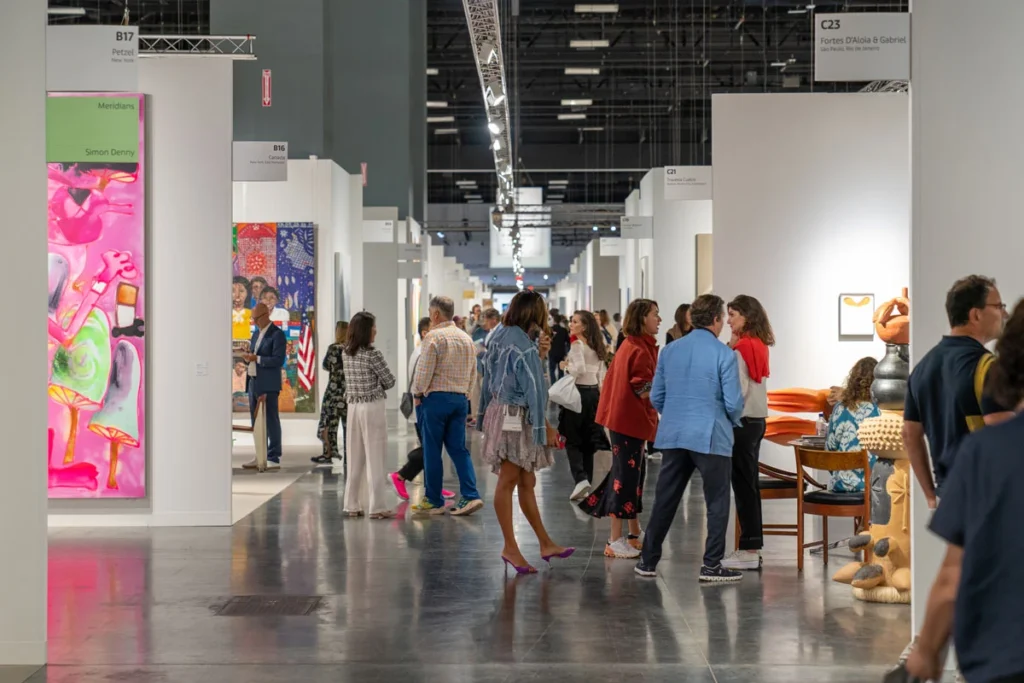
Art Basel Miami Beach (ABMB), the cornerstone of the North American art market, has officially announced the exhibitor list and a sweeping set of structural changes for its upcoming 2026 edition. Scheduled to take place from December 4 to December 6 at the Miami Beach Convention Center, with VIP preview days on December 2 and 3, the fair is signaling a pivot away from the "bigger is better" philosophy that has defined the last decade of mega-fairs.
Under the leadership of Director Bridget Finn, the 24th edition of Art Basel Miami Beach will feature 272 exhibitors—a notable reduction from previous years. The fair is introducing a completely revamped floor plan, a streamlined sector strategy, and the high-profile elimination of the "Meridians" section for large-scale works. These changes represent a calculated response to a shifting global art market and a desire to prioritize the "pacing" and "quality" of the visitor experience.
Main Facts: A Leaner, More Navigable Fair
The 2026 iteration of Art Basel Miami Beach is defined by a "less is more" approach. While the fair remains a massive undertaking, the statistics reveal a deliberate tightening of the reins.
Key Figures for 2026:
- Total Exhibitors: 272 galleries (down from 285 in the previous announcement cycle).
- Main "Galleries" Sector: 204 exhibitors (a 10% reduction from 226).
- Floor Space: A 12% reduction in the total footprint within the Miami Beach Convention Center.
- Structural Changes: The removal of the "Meridians" sector and the consolidation of the "Zero 10" initiative.
- Layout: A shift from five internal plazas to four enlarged, rotated plazas designed for better architectural alignment.
The reduction in the number of galleries is not a sign of waning interest; according to fair organizers, the selection committee—composed of seven prominent international dealers—vetted a high volume of applications. Instead, the move is described as a "refinement," intended to create a more "symmetrical and balanced" floor plan that prevents the "fair fatigue" often reported by high-net-worth collectors and casual visitors alike.
Chronology: The Evolution of the 24th Edition
The road to the 2026 fair has been paved by three years of internal evaluation since Bridget Finn took the helm. To understand the 2026 strategy, one must look at the progression of the fair’s recent history:
- The Post-Pandemic Boom (2021–2023): ABMB saw record attendance and a surge in exhibitor numbers as the market rebounded. However, feedback from galleries suggested that the sheer scale was becoming a hindrance to client-dealer connections.
- The Appointment of Bridget Finn (Three Years Ago): Finn joined with a mandate to modernize the fair. Her tenure has been defined by a "longstanding conversation" with the selection committee about streamlining the visitor journey.
- The 2025 Transition: Last year’s fair acted as a bridge, maintaining 285 galleries while beginning to test new digital and curated initiatives.
- The 2026 Pivot: The upcoming fair represents the full realization of Finn’s vision—a "sharp, tailored experience" that moves away from reactionary planning in favor of long-term structural health.
Supporting Data: Sector Breakdowns and Strategic Relocations
The data behind the 2026 exhibitor list reveals a significant reshuffling of power and presence on the show floor.
The Core Sectors
While the "Galleries" section (the fair’s main floor) has been slimmed down, the focused sectors remain the heartbeat of the fair’s discovery mission. These will now be clustered near the east entrance (closest to the beach and Washington Avenue) to ensure they are not overlooked:
- Nova: 20 galleries presenting works created within the last three years.
- Positions: 12 galleries featuring solo presentations by emerging artists.
- Survey: 18 galleries dedicated to historical art-marginalized narratives and 20th-century masters.
The "Blue-Chip" Redistribution
In a move reminiscent of recent changes at Frieze London, ABMB is decentralizing its most famous exhibitors. Traditionally, "mega-galleries" were clustered in specific high-traffic zones. In 2026, many are being relocated to "Plaza B" (the southeast corner) or "Plaza C" (the southwest corner) to force a more organic flow of traffic through mid-sized and emerging gallery aisles.
Confirmed Relocations to Plaza B:
- Hauser & Wirth
- David Zwirner
- Lisson Gallery
- Sprüth Magers
- David Kordansky
- Mendes Wood DM
Confirmed Relocations to Plaza C:
- 303 Gallery
- Casey Kaplan
- neugerriemschneider
- Lehmann Maupin
The Rise of Zero 10
Replacing the space previously held by Meridians, the "Zero 10" initiative will feature 22 projects curated by Karen Archey of Kunstsammlung Nordrhein-Westfalen. This section focuses on the intersection of art and technology, providing "breathing room" between the traditional booth-based fair and large-scale experimental installations.
Official Responses: A Vision of "Market Correction"
In an exclusive dialogue regarding the changes, ABMB Director Bridget Finn emphasized that the fair’s evolution is a proactive response to the global economy and the needs of the art ecosystem.
"The market correction over the last few years has caused some reactionary planning across the board," Finn told ARTnews. "We are not working that way. We are thinking in advance of what the need is and how to provide a better experience for galleries and their businesses."
Finn was quick to clarify that the reduction in exhibitors was a choice, not a necessity. "This reduction is more about refinement than contraction. We could have sold more booths if we wanted to. A long-running ambition of the committee is to streamline, reduce, and move forward."
Addressing the common complaint that clients often get "lost" in the sprawling convention center, Finn noted: "The worst thing you can hear is a dealer saying, ‘My client couldn’t find me.’ We’re trying to address that by reducing distractions and providing a very sharp, tailored experience."
Regarding the elimination of the "Meridians" section, Finn explained that the Miami Beach Convention Center’s unique single-floor layout allows for larger booth footprints than venues in Paris or Hong Kong. "We have space within the convention center for galleries to bring those kinds of [large-scale] works to their booth. It gives galleries the advantage to build it into the broader narrative of what they’re presenting without the client having to traverse the entire floor to see one piece."
Implications: What This Means for the Global Art Market
The restructuring of Art Basel Miami Beach carries several significant implications for the broader art world:
1. The "Frieze Effect" and Middle-Market Support
By moving blue-chip galleries to the "back" or "corners" of the fair, ABMB is acknowledging the "Frieze London" trend. This strategy is designed to boost the visibility of mid-career and emerging galleries. As Finn stated, these galleries are the "lifeblood" of the fair. If collectors must pass a mid-sized booth to reach David Zwirner, the likelihood of "impulse" discovery and sales for smaller galleries increases significantly.
2. Quality Over Quantity as a Survival Strategy
In an era of "fair fatigue," where collectors are invited to dozens of international events annually, ABMB is betting that a curated, easier-to-navigate experience will result in higher transaction volumes than a larger, more chaotic one. This "refinement" suggests that the prestige of being in Art Basel Miami Beach will increase as the number of available slots decreases.
3. The Re-Integration of Large-Scale Works
By folding large-scale works back into individual booths rather than a separate "Meridians" sector, the fair is encouraging galleries to curate more ambitious, museum-quality presentations within their own spaces. This could lead to more immersive booth designs that feel like cohesive exhibitions rather than "art malls."
4. Strengthening the Miami Cultural Identity
Beyond the convention center, the fair is deepening its roots in the local landscape. The unveiling of a new outdoor work by James Turrell and the Public Art Fund’s "Between Tides" ping-pong table installation in Collins Park suggest that ABMB is increasingly focused on the "experience" of being in Miami, rather than just the commerce inside the hall.
5. A Benchmark for Other Art Basel Editions
The success of this 12% reduction in floor space and the symmetrical four-plaza layout will likely be monitored by the directors of Art Basel’s other fairs in Hong Kong, Paris, and Basel. If the 2026 Miami edition sees a spike in satisfaction and sales, it could signal a permanent shift in how the world’s most important art fairs are designed.
As the art world looks toward December 2026, the industry will be watching to see if this "refined" version of Art Basel Miami Beach can maintain its status as the premier destination for the global elite while successfully fostering a more sustainable environment for the galleries that support it.



