

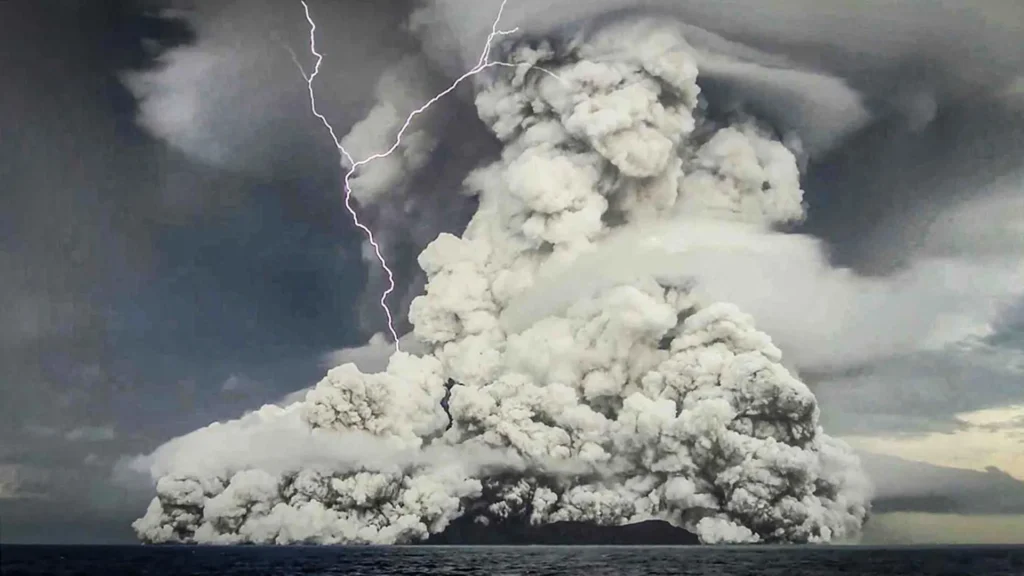
In January 2022, the Hunga Tonga-Hunga Ha’apai volcano in the South Pacific unleashed one of the most violent geological events of the modern era. The subaqueous eruption sent a shockwave around the globe and injected an unprecedented amount of water vapor and volcanic material into the stratosphere. While the immediate devastation was profound, scientists have now uncovered a startling, unintended consequence: the volcanic cloud functioned as a massive, high-altitude laboratory, actively destroying methane, a potent greenhouse gas, at a rate previously thought impossible in such extreme conditions.
This discovery, detailed in a new study published in Nature Communications, suggests that nature may possess self-cleansing mechanisms that scientists have largely overlooked. By observing the chemical "fingerprint" left behind by the plume, researchers have gained new insights into how atmospheric chemistry—specifically the interaction between sunlight, sea salt, and volcanic ash—can neutralize methane, offering a potential, albeit experimental, blueprint for future climate intervention strategies.
The Chemistry of the Plume: Unlocking the Mystery
The core of this discovery lies in the detection of formaldehyde within the volcanic plume. Under normal atmospheric conditions, formaldehyde is a fleeting, transient molecule, surviving for only a few hours before it breaks down. However, satellite imagery captured by the European Space Agency’s Sentinel-5P instrument showed record-high concentrations of formaldehyde persisting for ten days as the cloud drifted toward South America.
Because formaldehyde is a byproduct of the chemical reactions that break down methane, its prolonged presence served as a smoking gun. It indicated that methane was being systematically dismantled within the plume continuously for over a week.
"When we analyzed the satellite images, we were surprised to see a cloud with a record-high concentration of formaldehyde," says Dr. Maarten van Herpen of Acacia Impact Innovation BV, the study’s lead author. "Because formaldehyde only exists for a few hours, this showed that the cloud must have been destroying methane continuously for more than a week."
The "Iron Salt" Mechanism
The chemical process behind this destruction is as elegant as it is unexpected. It involves a reaction first identified in 2023, though in a drastically different setting. Scientists previously discovered that Saharan dust, when mixed with sea salt from breaking ocean waves, forms microscopic particles known as "iron salt aerosols."
When sunlight strikes these aerosols, it triggers a release of highly reactive chlorine atoms. Chlorine is essentially a "methane-eater"; it attacks methane molecules, breaking them apart in the atmosphere. While this process was previously understood to occur in the troposphere (the lower atmosphere), the Hunga Tonga eruption proved it could occur in the stratosphere—a layer of the atmosphere with entirely different physical and chemical conditions.
Because the Hunga Tonga eruption occurred beneath the ocean, it blasted vast quantities of seawater and volcanic ash directly into the upper atmosphere. The resulting interaction between the sunlight and this mixture of salt and ash created a massive "reactor" that accelerated the degradation of methane on a global scale.
Chronology: From Eruption to Global Observation
The timeline of this discovery reflects the rapid evolution of atmospheric monitoring technology.
- January 2022: The Hunga Tonga-Hunga Ha’apai volcano erupts. The blast is so powerful that it injects material into the stratosphere, far above the typical reach of most volcanic plumes.
- Post-Eruption Phase: The plume drifts across the Pacific Ocean. During this time, the TROPOMI instrument aboard the Sentinel-5P satellite monitors the chemical composition of the plume.
- Data Analysis: Researchers, led by a multi-institutional team, notice an anomalous, sustained signal of formaldehyde.
- Validation: Dr. Isabelle De Smedt and her team at the Royal Belgian Institute for Space Aeronomy work to correct the satellite data for the unusual altitude and the interference of sulfur dioxide, confirming that the formaldehyde signal is authentic.
- The Breakthrough: The team realizes the data signifies the mass destruction of methane, leading to the publication of their findings in Nature Communications in mid-2024.
Supporting Data: The Scale of Destruction
The implications of this process are highlighted by the staggering scale of the volcanic activity. According to the researchers’ calculations, the Hunga Tonga eruption released approximately 300 gigagrams (Gg) of methane—a volume equivalent to the annual methane emissions of over two million cows.
However, the "cleaning" effect was equally significant. The plume was observed to be removing roughly 900 megagrams (Mg) of methane per day. This discovery forces a re-evaluation of the "global methane budget," the accounting system used to track how much methane enters and leaves the atmosphere.
"We now know that atmospheric dust—for example from a volcanic eruption—impacts the methane budget," explains Professor Matthew Johnson of the University of Copenhagen. "Because dust has not previously been taken into account, it is important that we correct the data on which these estimates are based."
Implications for Climate Policy and Strategy
Methane is a formidable foe in the battle against climate change. While it is less abundant than carbon dioxide, its warming potential is roughly 80 times greater over a 20-year period. Because methane has a relatively short atmospheric lifespan of about a decade—compared to centuries for CO2—it is often viewed as the "emergency brake" for climate warming. If we can accelerate the removal of existing methane, we could see a noticeable reduction in global warming within just ten years.
Could We Copy Nature?
The discovery has sparked intense interest in the field of atmospheric methane removal. While the idea of deliberately manipulating the atmosphere is controversial and fraught with potential ecological risks, the Hunga Tonga event provides a proof-of-concept for how such a process might work.
"It’s an obvious idea for industry to try to replicate this natural phenomenon—but only if it can be proven to be safe and effective," says Professor Johnson.
The research team emphasizes that their satellite-based monitoring method could be the missing link in climate technology. One of the greatest challenges in methane removal has been measurement: how does one prove that a specific technology is actually working? By utilizing the same satellite-tracking techniques that identified the Hunga Tonga reaction, scientists now have a reliable way to verify atmospheric chemistry changes from space.
The Future of Atmospheric Monitoring
The use of the TROPOMI instrument to detect stratospheric formaldehyde pushed the technology to its absolute limit. Dr. Isabelle De Smedt noted that retrieving this data required correcting for variables the instrument was not originally designed to handle, such as high sulfur dioxide interference and extreme altitudes.
This technical feat has provided a blueprint for future studies. If scientists can track methane destruction within a volcanic plume, they can likely monitor the efficacy of future, man-made atmospheric interventions.
Addressing the Risks
While the potential for methane removal is promising, the researchers remain cautious. Any attempt to replicate the "volcano effect" would require years of rigorous environmental impact studies. The atmosphere is a delicate, interconnected system; injecting aerosols or salt into the stratosphere to induce chemical reactions could have unforeseen consequences, such as impacting the ozone layer or disrupting regional weather patterns.
"Reducing methane is not a substitute for reducing carbon dioxide," the researchers caution. Long-term stabilization of Earth’s climate still rests firmly on the reduction of CO2 emissions. Nevertheless, as the world searches for ways to avoid dangerous climate tipping points, the Hunga Tonga eruption has provided a valuable lesson: the atmosphere may hold secrets to its own healing that we are only just beginning to understand.
Conclusion
The eruption of Hunga Tonga-Hunga Ha’apai was a reminder of the raw, destructive power of our planet. Yet, it also revealed a silver lining—a chemical process that highlights the complexity of our atmosphere and the potential for innovative solutions to the climate crisis. By integrating the role of volcanic ash and mineral dust into our understanding of the global methane budget, scientists have taken a significant step forward. Whether this natural phenomenon can be safely scaled and replicated remains a question for the future, but the path toward that answer is now clearer, illuminated by the very satellite data that watched the volcano change the chemistry of our skies.
Study Details:
"Stratospheric methane destruction by volcanic ash and seawater interaction"
Journal: Nature Communications
Lead Authors: Maarten van Herpen (Acacia Impact Innovation BV), Matthew Johnson (University of Copenhagen), et al.
Support: Research supported by Spark Climate Solutions.



