Introduction: The Silent Sentinels of the High Seas
The global economy is anchored by the sea. Over 80% of the world’s trade volume is carried by merchant vessels, navigating vast, often lawless expanses of international waters. Yet, this vital artery of commerce remains under constant threat from organized criminal syndicates, opportunistic pirates, and armed robbers who view maritime trade not as an engine of prosperity, but as a target for illicit gain. Standing as the primary bulwark against this threat is the International Maritime Bureau (IMB) Piracy Reporting Centre (PRC). Since its inception in 1991, the PRC has evolved from a rudimentary clearinghouse for intelligence into a sophisticated, 24/7 global nexus of maritime safety, coordination, and advocacy.
Main Facts: The Mandate of the PRC
The IMB Piracy Reporting Centre operates as a non-profit, specialized agency designed to act as a single, centralized point of contact for shipmasters and fleet owners facing the existential threat of piracy. Unlike national navies, which operate within jurisdictional boundaries, the PRC functions as a borderless entity.
Its operational mandate is threefold:
- Immediate Crisis Response: Providing 24-hour support to vessels under active threat, facilitating communication between shipmasters and regional authorities.
- Intelligence Dissemination: Utilizing an automated warning system to broadcast real-time alerts to ships operating in high-risk zones, effectively turning potential targets into alerted, hardened vessels.
- Evidence-Based Advocacy: Collecting, analyzing, and disseminating data that paints an accurate picture of modern piracy, which is then used to lobby governments and international bodies for increased naval patrols and legislative action.
By bridging the gap between vulnerable vessels and often slow-to-respond national authorities, the PRC has saved countless lives and prevented the loss of billions of dollars in cargo.
A Chronology of Maritime Vigilance
To understand the significance of the IMB PRC, one must look at the evolution of maritime security over the last three decades.
- 1991: The Genesis: Following a spike in violent attacks in the Southeast Asian waterways, the ICC established the IMB Piracy Reporting Centre in Kuala Lumpur. It was a pioneering move, creating the first global database for maritime crime.
- The 2000s: The Somali Surge: The world witnessed an explosion of piracy off the coast of Somalia. The PRC became the primary conduit for information, coordinating with the Combined Maritime Forces (CMF) and EU NAVFOR to track the movement of "mother ships."
- 2010–2015: The Gulf of Guinea Crisis: As Somali piracy declined due to private armed guards and naval presence, the focus shifted to West Africa. The PRC adapted by training masters on "best management practices" (BMP) to harden vessels against boardings.
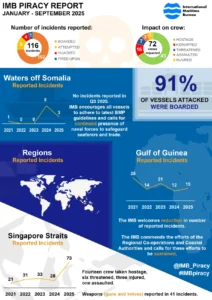
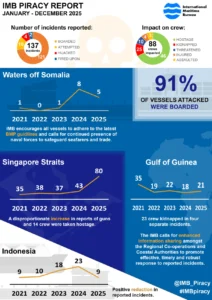
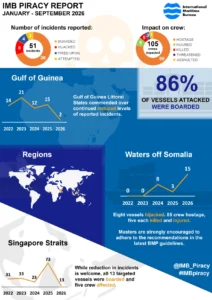
- 2020–Present: The Digital Frontier: The modern era has seen the PRC integrate satellite tracking and rapid email-alert protocols. The recent release of the January to September 2025 Piracy and Armed Robbery Against Ships report marks a continuation of this rigorous oversight, documenting the shift in tactics from opportunistic theft to sophisticated, technology-aided boardings.
Supporting Data: The Anatomy of Modern Piracy
The data gathered by the IMB is not merely administrative; it is the lifeblood of maritime strategy. According to the 2025 report, while the total number of attacks has fluctuated, the nature of these attacks has become increasingly violent.
Analyzing the Trends
The 2025 data highlights several critical shifts:
- The Geographic Dispersion: While traditional hotspots like the Singapore Straits remain active, there is a marked increase in incidents within the Gulf of Guinea and off the coast of South America.
- The "Opportunistic" Shift: A significant percentage of reported incidents involve low-level armed robbery while ships are at anchor or in port. The PRC’s data shows that when vessels follow strict watch-keeping protocols, the success rate of these robbers drops by over 60%.
- Success vs. Attempted Incidents: The gap between successful boardings and thwarted attempts is the primary metric for the effectiveness of the IMB’s warnings. When the PRC issues an alert, the "thwarted" percentage rises significantly, proving that information is, in itself, a weapon.
The IMB strongly encourages shipmasters to report all incidents—even those that do not result in theft or injury. This "zero-omission" reporting policy ensures that authorities have the accurate data required to allocate naval assets to the correct zones. Without this reporting, piracy hotspots would remain invisible to policymakers.
Official Responses and Strategic Collaboration
The influence of the IMB Piracy Reporting Centre extends into the highest echelons of international governance. The International Maritime Organization (IMO) consistently references IMB data in its biannual sessions on maritime safety.
Michael Howlett, Director of the ICC International Maritime Bureau, emphasizes that the Centre’s success is predicated on cooperation. "The piracy threat is dynamic," Howlett notes. "Criminals are quick to adapt, utilizing drones, high-speed skiffs, and encrypted communications. To counter them, the global maritime community must be even faster. Our role is to ensure that when a ship is under threat, they are not alone. By connecting the shipmaster to the nearest naval response center, we turn a moment of terror into a coordinated tactical operation."
Furthermore, the PRC works closely with the insurance industry. By providing objective data on high-risk areas, the Centre helps shipping companies manage risk premiums. When the IMB reports a reduction in incidents in a specific region, insurance costs often follow suit, providing a tangible financial incentive for nations to clean up their territorial waters.
Implications: The High Cost of Silence
The failure to report a piracy incident is the greatest gift a captain can give to a pirate. When incidents go unreported, the international community assumes the waters are safe. This leads to a withdrawal of naval assets, a reduction in port security, and an eventual resurgence in criminal activity.
The Macro-Economic Impact
Maritime piracy is not a victimless crime. It inflates the cost of consumer goods, endangers the lives of seafarers, and complicates global supply chains. A single hijacked vessel can cause a cascade of delays, affecting everything from energy prices to the availability of essential medicines.
The Moral Imperative
Beyond the economic, there is a profound human rights dimension. Seafarers often endure months of isolation, and the added stress of operating in waters where they might be held for ransom is a psychological burden that the industry is only now beginning to address. The IMB PRC provides a safety net that validates the seafarer’s experience, ensuring that their ordeal is acknowledged and acted upon.
Conclusion: A Call to Action for the Global Shipping Industry
The work of the IMB Piracy Reporting Centre is a testament to the power of centralized intelligence and global cooperation. However, the Centre is only as strong as the reports it receives. Shipowners and masters are the frontline observers of the high seas; their vigilance and commitment to reporting are the final pieces of the security puzzle.
As we look toward the remainder of 2025 and beyond, the challenges of maritime security will only grow in complexity. From cyber-attacks on navigation systems to the traditional threat of physical boarding, the IMB PRC remains the lighthouse guiding the industry through the storm.
For those navigating the global waters, the message is clear: Report every incident. Remain vigilant. Protect your crew.
Resources and Contact Information
To contribute to the global effort against maritime crime, all shipmasters are urged to consult the latest findings:
- Download the Report: January to September 2025 Piracy and Armed Robbery Against Ships
- Direct Support: For incidents requiring immediate attention, contact the IMB PRC 24-hour hotline.
For inquiries and media relations:
Michael Howlett,
Director, ICC International Maritime Bureau
Tel: +44 207 423 6960
Email: [email protected]
The IMB Piracy Reporting Centre stands as a beacon of safety, ensuring that the world’s oceans remain open, secure, and available for the benefit of all nations.