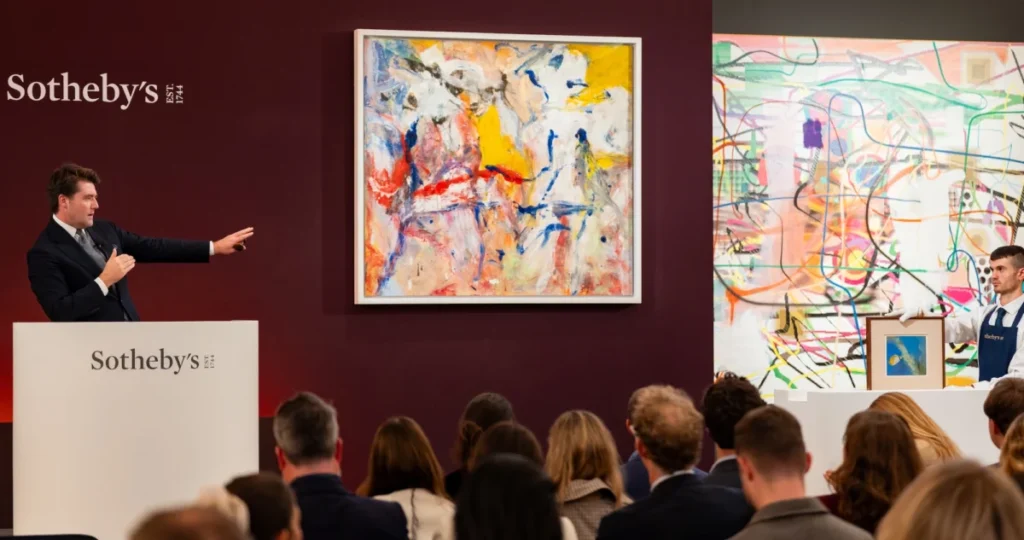
The atmosphere inside Sotheby’s New Bond Street saleroom on Thursday evening was described by several attendees as less of a celebratory auction and more of a high-stakes courtroom. Under the watchful eye of auctioneer Tom Eddison, the room was punctuated by long, anxious pauses and a palpable sense of hesitation. Despite the tension, the evening concluded as a "slow but steady" affair, with Sotheby’s Contemporary Art Evening Auction realizing a total of £46.1 million ($61.1 million).
While the total figure sat within the pre-sale estimate of £41.7 million to £58.6 million ($55.3 million to $77.8 million) when including the house’s buyer’s premiums, the hammer total of £36.9 million—the price before fees—fell short of the low estimate. This discrepancy serves as a stark barometer for a global art market currently defined by extreme selectivity, fiscal prudence, and a retreat from the speculative fervor of previous years.
Main Facts: A Leaner, More Focused Offering
Sotheby’s presented a relatively trim catalog for its marquee Frieze Week sale, consisting of 34 lots. Of these, 10 were backed by financial guarantees, providing a safety net for the house in an unpredictable climate. However, the lead-up to the event was marked by the withdrawal of three significant works by blue-chip stalwarts: Damien Hirst, Anselm Kiefer, and Leon Kossoff. These withdrawals often suggest a lack of sufficient pre-sale interest, as consignors opt to hold their works rather than risk a public "buy-in."
The top lot of the evening was a 1977 untitled abstraction by Willem de Kooning, which fetched £9.8 million ($12.9 million). While a formidable sum, it was symptomatic of the evening’s broader trend: most works sold within or at the lower end of their estimates. The sell-through rate remained respectable, with 28 of the 34 lots finding buyers, but the "unsold" list included heavy hitters such as Banksy, Georg Baselitz, Lucian Freud, and Gerhard Richter, signaling that even "trophy" names are not immune to the current market’s discerning eye.
In comparison to the previous year’s equivalent sale, which totaled £47.6 million ($63.3 million) and was led by a £13 million Francis Bacon, the 2024 results represent a slight contraction in volume, though the house successfully navigated a much more difficult macroeconomic environment.

Chronology of the Evening: From Silent Pauses to Surprise Successes
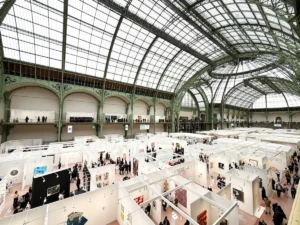
The auction commenced against the backdrop of Frieze London, the city’s premier art fair, which had seen stars like Tilda Swinton and Raf Simons roaming the aisles just a day prior. While the fair reported robust sales at the primary market level, the secondary market at Sotheby’s faced a more grueling test of value.
The Opening Volleys and High-Profile Passes
The sale began with a measured pace. Early lots by younger, "ultra-contemporary" artists provided some momentum, but the room remained quiet. The tension escalated as several high-profile works failed to meet their reserves. Notably, a painting by Jadé Fadojutimi and a figurative work by Lynette Yiadom-Boakye—both darlings of the auction circuit in recent years—went unsold. This marked a shift in sentiment for the "under-50" category, which has seen explosive growth but is now undergoing a period of price consolidation.
The De Kooning Peak
The momentum shifted when the centerpiece of the evening, Willem de Kooning’s Untitled (1977), came to the block. Measuring five feet wide and characterized by the artist’s signature late-career fluid gestures, the work carried an estimate of £8 million to £12 million. The bidding was professional and efficient, hammering at £8.2 million. With fees, the final price reached £9.8 million. For the seller, this represented a significant appreciation in value; the work had last been seen at Sotheby’s New York in 2015, where it sold for $6.1 million.
The Mid-Sale "Courtroom" Atmosphere
Following the De Kooning, the sale settled into a rhythmic but slow cadence. Auctioneer Tom Eddison frequently had to coax bids from a room that seemed more interested in observing than participating. Gerhard Richter’s Abstraktes Bild (1992), an eight-foot-wide masterpiece of squeegee abstraction, struggled to reach its low estimate of £6 million. It eventually hammered at £5.4 million, resulting in a final price of £6.7 million ($8.9 million). Although it technically "underperformed" against the estimate, the seller still realized a profit from their 2011 purchase price of £3.6 million.
The Michael Andrews Breakthrough
The most electric moment of the night came unexpectedly with the appearance of Michael Andrews’ Butterfly Fish (1978). Estimated at a modest £120,000 on the high end, the work on paper sparked a fierce and extended bidding war. The price climbed rapidly, eventually hammering at £550,000, for a final total of £704,000 ($933,117). This set a new auction record for a work on paper by the artist and provided a rare moment of unbridled enthusiasm in an otherwise restrained evening.

Supporting Data: Historical Performance and ROI
The results of the Sotheby’s sale highlight a market that is increasingly reliant on historical provenance and "long-hold" returns rather than quick flips.
- Mark Rothko’s Longevity: An untitled dark-hued abstract from 1969 by Mark Rothko hammered at its low estimate of £3.8 million (just under $5 million with fees). While this was at the bottom of the expectations, the historical data reveals the immense value of time in the art market. The seller had acquired the piece in 1992 for a mere $264,000, representing an nearly 1,800% return over three decades.
- The "Under-50" Stability: While some younger artists struggled, others showed resilience. Louis Fratino’s Kissing Couple (2019) sold for £320,000 ($424,144), and Adrian Ghenie’s The Wall (2019) brought in £640,000 ($848,288). Both results fell within their pre-sale estimates, suggesting that for certain contemporary artists, there is still a solid, albeit less speculative, floor.
- Comparative Nightly Totals: Sotheby’s £46.1 million total was dwarfed by Christie’s performance the previous evening, which realized £218.6 million ($289.4 million) across two sales. However, Christie’s total was bolstered by the sale of the Peter Simon collection, which included massive, one-off estates that Sotheby’s did not have in this specific cycle.
Official Responses: Market Caution vs. Joyous Demand
In the aftermath of the sale, experts and auction house officials sought to frame the results within the context of a transitional market.
Ivana Miloradovic, an art historian and consultant who attended the sale, provided a blunt assessment to ARTnews. “I would say the market is very cautious,” she noted. “Most of the lots either underperformed or were at the lower end.” However, she also observed a distinct regional pride that influenced the bidding for certain lots. “British sales on British soil are always joyous. Everybody knows the artist, the gossip, and the history. It was a homey atmosphere.”
Ottilie Windsor, Head of Contemporary Art at Sotheby’s London, defended the results, emphasizing the difficulty of the current environment. "Getting 28 lots across the line out of 34 was still a success," Windsor argued. She specifically highlighted the Michael Andrews result as a testament to the market’s hunger for rare, high-quality material.
“The paintings that [Andrews] did make were often bought as they were being made by a group of collectors who followed his work really closely,” Windsor explained. “Those collectors have never really needed to sell, and so we get very, very low supply of his work to the market; when they do come up, they really do very well.”

Windsor concluded by noting that while the money is present, the psychology of the buyer has shifted: “The market continues to be selective and continues to surprise us with what it’s looking for.”
Implications: The "Connoisseur’s Market" Takes Hold
The Sotheby’s sale offers several key takeaways for the future of the art market as it moves into the final quarter of the year.
1. The Death of Speculation
The failure of high-profile works by Jadé Fadojutimi and others suggests that the era of "buying today to flip tomorrow" is largely over. Collectors are no longer willing to pay record-shattering prices for artists who lack a decades-long secondary market track record unless the work is of exceptional quality.
2. Rareness Trumps Name Recognition
The success of Michael Andrews—an artist less globally famous than Bacon or Freud but revered by insiders—proves that "low supply" is currently a more powerful driver of price than "high fame." In a market saturated with Gerhard Richters and Andy Warhols, collectors are willing to fight for something they may not see again for another thirty years.
3. London’s Resilience Amidst Global Headwinds
Despite the "courtroom" tension, the sale’s ability to stay within its estimate during a week of intense competition from Frieze and Christie’s suggests that London remains a vital hub for the art trade. However, the "safety first" approach of auction houses—evidenced by the high number of guarantees and strategic withdrawals—indicates that the industry is bracing for a period of slower growth.

4. The Value of Provenance
The massive returns seen on the Rothko and De Kooning lots reinforce the idea that art remains a premier long-term asset class. For collectors who can afford to hold works for 10 to 30 years, the market continues to offer returns that outpace many traditional investments, even when the "hammer" falls at the low end of the estimate.
In summary, Sotheby’s London Contemporary sale was a microcosm of the 2024 art world: a place where the "joyous" history of British art met the cold reality of global economic caution. The results were not a disaster, but they were a clear signal that the days of easy records are, for now, a thing of the past.