
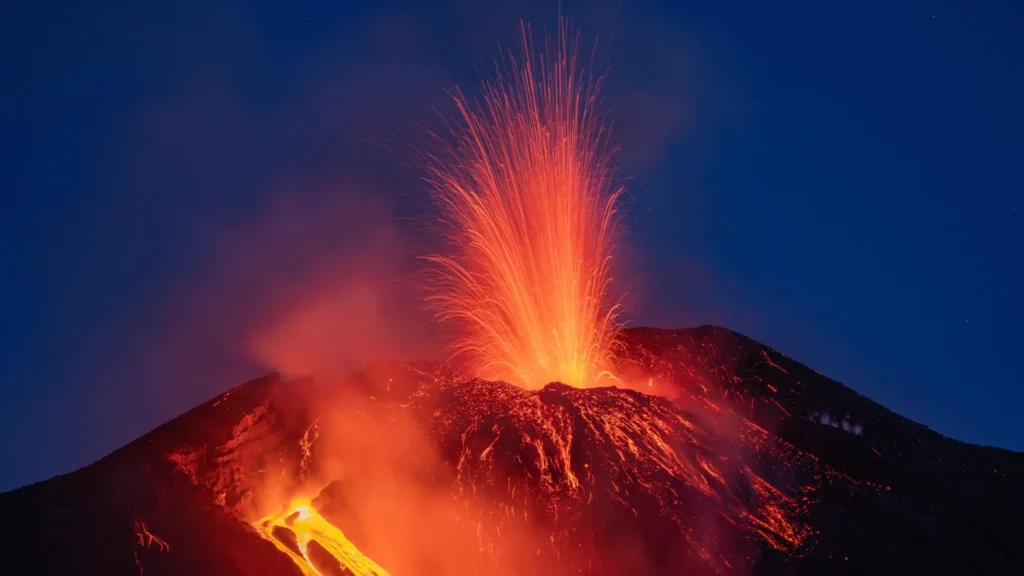
Volcanoes are often perceived as singular, monolithic entities—mountains that behave in predictable, repetitive ways. However, beneath the serene slopes and picturesque craters of the world’s most famous volcanoes lies a complex, shifting architecture of magma, gas, and pressure. A groundbreaking study led by researchers at Cornell University has revealed that a single volcano can operate through vastly different, and often competing, geological pathways.
By conducting a forensic reconstruction of two major eruptions at Mount Etna in Italy, a team of geoscientists has decoded the hidden "plumbing" of the mountain, demonstrating that magma does not always follow a standard trajectory. Instead, the speed, depth, and chemical composition of an eruption are dictated by a sophisticated interplay between water and carbon dioxide. This discovery provides a vital new toolkit for volcanologists, potentially transforming how we assess the risks posed to the millions of people living in the shadows of active volcanic systems worldwide.
Decoding the Mechanics of an Eruption
The research, published in the journal Geochemistry, Geophysics, Geosystems, offers an unprecedented look at how volcanoes transition from dormancy to disaster. The project was led by Esteban Gazel, the Charles N. Mellowes Professor in the Department of Earth and Atmospheric Sciences at Cornell’s Duffield College of Engineering. Alongside lead author and former postdoctoral researcher Maxim Gavrilenko, the team sought to answer a fundamental question: what determines the explosiveness of a volcanic event?
At its core, a volcano’s behavior is governed by its "volatiles"—the gases trapped within magma. As magma rises toward the surface, the pressure decreases, causing these gases to exsolve, or separate, from the liquid rock.
"Imagine a bottle of soda," says Gazel. "If you open that bottle without agitating it, you can drink it, but if you shake it up, all the bubbles get separated really fast, and you have an explosion. Volcanoes work in a similar way, and my lab is trying to quantify these processes."
Historically, the scientific community focused primarily on water as the primary driver of volcanic pressure. However, in 2023, Gazel’s group challenged this consensus by demonstrating that carbon dioxide (CO2) plays an equally critical, and often more rapid, role in triggering explosive activity.
The Precision of Raman Spectroscopy
To reconstruct the plumbing systems of Mount Etna, the team employed a pioneering technique using Raman spectroscopy. This method allows researchers to look inside the microscopic "time capsules" left behind by past eruptions: crystals that formed within the magma as it cooled.
Trapped inside these crystals are tiny glass inclusions—microscopic gas bubbles that are often only 1% to 10% the thickness of a human hair. By analyzing the density of the carbon dioxide within these bubbles, the team can calculate the pressure at the moment the crystal formed. Using a specific state equation, they then convert that pressure into a precise depth.
"That technique gives us the density of CO2, and using a state equation we can transform that density into pressure, and pressure can be transformed into depth," explains Gavrilenko. "Then we apply those techniques to these explosive eruptions, and we are able to reconstruct the plumbing system with an unprecedented precision."
A Chronological Reconstruction: 122 B.C. vs. The Fall Stratified Event
Mount Etna served as the ideal laboratory for this study. While generally considered less volatile than some of the world’s more dangerous peaks, it possesses a rich history of extreme eruptions that serve as cautionary tales. The team chose to analyze two distinct events: the massive, violent eruption of 122 B.C. and the "Fall Stratified" event from approximately 4,000 years ago.
The 122 B.C. Plinian Eruption
The 122 B.C. event is classified as both "mafic"—rich in iron and magnesium with low viscosity—and "Plinian," the most explosive class of volcanic eruptions. Collaborators Terry Plank of Columbia University and Bruce Houghton of the University of Hawaii, Manoa, conducted extensive field collection to gather the necessary crystal samples.
The team’s reconstruction revealed a long, slow ascent. The magma originated at a depth of approximately 22 kilometers. Rather than surging to the surface, the material stalled at a shallow depth of 2 to 5 kilometers. It remained in this holding pattern for weeks, slowly releasing gas before ultimately erupting. This suggests a "water-controlled" process where the stalling period allowed for the build-up of pressure in the upper crust.
The Fall Stratified Event (4,000 Years Ago)
In sharp contrast, the Fall Stratified eruption followed a rapid, high-velocity path. The team found that this magma originated much deeper in the mantle, starting at 24 to 30 kilometers below the surface. Instead of lingering, it raced to the surface, erupting in a matter of hours. The data indicated that this event was driven by a much higher concentration of carbon dioxide, which bypassed the shallow-crust stalling phase entirely.
Supporting Data: The Competition of Volatiles
The contrast between these two events highlights a fundamental threshold in volcanic dynamics. According to Gazel, Mount Etna is one of the few places on Earth where water and carbon dioxide are in constant competition to drive an eruption.
"This shows that at a certain threshold of CO2, the eruption will come from very deep and really fast, but when you have a higher threshold of water, then the process is controlled at shallow levels," Gazel explains.
This duality explains why a single volcano can produce such varied eruption styles. When CO2 levels are dominant, the ascent is rapid and direct, leaving little time for warning. When water is the primary volatile, the magma tends to reside in the shallower crust, allowing for more complex gas-release processes that can either lead to sustained eruptions or potentially provide more precursor signals.
Implications for Global Risk Assessment
The implications of this research extend far beyond the slopes of Mount Etna. The Cornell-led team is already applying these techniques to volcanoes in Chile, Hawaii, and beyond. In the realm of disaster management, the "when and how" of an eruption is the difference between a successful evacuation and a tragedy.
Current physical models of eruptions—which are the bedrock of local and national risk assessments—often rely on generalized assumptions about magma ascent. By providing a method to determine exactly where magma begins its journey and which gases are powering its rise, Gazel’s team is enabling the creation of more realistic, site-specific hazard models.
"Ideally, this should be done in every volcano on the planet," says Gazel. "This is data we need for physical models of eruptions that are the base of risk assessment."
Myth and Science: The Giants Beneath the Mountain
The research also bridges the gap between modern science and ancient narrative. Mount Etna has long been a site of mythological significance, famously associated with the burial of the giants Typhon and Enceladus, who were said to be imprisoned beneath the mountain after their defeat by the Olympian gods.
In an intriguing parallel to their findings, Gazel notes the structural similarities between the mythological giants and the geological plumbing discovered by his team. The Plinian system, characterized by an elongated and serpentine structure, mirrors the mythological descriptions of Typhon. Meanwhile, the smaller, more localized plumbing structures appear to correspond to the smaller figure of Enceladus.
"If you work in Etna, it’s hard not to be connected to history, classical work and great food," says Gazel. While the giants remain confined to the realm of myth, the "monsters" of magma and gas beneath the surface are now, for the first time, being mapped with scientific clarity.
Conclusion
The work of Gavrilenko, Gazel, and their colleagues marks a significant advancement in our ability to peer into the Earth’s interior. By understanding the volatile competition between water and carbon dioxide, scientists can better interpret the "voice" of a volcano before it speaks. As the team continues to expand their research to other global sites, the legacy of their work will likely be found in more robust, data-driven safety protocols that protect those living in the shadow of the world’s most volatile mountains.
The research was supported by the National Science Foundation, with contributions from a diverse team of co-authors, including postdoctoral researchers Kyle Dayton and Ellyn Huggins, as well as Anna Barth of the University of California, Berkeley. As this team continues to decode the complex, serpentine paths of magma, they are proving that the most dangerous parts of a volcano are often those hidden deepest within the crust.