The landscape of modern horology has undergone a seismic shift. No longer are enthusiasts forced to trawl the digital archives of auction houses or settle for the often-prohibitive prices of vintage boutiques to satisfy a craving for avant-garde, era-specific design. Today, a vibrant ecosystem of independent micro-brands—working in tandem with established manufacturers—is democratizing high-concept watchmaking. Standing at the forefront of this movement is the Nectere Eclipse, a 100-piece limited edition that bridges the gap between artistic expression and mechanical accessibility.

Priced at $880 USD, the Nectere Eclipse represents more than just a timepiece; it is an exercise in structural ambition. By pairing a distinct, celestial-inspired aesthetic with the slender, hand-wound Sea-Gull ST-17 caliber, Nectere has crafted a watch that challenges the conventions of entry-level luxury.

Main Facts: The Anatomy of an Eclipse
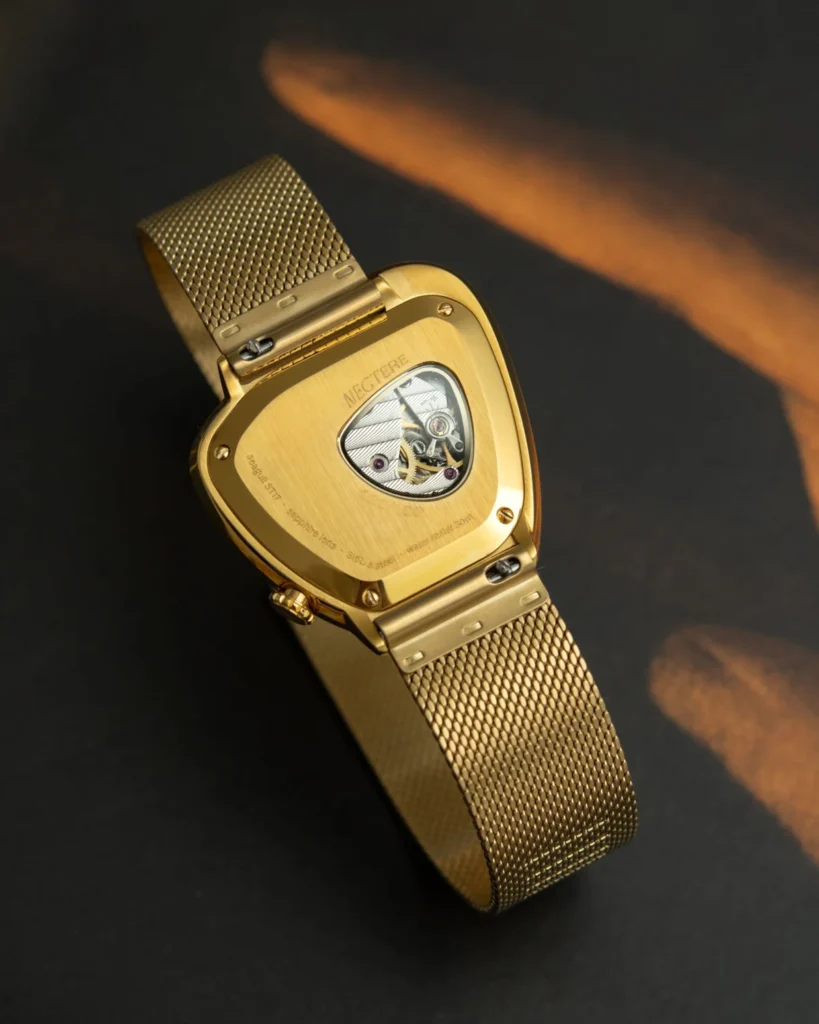
The Nectere Eclipse is defined by its dramatic, asymmetric geometry. Inspired by the cosmic phenomenon of a total solar eclipse, the watch captures the transitionary light of the corona through its unconventional case silhouette. The juxtaposition of a deep, obsidian-black dial against gold-toned surroundings creates a visual depth that feels both ancient and futuristic.

Key Specifications:
- Case Material: Stainless steel with gold PVD coating.
- Dimensions: 38mm wide, 40.5mm lug-to-lug.
- Profile: 8.5mm total thickness.
- Movement: Sea-Gull ST-17 manual-wind caliber.
- Frequency: 3Hz (21,600 vibrations per hour).
- Power Reserve: 39 hours.
- Crystal: Domed sapphire lens (front), K1 mineral crystal (caseback window).
- Limited Edition: 100 individually numbered pieces.
The decision to limit the run to just 100 units creates a sense of exclusivity that is rarely found at this price point. In an era of mass production, Nectere is banking on the "Chaos" collector—a demographic that values design-forward, narrative-heavy timepieces over traditional market staples.

Chronology: The Evolution of Nectere’s Design Language
The trajectory of Nectere as a brand has been defined by a departure from the "homage" culture that plagues many micro-brands. The Eclipse is a spiritual successor to the brand’s previous "Chaos" collection, which garnered a cult following for its willingness to ignore the "safe" design choices typically favored by startups.

- Conceptualization Phase: Nectere’s design team sought to emulate the organic, fluid shapes seen in the works of surrealist painters and high-jewelry houses like Cartier (notably the Crash).
- Prototyping: The greatest hurdle was the multi-tier bezel. Integrating a bespoke sapphire crystal with a complex, dripping-metal aesthetic required multiple iterations to ensure water resistance and structural integrity.
- Movement Selection: The brand opted for the Sea-Gull ST-17. By choosing a manual-wind version (avoiding the rotor of an automatic), they were able to keep the case height at a svelte 8.5mm, a feat rarely achieved in this price segment.
- Launch: With the release of the 100-piece limited edition, Nectere is testing the appetite of the market for watches that prioritize sculptural beauty over raw functional legibility.
Supporting Data: The Engineering Paradox
One of the most impressive aspects of the Nectere Eclipse is the deliberate trade-off between form and performance. To achieve a thickness of 8.5mm, Nectere utilizes the Seagull ST-17 "Ultra-Thin" movement.

The Movement Performance
The ST-17 is a workhorse caliber, but in its manual-wind configuration, it measures a mere 3.2mm in height. This is the engine that allows the watch to sit flush against the wrist. However, this thinness comes with inherent compromises:

- 3Hz Frequency: While standard, it lacks the silky sweep of a high-beat movement.
- 39-Hour Reserve: This necessitates a daily winding ritual.
The Human Interface
The crown is perhaps the most underrated element of the Eclipse. Often, small-diameter crowns are difficult to manipulate, but Nectere has engineered a crown that is both elegant and highly tactile. The winding experience is smooth, with no sharp edges to irritate the skin—a critical detail often overlooked by larger brands. The inclusion of a small "triangular" window on the caseback allows for a glimpse of the industrial finishing of the movement, proving that even at $880, the brand is thinking about the full 360-degree experience.

Official Perspectives: The Philosophy of the Brand
Nectere has positioned itself as a disruptor. In discussions regarding their design process, the brand emphasizes the "cool factor" of thinness. "Anyone can make a thick, ungainly watch," the design team notes. "It takes restraint to shave off every last fraction of a millimeter to achieve proportionality."

The brand acknowledges the controversy surrounding their design. They recognize that the Eclipse is a "developed taste." By embracing an aesthetic that feels like it is "leaping off the wrist," they are catering to collectors who want their watch to be a conversation starter. The choice of a golden mesh bracelet further accentuates this; while some might prefer a leather strap—which the brand conveniently offers as an alternative—the mesh reinforces the "liquid gold" theme of the celestial event.

Implications: A New Era for Accessible Independent Watchmaking
The Nectere Eclipse serves as a bellwether for the future of the watch industry. It demonstrates that the technical barriers to entry are collapsing. A decade ago, a small brand would have found it impossible to source a custom-shaped sapphire crystal or an ultra-thin manual movement without massive capital investment. Today, that barrier is gone.

The Market Impact
- Accessibility of High-Concept Design: If a consumer can access this level of avant-garde styling for under $1,000, it puts pressure on larger, legacy brands to justify their multi-thousand-dollar price tags for similar "shaped" watches.
- The "Clasp" Debate: The brand’s choice of a traditional-style clasp for the mesh bracelet highlights a common pain point: the friction between aesthetics and usability. While the design is beautiful, the difficulty of the clasp operation may prove to be a point of contention for potential buyers. It serves as a reminder that even the most innovative brands still have room for refinement in user experience.
Final Verdict
The Nectere Eclipse is not a watch for the conservative collector. It is a watch for the individual who treats their wrist as a canvas. It is technically proficient, conceptually bold, and remarkably well-proportioned. While it may not possess the chronometric precision of a COSC-certified movement, it possesses something arguably more important for a piece in this collection: personality.

As the 100 units find their way into the hands of collectors, the Eclipse will likely be remembered as one of the most daring designs in the micro-brand space for the year 2026. For those looking to move away from the saturated market of dive watches and standard dress pieces, Nectere offers a glimpse of the heavens—at a price that is firmly grounded on Earth.