

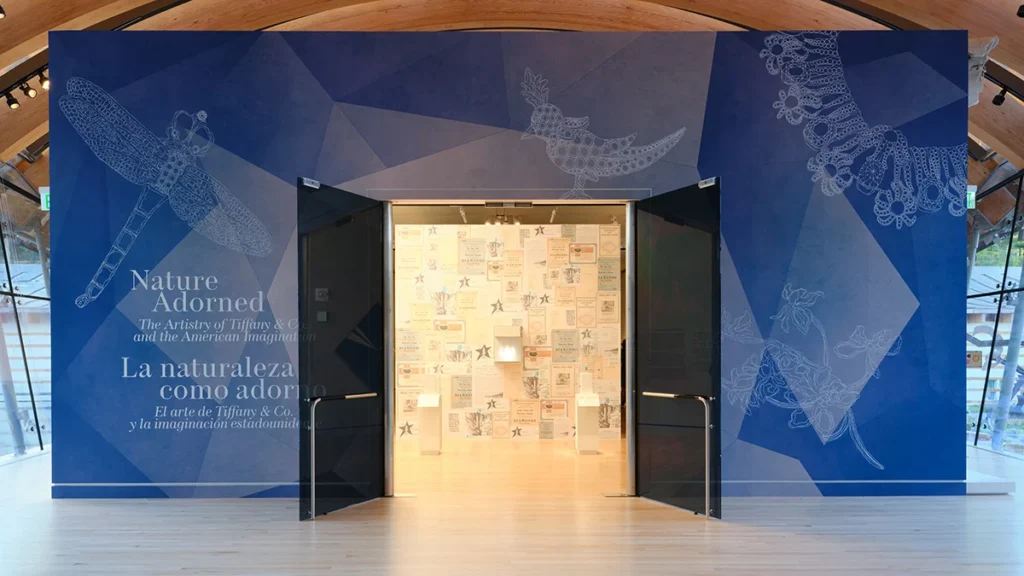
BENTONVILLE, Ark. — An extraordinary convergence of American decorative arts, high jewelry, and landscape painting has opened at the Crystal Bridges Museum of American Art. Titled Nature Adorned: The Artistry of Tiffany & Co. and the American Imagination, the major exhibition examines how the United States’ natural wonders, native gemstones, and diverse ecosystems shaped the aesthetic identity of the nation’s preeminent luxury house over the course of a century.
The exhibition, which runs through March 29, 2027, pairs rare jewelry and archival objects from Tiffany & Co. dating from 1885 to 1987 with foundational paintings and decorative works from Crystal Bridges’ permanent collection. In keeping with the museum’s core founding mission of public accessibility, the exhibition is offered to visitors free of charge, requiring no tickets or advance reservations.
1. Main Facts: Bridging Fine Art and High Craft in the Ozarks
Founded in 2011 by philanthropist Alice Walton, daughter of Walmart founder Sam Walton, the Crystal Bridges Museum of American Art has spent over a decade redefining the geography of American cultural institutions. Nestled in the forest springs of Northwest Arkansas, the Moshe Safdie-designed museum has assembled one of the nation’s most significant collections of American art, spanning colonial-era portraiture to contemporary sculpture.
With Nature Adorned, the museum has entered into an ambitious partnership with the Tiffany & Co. Archives. The exhibition traces how jewelers, enamelists, glassmakers, and painters looked to the same American wilderness for inspiration, creating a uniquely national design vocabulary that stood in stark contrast to prevailing European academic traditions.
================================================================================
EXHIBITION AT A GLANCE
================================================================================
       Nature Adorned: The Artistry of Tiffany & Co. and the American Imagination
Venue:       Crystal Bridges Museum of American Art, Bentonville, Arkansas
Duration:    October 2026 – March 29, 2027
Admission:   Free and open to the public; no reservations required
Scope:       Archival jewelry and decorative arts (1885–1987) paired with
             Crystal Bridges' permanent collection of American fine art
Key Highlights:
  • The 27.21-carat Arkansas Diamond (discovered 1926, acquired by Tiffany in 1946)
  • G. Paulding Farnham's 19th-century enameled botanical brooches
  • Jean Schlumberger's mid-century masterpieces, including "Bird on a Rock"
  • Clara Driscoll stained-glass table lamps and Tiffany Studios leaded glass
  • Agnes F. Northrop monumental stained-glass landscape window
================================================================================
Rather than presenting high jewelry purely as luxury adornment, Nature Adorned reframes it as a vital discipline of American craft and material culture. By placing diamond, gold, and enamel artifacts directly alongside oil canvases by American masters, the exhibition illustrates a shared creative dialogue centered on domestic landscapes, native flora, and regional fauna.

2. Chronological Evolution: From Frontier Minerals to Global Luxury
The dialogue between Tiffany & Co. and the American landscape traces back to the company’s inception and evolved across several pivotal eras:
CHRONOLOGY: TIFFANY & CO. AND THE AMERICAN LANDSCAPE
────────────────────────────────────────────────────────────────────────────────
1837        Charles Lewis Tiffany founds "Tiffany & Young" in New York City,
            initially trading in stationery and fancy dry goods.

1879        Famed mineralogist Dr. George Frederick Kunz joins Tiffany & Co.,
            initiating a lifelong campaign to identify, source, and celebrate
            domestic, American-origin gemstones.

1889        At the Exposition Universelle in Paris, chief designer George Paulding
            Farnham stuns the international art world with life-sized, enameled
            wild-orchid brooches, securing Tiffany's design autonomy from Europe.

1890s–1910s Under Louis Comfort Tiffany and lead designers like Clara Driscoll
            and Agnes F. Northrop, Tiffany Studios revolutionizes art glass,
            translating regional botanicals and scenic landscapes into stained glass.

1926        A massive 27.21-carat rough diamond is unearthed on a farmland tract
            near Searcy, Arkansas—one of the largest ever discovered on U.S. soil.

1946        Tiffany & Co. acquires the Arkansas Diamond, reaffirming its dedication
            to landmark American geological finds.

1956        French designer Jean Schlumberger joins Tiffany & Co., embarking on
            a transformative era of imaginative, fauna-inspired high jewelry.

2026–2027   Crystal Bridges presents "Nature Adorned," reuniting the Arkansas
            Diamond with its home state and placing historical jewelry alongside
            masterworks of American landscape painting.
────────────────────────────────────────────────────────────────────────────────
The Kunz Era and Domestic Gemological Independence
When Charles Lewis Tiffany founded the firm on Broadway in 1837, the American luxury trade was almost wholly dependent on imported European styles and traditional gemstones—principally Old World diamonds, Burmese rubies, and Colombian emeralds. The transformative turning point occurred in the late 19th century under the guidance of Dr. George Frederick Kunz, the firm’s legendary chief gemologist.
Kunz actively prospected the American interior, championing stones that European purveyors had largely overlooked. Under his direction, Tiffany began incorporating Montana sapphires, Maine tourmalines, Utah topazes, and freshwater pearls from the Mississippi Valley basin. This domestic sourcing provided American jewelry with a unique chromatic range, mirroring the distinct light and mineral richness of North America.
The Gilded Age: Natural Realism at the Paris Exposition
This gemological shift coincided with a revolutionary approach to design. By the 1889 Paris Exposition Universelle, chief designer George Paulding Farnham used American-mined gemstones and innovative enameling techniques to capture botanical forms with lifelike accuracy. Farnham’s series of orchid brooches—sculpted directly from North American and exotic species—won international acclaim and liberated American jewelry design from European conventions.
Concurrently, Louis Comfort Tiffany was developing Tiffany Studios, where designers such as Clara Driscoll and Agnes F. Northrop translated native flora—wisteria, apple blossoms, and water lilies—into Favrile glass, leaded-glass lamps, and architectural windows.

Mid-Century Whimsy and the Archival Legacy
By the mid-20th century, the house’s artistic vision expanded under French-born jeweler Jean Schlumberger. Arriving at Tiffany in 1956, Schlumberger infused botanical and oceanic themes with witty, sculptural modernism. Iconic creations like the Bird on a Rock brooch and the intricate Hedges and Flowers necklace merged post-war architectural structure with the fluid kinetics of nature, closing a century-long arc of organic design.
3. Supporting Data and Gemological Significance
The centerpiece of Nature Adorned is an artifact of profound local and national historic importance: The Arkansas Diamond.
+-------------------------------------------------------------------------------+
|                        THE ARKANSAS DIAMOND: DATA PROFILE                     |
+-------------------------------------------------------------------------------+
| Discovery Date:      1926                                                     |
| Location Found:      Near Searcy, White County, Arkansas                      |
| Uncut Weight:        27.21 carats                                             |
| Historical Rank:     Among the largest uncut diamonds ever found in the U.S.  |
| Acquisition:         Purchased by Tiffany & Co. in 1946                       |
| Current Custody:     Tiffany & Co. Archives Collection                        |
| Significance:        Symbolizes the natural mineral wealth of the American    |
|                      interior and Tiffany's historic domestic sourcing.       |
+-------------------------------------------------------------------------------+
While most commercially viable diamond deposits are located in southern Africa, Russia, and Canada, Arkansas represents a unique geological exception in North America. The discovery of the 27.21-carat rough crystal near Searcy in 1926 occurred during an era of localized mineral prospecting across the state’s peridotite and lamproite pipes. Tiffany’s acquisition of the stone in 1946 cemented its place as an emblem of domestic mineral wealth.
THE DIALOGUE OF DISCIPLINES: CURATORIAL PAIRINGS
┌─────────────────────────────────┬────────────────────────────────────────────┐
│ TIFFANY & CO. ARCHIVAL OBJECT   │ CRYSTAL BRIDGES COMPANION ARTWORK          │
├─────────────────────────────────┼────────────────────────────────────────────┤
│ George Paulding Farnham:        │ Martin Johnson Heade:                      │
│ Enameled Orchid Brooches        │ Botanical and hummingbird studies          │
│ (circa 1889–1900)               │ (Oil on canvas, late 19th century)         │
├─────────────────────────────────┼────────────────────────────────────────────┤
│ Tiffany Studios (Clara Driscoll │ William Jacob Hays Sr.:                    │
│ & Agnes F. Northrop):           │ American wildlife and landscape paintings  │
│ Stained-Glass Mountainscape &   │ (Mid-to-late 19th century)                 │
│ Leaded Glass Floral Lamps       │                                            │
├─────────────────────────────────┼────────────────────────────────────────────┤
│ Jean Schlumberger:              │ Mid-Century American Still Lifes           │
│ "Bird on a Rock" Brooches &     │ and Post-War Sculptural Works              │
│ "Hedges and Flowers" Necklace   │ (Permanent Collection galleries)           │
└─────────────────────────────────┴────────────────────────────────────────────┘
The exhibition’s visual pairings highlight structural connections between two- and three-dimensional media. Farnham’s enameled orchids, for example, mirror the meticulous botanical accuracy of Martin Johnson Heade’s canvases, which documented orchids and hummingbirds across North and South America. In both mediums, artists captured organic fragility using challenging materials—thin coats of fired enamel over gold, and delicate layers of oil glaze over linen.
4. Curatorial Perspectives and Institutional Leadership
Representatives from both institutions emphasize that the exhibition was curated to bridge the divide between fine art and functional decorative craft, highlighting their shared lineage in the American imagination.

"I hope visitors appreciate how the American landscape inspired Tiffany’s enduring vision of color artistry, artfully curating American-origin gemstones, exceptional jewelry, and artistic works that reflect the nation’s natural grandeur," said Victoria Reynolds, Chief Gemologist and Vice President of High Jewelry Diamond and Gemstone Acquisition at Tiffany & Co.
Reynolds noted that early decisions by the house to embrace domestic gems were unconventional for the era, but established an artistic legacy that continues to influence contemporary high-jewelry design.
The curatorial team at Crystal Bridges approached the collaboration as a study in material ingenuity.
"This exhibition reveals the power of seeing the Tiffany Archives and Crystal Bridges collection in conversation," stated Jen Padgett, the Windgate Curator of Craft at Crystal Bridges. "Through this collaboration, we can highlight the remarkable creativity, attention to materials, and skilled making that have shaped American art and design across generations."
Padgett underscored that the exhibition also elevates the historic, often undercredited roles of women artists within Tiffany Studios. The showcase specifically highlights lead designer Clara Driscoll—who directed the Women’s Glass Cutting Department and designed some of Tiffany’s most celebrated lamps—alongside Agnes F. Northrop, whose mastery of stained-glass landscapes translated the scale of the Hudson River School into architectural glass.

5. Broader Implications for Art, Heritage, and Museum Accessibility
The presentation of Nature Adorned at Crystal Bridges carries several broader implications for museum curation, decorative arts scholarship, and the democratization of luxury heritage.
Decentering Cultural Gatekeeping
Historically, comprehensive retrospectives of historic high jewelry have been confined to major metropolitan capitals—primarily Paris, London, New York, and Geneva. Staging a high-profile archival exhibition of this caliber in Bentonville, Arkansas, underscores the continuing decentralization of the American art world. By hosting the showcase in the Ozarks, Crystal Bridges continues its mission of bringing world-class artistic heritage to regions historically overlooked by legacy institutions.
Eliminating Economic Barriers
Crystal Bridges’ decision to keep the exhibition entirely free of admission fees contrasts with typical institutional models, where traveling and high-jewelry showcases often carry steep surcharges. This policy removes financial barriers, enabling broad community engagement and student access to major works of American craft and design.
Reevaluating the Hierarchy of Craft and Fine Art
For decades, academic art history maintained a rigid divide between the "fine arts" (painting, sculpture) and the "decorative arts" (jewelry, glass, ceramics). Nature Adorned breaks down these classifications. By presenting a Schlumberger brooch or a Driscoll lamp with the same critical care and institutional reverence as an oil painting by Heade, the exhibition encourages a more integrated understanding of American visual culture.
Reclaiming Regional Geological Heritage
Finally, the return of the Arkansas Diamond to its home state honors the geographic origins of the materials behind American luxury. By showing rough mineral history alongside finished masterworks, the exhibition highlights the journey from raw natural resource to refined cultural artifact. It reminds visitors that the country’s artistic history was shaped not only by the brush and chisel, but by the soil, stone, and minerals of the American earth itself.



