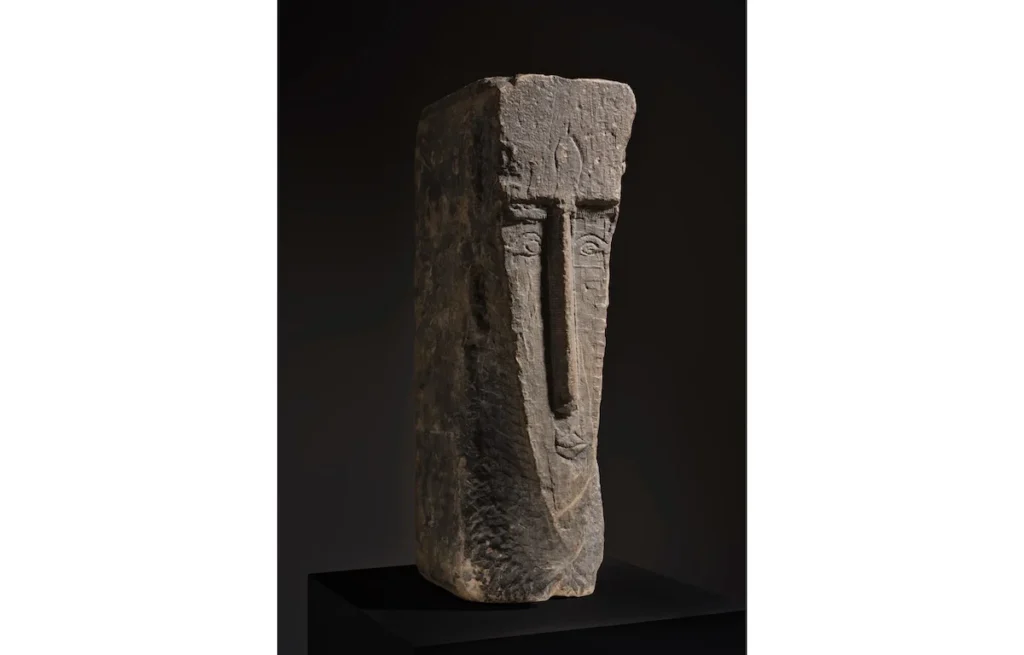
The upcoming November marquee auction season in New York is poised to become a landmark moment for the modernist market as Phillips announces the consignment of a rare and luminous limestone sculpture by Amedeo Modigliani. Titled Tête (1911–12), the work carries a formidable estimate of $28 million to $35 million, signaling a strategic attempt by the auction house to capitalize on a recent surge of "Modigliani momentum" that has swept through European salesrooms over the past two years.
For a market often dominated by the artist’s sultry, elongated female nudes on canvas, the appearance of a three-dimensional carving represents a significant shift in focus. Modigliani, who viewed himself primarily as a sculptor rather than a painter, produced only a handful of these stone works before failing health and the physical rigors of carving forced him to return to the brush. With only 26 surviving sculptures known to exist, the arrival of Tête on the block is not merely a commercial event but a major art historical occasion.
Main Facts: The $35 Million Limestone Masterpiece
The work at the center of this high-stakes auction is a slender, totemic head carved from a single block of limestone. Standing as a testament to the "direct carving" movement of the early 20th century, the sculpture features the hallmarks of Modigliani’s aesthetic: an exaggeratedly long nose, a tiny, pursed mouth that suggests a faint smile, and a graceful, columnar neck.
A Rare Opportunity for Collectors
While Modigliani’s paintings frequently appear in the upper echelons of the secondary market, his sculptures are exceedingly rare. Of the approximately 28 sculptures he is believed to have created during his tragically short life, the vast majority are permanently housed in the world’s most prestigious institutions. These include the Metropolitan Museum of Art in New York, the Musée National d’Art Moderne (Centre Pompidou) in Paris, and the Tate in London.
The specific Tête being offered by Phillips has remained in the same private collection since 1972, making it "fresh to the market"—a term that carries immense weight in the world of high-end art collecting. Its estimated price of $28 million to $35 million positions it to become one of the most expensive sculptures ever sold by the artist, though it remains a fraction of the value commanded by his most famous paintings.
Technical and Aesthetic Significance
Created during the peak of Modigliani’s sculptural period (1911–1912), the work reflects the artist’s fascination with non-Western art, particularly African masks and Egyptian antiquities. The limestone medium allowed Modigliani to explore the "primitive" elegance that would later define his portraiture. The sculpture’s surface retains the tactile quality of the artist’s hand, a stark contrast to the polished finishes of many of his contemporaries.
Chronology: From Montparnasse to the Global Stage
To understand the weight of this sale, one must look at the timeline of Modigliani’s career and the subsequent journey of his sculptural output.
- 1909–1914: The Sculptural Obsession. After arriving in Paris from Italy, Modigliani met Constantin Brâncuși, who encouraged him to abandon the modeling of clay and embrace the "direct carving" of stone. During this period, Modigliani became obsessed with the idea of creating a "Temple of Beauty," for which his carved heads were intended to serve as architectural pillars or caryatids.
- 1912: The Salon d’Automne. Modigliani exhibited several of these stone heads at the Salon d’Automne in Paris. The works were displayed as a decorative ensemble, emphasizing their rhythmic, repetitive qualities. The current Tête is part of this seminal body of work.
- 1914–1920: The Return to Painting. Due to the dust from the limestone exacerbating his tuberculosis and the scarcity of materials during World War I, Modigliani largely abandoned sculpture. He died in 1920 at the age of 35.
- 1972: The Last Acquisition. The work being sold at Phillips was acquired by its current owner over half a century ago. Since then, it has been largely hidden from public view, adding to the intrigue and desirability of the piece.
- 2010–2019: Previous Benchmark Sales. In 2010, another stone head from the same series set a then-record for the artist at Christie’s, selling for $52.8 million. In 2014, a different Tête fetched $70.7 million at Sotheby’s. More recently, in 2019, a similar work sold for $34.3 million, establishing the price floor for the current offering.
Supporting Data: Market Trends and Comparative Analysis
The art market’s valuation of Modigliani has seen extreme volatility and record-shattering heights over the last decade. Phillips is entering a market that has shown a renewed appetite for "blue-chip" modernism following a period of post-pandemic correction.
The Painting vs. Sculpture Gap
There remains a massive disparity between Modigliani’s work in two dimensions and three dimensions. The artist’s current auction record stands at $170.4 million, achieved in 2015 for the painting Nu couché (1917–18). While the sculpture estimate of $35 million is significant, it reflects the specialized nature of the sculpture market. However, because there are so few sculptures compared to paintings, they are often viewed as more stable long-term assets.
Recent European Success
Phillips’ decision to bring this work to New York is backed by strong data from the European market:
- Paris (2025): At Christie’s, a Modigliani portrait sold for $31.3 million, more than tripling its initial estimate and setting a record for the artist’s work sold in France.
- London (2026): A painting of a nude from the Joe Lewis collection sold for $63.5 million at Sotheby’s, marking a new high-water mark for the artist in the European theater.
These figures suggest that collectors are once again aggressively pursuing Modigliani, perhaps spurred by the rarity of high-quality works remaining in private hands.
Official Responses: The Auction House Perspective
Phillips has positioned the sale of Tête as the centerpiece of its November offerings, a move designed to elevate the house’s profile alongside its larger rivals, Sotheby’s and Christie’s.
Jeremiah Evarts, Phillips’ Deputy Chairman of the Americas and Senior International Specialist, emphasized the historical gravity of the work. "Fresh to the market after over half a century in the same important private collection, Tête embodies everything that makes Modigliani’s sculpture so revered, including its profound art historical importance," Evarts stated.
By labeling the work a "masterpiece," Phillips is signaling to the global elite that this is not merely a decorative object but a foundational pillar of modern art. The house has declined to name the seller, adhering to the traditional anonymity afforded to high-profile consignors, but they have confirmed the provenance dates back to 1972, a factor that mitigates concerns regarding the "churn" of artworks frequently seen in the contemporary market.
Implications: What This Sale Means for the Art World
The auction of Tête carries implications that extend beyond the final hammer price. It serves as a litmus test for several burgeoning trends in the 2024–2025 art market.
The Shift Toward "Tangible" Modernism
In an era where digital art and speculative contemporary works have seen fluctuating fortunes, there is a visible "flight to quality" among ultra-high-net-worth individuals. Modigliani’s sculptures, being physical manifestations of early 20th-century labor and stone-carving, offer a sense of permanence and historical continuity that appeals to conservative investors.
The Competition Between Auction Houses
Phillips has traditionally been known for its dominance in the contemporary and watch markets. By securing a $30 million+ Modigliani sculpture, the house is making a play for the "Impressionist and Modern" territory that has long been the bread and butter of the "Big Two." If the sale exceeds its high estimate, it will solidify Phillips as a destination for the most prestigious estates and primary modern masterpieces.
The Scarcity Factor
As more works of this caliber are donated to museums for tax purposes or to secure an artist’s legacy, the "circulating supply" of authentic Modigliani sculptures dwindles. Every time one of the 26 surviving heads appears at auction, it could potentially be the last time that specific piece is available to a private buyer for a generation. This scarcity creates a "now or never" psychology among top-tier collectors.
Conclusion
As the New York sales approach, all eyes will be on Phillips. Whether Tête reaches the heights of the $70 million record or settles within its $28 million–$35 million estimate, its presence on the block reaffirms Amedeo Modigliani’s status as a titan of the 20th century. In the silent, limestone gaze of this "Tête," the market finds a rare bridge between the ancient past and the radical birth of modernism.