

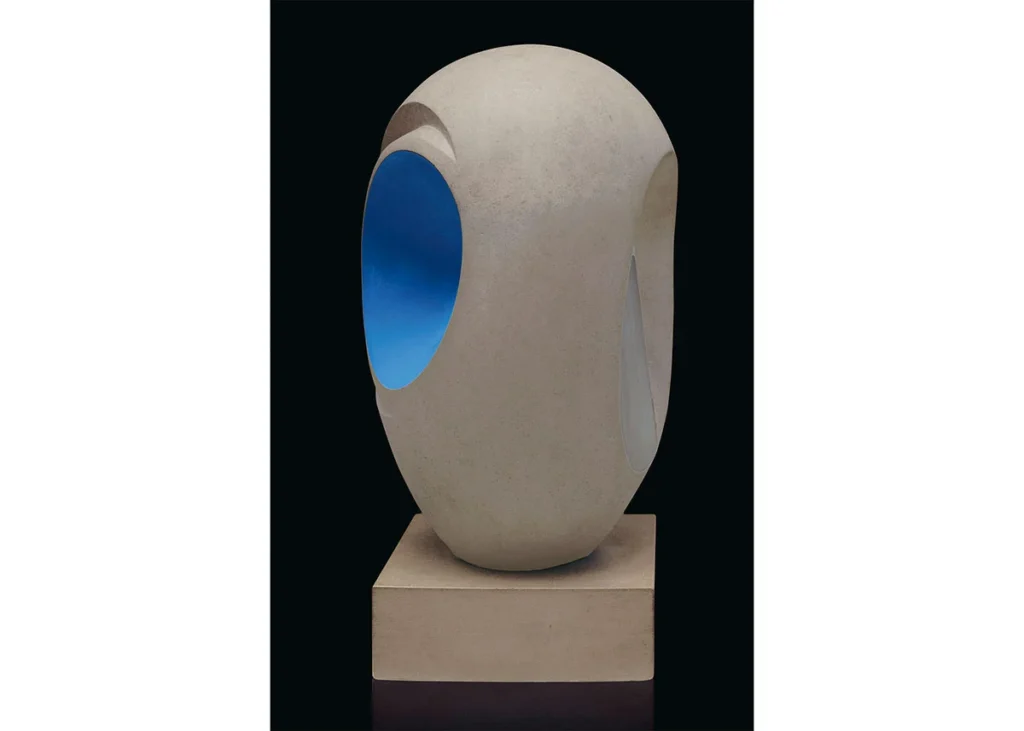
The international art market is turning its gaze toward London this autumn as Christie’s prepares to headline its Modern British and Irish Art Evening Sale with a cornerstone of 20th-century modernism. On October 21, the auction house will offer Barbara Hepworth’s seminal 1946 work, Sculpture with Colour (Eos), a piece that serves as a bridge between the artist’s pre-war geometric abstractions and her later, more organic, landscape-inspired forms.
With an estimate of £5 million to £8 million ($6.6 million to $10.5 million), the sculpture represents not only a significant financial asset but a pivotal moment in the history of British sculpture. Its appearance at auction follows a period of renewed institutional interest in Hepworth’s mastery of color and form, most recently highlighted in major exhibitions across the United Kingdom.
Main Facts: The Materiality and Vision of Eos
Sculpture with Colour (Eos) is a mid-career masterpiece carved from a single block of Hopton Wood stone—a fine-grained, cream-colored limestone from Derbyshire that was a favorite of both Hepworth and her contemporary, Henry Moore. Standing approximately two feet tall, the egg-shaped form exemplifies Hepworth’s "piercing" technique, a revolutionary approach she pioneered in the 1930s to explore the relationship between the exterior shell and the interior void.
What distinguishes this work from her earlier, purely monochromatic carvings is the deliberate and evocative use of color. The sculpture features three meticulously hollowed-out concavities, each painted in distinct shades: a pale gray, a soft off-white, and a deep, resonant blue. According to Christie’s, these pigments were not merely decorative but were intended to evoke "the depths of the ocean, the boundless sky and the infinite reaches of the cosmos."
The title itself, Eos, refers to the Greek goddess of the dawn, suggesting a theme of awakening and the interplay of light—a fitting metaphor for a work created in the immediate aftermath of World War II, as the British art scene sought to rebuild itself from the ruins of the conflict.
Chronology: From the Cornish Coast to the Pages of Vogue
The history of Sculpture with Colour (Eos) is inextricably linked to Hepworth’s life in Cornwall, a rugged landscape that fundamentally altered her artistic trajectory.
1939–1946: The Cornwall Migration
In 1939, on the eve of World War II, Hepworth moved from London to Carbis Bay, near St. Ives, with her husband, the painter Ben Nicholson, and their young triplets. The move was initially a flight from the Blitz, but the coastal environment—with its dramatic cliffs and shifting tides—became her primary muse. Sculpture with Colour (Eos) was carved in 1946, during a period when Hepworth was balancing the demands of motherhood with an intense creative output in a cramped studio.
1948–1949: The Lee Miller Connection
In 1948, the legendary photographer and war correspondent Lee Miller visited Hepworth at her Carbis Bay studio. Miller, a close friend of the artist, captured a series of intimate photographs for American Vogue. One iconic black-and-white image, published in the October 15, 1949, issue, shows Hepworth seated in a domestic setting, a cat curled nearby and a tea set in the foreground. To the right of the frame, resting on a side table, is Sculpture with Colour (Eos). This photograph cemented the sculpture’s status as a part of Hepworth’s personal and professional identity during her formative St. Ives years.
1949–Present: St. Ives and Beyond
Shortly after the Vogue feature, Hepworth moved to Trewyn Studio in St. Ives, where she would remain until her death in 1975. While the artist moved on to larger-scale bronze commissions in her later years, Eos remained a high-water mark of her direct carving phase. In the summer of 2024, the sculpture was a centerpiece of the "Hepworth in Colour" exhibition at the Courtauld Gallery in London, reaffirming its relevance to contemporary audiences.
Supporting Data: Provenance and Market Performance
The financial trajectory of Sculpture with Colour (Eos) reflects the explosive growth of the Modern British art market over the last several decades.
The Pincus Legacy
For much of the late 20th century, the sculpture was held in the prestigious collection of American philanthropists David and Geraldine Pincus. The couple acquired the piece in 1962 from the Martha Jackson Gallery in New York, a powerhouse of the mid-century art scene. The Pincus estate is renowned in the art world for its discerning eye; they famously owned Mark Rothko’s Orange, Red, Yellow (1961), which sold for a record-breaking $86.9 million in 2012.
Previous Auction Records
The current seller acquired Eos at Christie’s in 2016 for $5.4 million. At the time, the work carried an estimate of $1.2 million to $1.8 million, meaning the final hammer price was nearly triple its high estimate. The jump from a $5.4 million purchase price in 2016 to a potential $10.5 million valuation in 2024 represents a significant appreciation in value, underscoring the scarcity of museum-quality Hepworth carvings on the private market.
| Year | Event | Price/Estimate |
|---|---|---|
| 1946 | Created by Barbara Hepworth | N/A |
| 1962 | Purchased by David & Geraldine Pincus | Private Sale |
| 2016 | Sold at Christie’s New York | $5.4 Million |
| 2024 | Offered at Christie’s London | £5M – £8M ($6.6M – $10.5M) |
Official Responses: Expert Commentary
The significance of the upcoming sale has been emphasized by Christie’s leadership, who view the sculpture as a vital narrative thread in the artist’s career.
Alice Murray, Head of Modern British and Irish Art at Christie’s London, noted that the work has been "at the heart of Hepworth’s story for 80 years." Murray highlighted the sculpture’s dual importance: its inclusion in Hepworth’s first major postwar solo gallery exhibition in 1946 and its recent scholarship-driven display at the Courtauld.
"This sculpture represents a moment of profound transition," Murray stated in a press release. "By introducing color into the carved stone, Hepworth was not just decorating a surface; she was defining space and emotion in a way that felt entirely new to the British avant-garde. Its provenance and its appearance in Lee Miller’s photography only add to its allure as a historical artifact."
Art historians have also noted that Eos represents Hepworth’s "Truth to Materials" philosophy. By using Hopton Wood stone, she honored the British geological tradition while simultaneously pushing the material into the realm of modern abstraction.
Implications: The Rising Tide of Female Modernists
The sale of Sculpture with Colour (Eos) carries broader implications for the art market and the canon of Modern British art.
1. The "St. Ives School" Valuation
For years, the market for Modern British sculpture was dominated by Henry Moore. However, the last decade has seen a dramatic recalibration, with Barbara Hepworth’s prices frequently rivaling or exceeding those of her male contemporaries. Collectors are increasingly drawn to the "St. Ives School," valuing the organic, spiritual, and landscape-integrated qualities of Hepworth’s work over the more monumental, civic-oriented sculptures of the era.
2. The Rarity of Stone vs. Bronze
While Hepworth is well-known for her large-scale bronze editions (such as Single Form at the United Nations), her direct carvings in stone are significantly rarer. Because these are unique objects—rather than editions of six or nine—they command a premium. Eos is a prime example of this "unique" appeal, offering collectors the opportunity to own a piece literally shaped by the artist’s own hands.
3. The Intersection of Art and Fashion
The connection to Vogue and Lee Miller highlights the growing importance of "lifestyle provenance." In today’s market, a work of art is often valued not just for its aesthetic merits, but for the cultural world it inhabited. The fact that Eos was positioned in Hepworth’s home as a lived-with object, documented by one of the 20th century’s greatest photographers, adds a layer of glamour and historical texture that resonates with modern collectors.
4. Institutional Validation
The timing of the sale—following the Courtauld exhibition—is a classic example of the "museum effect." When major institutions provide fresh scholarship and public exposure to a specific period of an artist’s work, the market typically responds with increased confidence and higher price floors.
As Christie’s prepares for the October 21 auction, Sculpture with Colour (Eos) stands as a testament to Hepworth’s enduring legacy. It is more than a piece of stone; it is a vessel of postwar optimism, a masterclass in the use of color within three-dimensional space, and a rare survivor from the golden age of British Modernism. Whether it exceeds its $10.5 million high estimate remains to be seen, but its place in the history of art is already firmly carved in stone.



