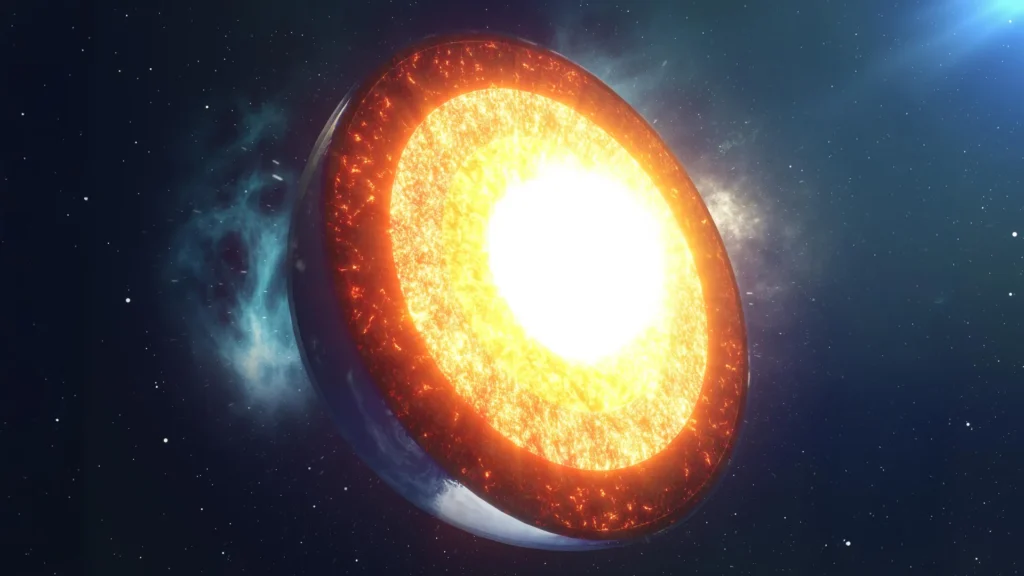
To the average person, a day is an immutable constant—a reliable 24-hour cycle dictated by the steady rotation of our planet. We set our alarms, manage our global infrastructure, and synchronize our digital lives based on this rigid framework. Yet, beneath the surface of our familiar clockwork reality, the Earth is engaged in a complex, invisible dance of momentum. Our planet’s rotation is not a perfect, uniform spin; it is a dynamic, shifting process, influenced by the turbulent, metallic heart hidden thousands of kilometers beneath our feet.
Recent research has brought a long-standing geophysical mystery into sharper focus: why the length of our days fluctuates by milliseconds. A new study, published in the journal Nature on September 23, provides a breakthrough explanation for these variations, revealing that the Earth’s inner core—a solid iron sphere—is far more dynamic and influential than previously understood.
The Mechanics of Time: Main Facts and Observations
The fundamental concept at play is the conservation of angular momentum. Because Earth is a closed system, its total angular momentum must remain constant. However, the components that make up the planet—the liquid outer core, the solid inner core, and the rocky mantle—are not locked together in a rigid, singular rotation.
For roughly three decades, geophysicists have observed that the liquid outer core does not rotate at a fixed rate. Fluctuations in the planet’s magnetic field have allowed scientists to track these changes, noting that the liquid core periodically speeds up over several decades, only to decelerate in the decades that follow.
As the liquid core alters its speed, the mantle—the 3,000-kilometer-thick layer of rock that includes the crust—must respond to compensate. When the core accelerates, the mantle slows down; conversely, when the core decelerates, the mantle speeds up. Because the mantle is the shell upon which we reside, these infinitesimal changes in its rotational speed translate directly into the shortening or lengthening of our days. While a change of a few milliseconds may seem trivial to the casual observer, it represents a profound interaction of physical forces on a planetary scale.
A History of Discovery: Chronology of Core-Mantle Dynamics
The realization that the Earth’s rotation is variable is not entirely new, but the mechanisms driving these fluctuations have remained elusive for decades.
The Early Observations (1990s–2000s)
In the late 20th century, satellite geodesy and high-precision monitoring of the Earth’s orientation began to reveal that the length of a day (LOD) was not perfectly stable. Scientists initially attributed these shifts to atmospheric and oceanic processes, such as changing wind patterns and ocean currents, which can shift mass around the planet and influence rotation. However, after accounting for these surface-level factors, a residual signal remained—one that pointed toward processes occurring deep within the Earth’s interior.
The Magnetic Connection
Researchers began linking these residuals to the Earth’s magnetic field. By studying the drift of magnetic poles and the variations in the magnetic field, geophysicists deduced that the fluid outer core was sloshing in a way that affected the rotation of the rest of the planet. This established the "Core-Mantle Coupling" theory, suggesting that the core and the mantle exert torques on one another.
The Recent Breakthrough (2024)
The study led by University of Alberta PhD student Huifeng Zhang and professor Mathieu Dumberry represents the latest chapter in this chronology. By applying sophisticated mathematical modeling to the relationship between the inner core and the mantle, the team has successfully identified the "gravitational tug" that acts as the missing link in the momentum exchange. This research shifts the focus from the fluid outer core alone to the interaction between the solid inner core and the mantle.
The Hidden Gravitational Tug: Supporting Data and Physics
The core of the new discovery lies in the gravitational interaction between the planet’s solid inner core and the mantle. The inner core is not a perfect sphere; it is slightly oblate and possesses an uneven distribution of mass.
Gravitational Torque
Zhang and Dumberry’s work demonstrates that as the inner core’s rotation fluctuates, its uneven mass distribution creates a "gravitational torque." Essentially, the inner core pulls on the uneven mass distribution within the mantle. This gravitational interaction acts as a coupling mechanism, allowing the inner core to exert a force that alters the rotational speed of the mantle.
The Counter-Force: Core-Mantle Boundary Torque
The system is not driven by gravity alone. The researchers identified a competing force known as "core-mantle boundary torque." This consists of friction and electromagnetic drag that oppose the gravitational pull.
The observed variation in the length of a day is the net result of a delicate tug-of-war between these two forces:
- Gravitational Torque: The "push-pull" effect caused by the non-spherical inner core acting on the mantle’s mass distribution.
- Electromagnetic/Frictional Torque: The resistance at the boundary between the liquid outer core and the mantle.
The study concludes that the small, measured variations in day length arise from the subtle shifts in the balance between these two forces. When the gravitational torque momentarily overcomes the frictional drag, the mantle’s rotation shifts, and the length of the day adjusts accordingly.
Official Perspectives and Scientific Implications
The implications of this research extend far beyond mere chronometry. By solving the riddle of the "missing" momentum exchange, Zhang and Dumberry have provided a window into the physical state of the Earth’s deepest interior.
Earth’s Dynamic Interior
Perhaps the most striking finding is the suggestion that the inner core is "viscously deformable." Traditionally, scientists viewed the solid inner core as a rigid, unyielding object. However, the models suggest that the inner core responds to gravitational and rotational forces by deforming over a timescale of roughly 10 years.
"This indicates that the Earth’s deepest interior is far more dynamic than its solid composition might suggest," the researchers noted. If the inner core can deform, it implies that the temperatures and pressures at the center of the planet allow for a level of plasticity that changes our understanding of how the Earth cools and evolves.
Implications for Geophysics
This study provides a new diagnostic tool for geophysicists. By observing changes in the length of a day, scientists can now "see" into the core-mantle boundary and the behavior of the inner core without needing direct samples. This non-invasive method of planetary probing helps refine models of the Earth’s magnetic field generation—the geodynamo—which protects our atmosphere from solar radiation.
Looking Toward Future Research
While the study provides a robust explanation for decadal variations, the scientific community is already looking ahead. Further research is required to determine if these models can account for even longer-term shifts in rotation, such as those occurring over centuries. Additionally, the role of thermal convection in the core remains a subject of intense investigation. As satellite technology improves, our ability to measure these milliseconds of difference will become even more precise, allowing researchers to test the Zhang-Dumberry model against even more granular data.
Conclusion: A World in Constant Motion
The realization that our days are being sculpted by the gravitational tug of an iron heart deep beneath our feet is a humbling reminder of Earth’s complexity. We often view the planet as a static stage upon which our lives unfold, but in reality, the stage itself is moving.
The work of Huifeng Zhang and Mathieu Dumberry bridges the gap between the abstract forces of physics and the tangible reality of our daily clocks. It transforms the "millisecond" from a mere measurement error into a vital piece of data that reveals the inner workings of our world. As we continue to refine our understanding of these deep-seated processes, we move closer to a complete picture of the Earth as a living, breathing, and constantly shifting machine. The next time you glance at your watch, remember: the pulse of the planet is ticking right along with you.