High in the Colorado Rockies, five acres of land in Snowmass serve as a sanctuary for the act of creation. The Anderson Ranch Arts Center, a sprawling complex of studios and residences, is frequently described as a “maker’s paradise.” Upon arrival, the moniker becomes tangible: the 8,000-foot elevation quickens the pulse, the air is sharp enough to invigorate the lungs, and the surrounding mountain vista—dotted with the watchful, eye-like markings of aspen bark—demands a tactile response. Here, the impulse to create feels primal, turning even the mundane task of brewing morning coffee into an act of intentionality.
However, during the center’s 60th-anniversary celebrations this past July, that crisp mountain air carried a more volatile charge. An unrelenting drought had rendered the landscape parched, placing the region under an "extreme" fire danger rating. At the nearby Snowmass Wildcat fire station, the warning arrow sat firmly in the red, a stark reminder of the environmental fragility of the high desert. The threat was so immediate that the Ranch’s artists required special permits just to fire their kilns, and the theme of the annual gala—"Sparkle"—felt almost transgressive in the tinderbox environment.
The Evolution of an Artistic Haven: A Chronology
The story of Anderson Ranch is inextricably linked to its founder, Paul Soldner, a visionary who sought to decouple the ceramic arts from their historical confinement to utility. In the 1960s, following the path set by his mentor Peter Voulkos, Soldner pioneered "American Raku," a technique that emphasized the expressive potential of clay over the manufacture of vessels.
The Ranch’s origin story is rooted in a moment of profound humanitarian realization. During his service as a medic in the U.S. Army, Soldner participated in the liberation of the Mauthausen concentration camp in Austria. There, he witnessed charcoal drawings etched into the walls of a cell by an anonymous prisoner. According to his daughter, this encounter fundamentally redirected his life; rather than pursuing a medical career, Soldner committed himself to art, eventually establishing the Ranch in 1966.
In its infancy, the center was little more than a kiln in an open field. Historical accounts from the era describe a rugged, almost mythic atmosphere. Early visitors often recount stories of sleeping in their cars and using garden hoses for showers, while a jerry-rigged hot tub became a central—and legendary—social hub. As the decades progressed, the Ranch began to professionalize. The 1970s and 80s brought a shift toward structured programming, the dismantling of the communal hot tub, and the implementation of formal dress codes, yet the "wild" spirit persisted. Stories remain of directors like Caleb Bach, a former CIA agent who used the Ranch as a cover while waiting for a Russian handler who never appeared.
Supporting Data: Growth and Infrastructure
Since its humble beginnings, Anderson Ranch has undergone a significant transformation. Today, it operates as a sophisticated, year-round institution with an operating budget of $7.6 million and an endowment of approximately $17 million.
The scale of its impact has increased exponentially. In the 1980s, the center hosted roughly 175 students during the summer months. Today, that number has swelled to over 1,200 students annually. The facilities have evolved in lockstep with this growth: the campus now boasts high-tech digital fabrication labs, state-of-the-art 3D printers, and a comprehensive scholarship program.
Despite this professionalization, current leadership maintains that the core mission remains the same: the preservation of artistic freedom. Under the direction of Peter Waanders, who joined in 2019 after a distinguished tenure at the Aspen Institute, the center has sought to balance its expansion with the preservation of its historical character.
Official Responses and Strategic Vision
Peter Waanders views his mandate as a dual effort: building a sustainable, long-term foundation while honoring the relationships that forged the Ranch’s legacy. In an interview, Waanders emphasized the importance of technology in keeping the center relevant.
"I want to make sure we continue to be on that edge that is melding craft and fine art," Waanders noted. He pointed to a photograph of Dennis Hopper using early Photoshop software at the Ranch in 1995 as evidence of the center’s long-standing commitment to innovation. Currently, the institution is investing heavily in advanced CNC machinery—tools costing as much as $250,000—to ensure students are equipped with the latest fabrication capabilities.
Looking toward the next two decades, Waanders is focused on infrastructure. "Our campus was mostly built in the 80s and 90s, so all of my boilers are 40 years old," he explained. The strategic plan involves a major overhaul of the facilities, including the potential replacement of the photography and new media buildings. Additionally, Waanders intends to expand the Ranch’s role as a thought leader, planning for a new seminar space dedicated to critical discussions on the role of public art, as well as the intersection of race, class, and gender in the contemporary art market.
Andrea Jenkins Wallace, the Ranch’s president of artistic affairs and an 18-year veteran of the staff, maintains that the institution retains its agility. "We’re still very nimble," Wallace said. "It’s not so big that we can’t just say, ‘Okay, let’s just do this’ to a new program."
Implications: The Tension of the "Art World"
The Anderson Ranch of today exists in a complex, often contradictory space. It seeks to remain in dialogue with the global contemporary art world while providing a refuge from it. Many practitioners value the Ranch specifically for its "separateness." Curator Helen Molesworth has famously praised the center for its "Utopian summer-camp vibe," where hierarchies collapse.
"You have everyone from Simone Leigh to a Sunday painter," Molesworth remarked. "If you put art-making at the center… all of those divisions fall away."
However, this "separateness" is challenged by the realities of its geography. Located just nine miles from Aspen—a town where the average home price sits at $14 million—the Ranch is surrounded by extreme wealth. Local artists, such as Richard Carter, have noted the difficulty of maintaining a creative life in an area where the cost of living has forced out essential support structures, such as assistants and specialized craftsmen.
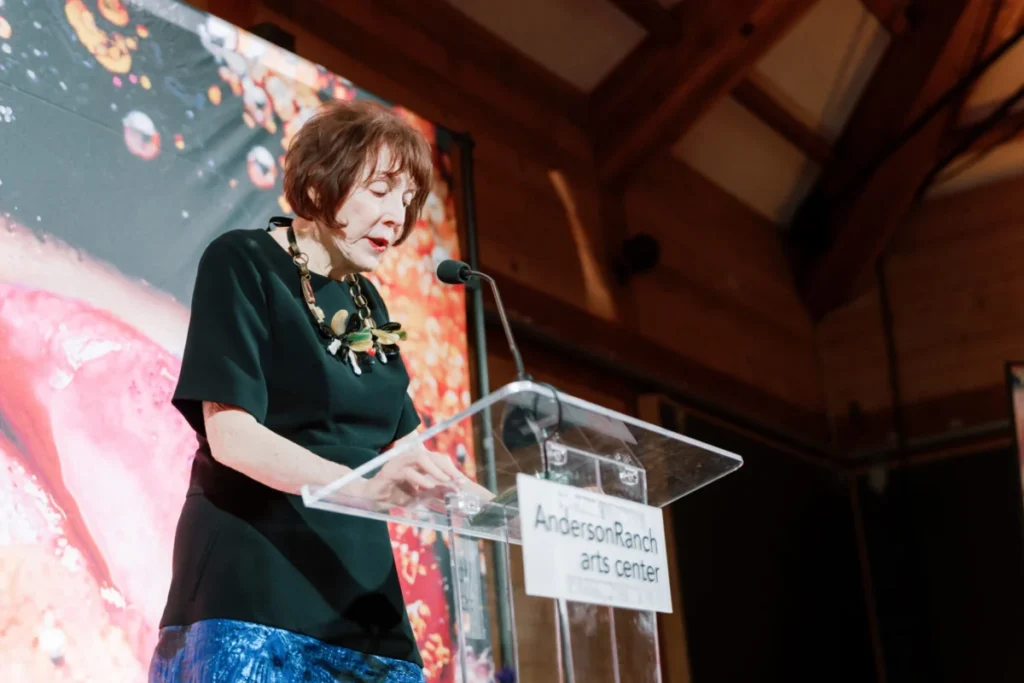
The annual gala serves as the most potent illustration of this tension. It is a moment where the "maker’s paradise" is momentarily overtaken by the high-stakes environment of the art market. The evening’s proceedings—featuring attendees in couture negotiating gravel paths in vertiginous heels—clash with the rustic, dirt-under-the-fingernails reality of the workshops.
Yet, the event remains vital; it provides nearly a third of the institution’s annual revenue. During this year’s auction, more than $1.6 million was raised for scholarships and programming. The juxtaposition was perhaps best summarized by the dessert served that night: humble doughnuts fashioned into rainbows. It was a small, sweet reminder of the Ranch’s ethos—the ability to take the most basic, elemental materials and, through effort and imagination, transform them into something that matters.
As the Ranch moves into its seventh decade, the challenge for Waanders and his team will be to keep that "can-do" spirit alive while the institution itself grows larger, more expensive, and more deeply integrated into the professional art establishment. Whether the Ranch can continue to be a place where a billionaire and a scholarship student sit side-by-side at a workbench remains the true measure of its success. For now, the kilns remain lit, the aspen trees continue to watch, and the work continues.