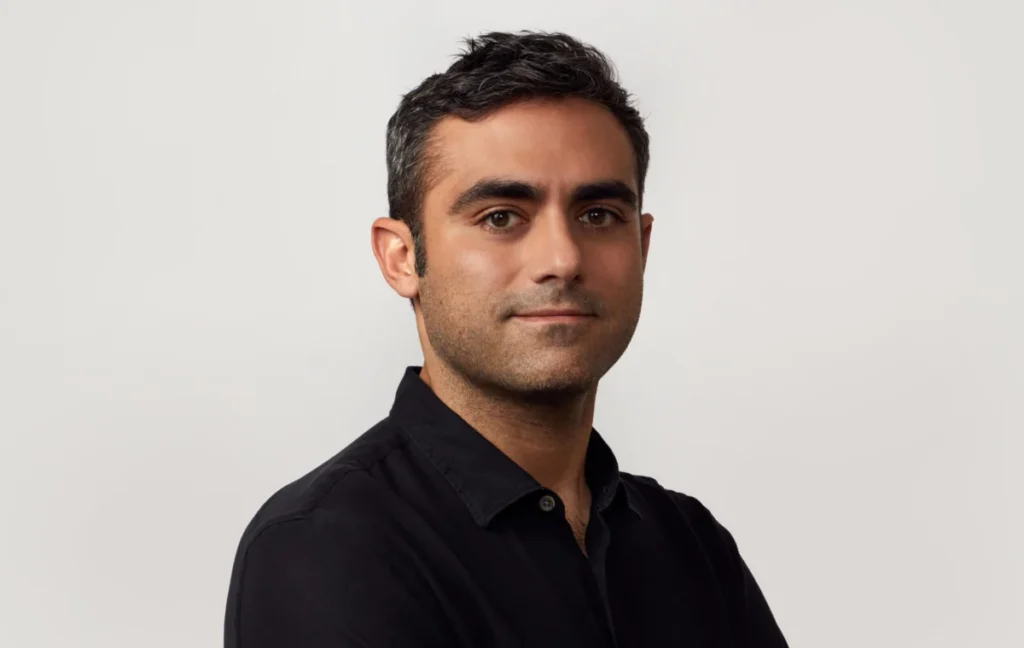
Michael Polansky is an anomaly in the high-decibel world of Silicon Valley and global celebrity. Seated at a sun-dappled patio in the affluent enclave of Mill Valley, California, the Harvard-educated polymath cuts a figure more reminiscent of a tenured professor than a high-stakes entrepreneur. With his dark, gray-streaked hair and thoughtful demeanor, he appears perfectly at ease—an unassuming mask for a man who is currently operating at the intersection of two of the world’s most intense industries: the cutthroat frontier of biotechnology and the blinding spotlight of international stardom.
As the co-founder of the stealth-mode startup Outer Biosciences and the long-term partner of global icon Lady Gaga (Stefani Germanotta), Polansky lives a life of profound contrast. While the tabloids track his movements alongside one of the world’s most famous performers, his professional life is defined by a meticulous, years-long endeavor to solve a fundamental biological mystery: how to keep living human tissue viable outside the body for weeks, not days.
The Unlikely Path: From Bridgewater to Biotechnology
Polansky’s professional trajectory was not a straight line toward scientific innovation. A Minnesota native, he arrived at Harvard University with an interest in applied mathematics and computer science, graduating in 2006. His early career saw him navigating the high-pressure corridors of hedge fund giant Bridgewater Associates. Polansky recalls the experience as "a very unique place" that provided a strong foundation, though it ultimately lacked the creative spark necessary to keep him engaged for the long term.
His pivot toward the West Coast began with a serendipitous connection. A childhood neighbor happened to be working as an assistant to Sean Parker, the co-founder of Napster and the first president of Facebook. At a wedding in Minnesota in 2009, the assistant suggested that Parker was looking for new talent. After a dinner in New York that resulted in an immediate rapport, Polansky resigned from Bridgewater the following day and relocated to San Francisco.
He initially cut his teeth as a principal at Founders Fund, sharing an office with Brian Singerman during the firm’s early, formative years under the leadership of Peter Thiel, Sean Parker, Luke Nosek, and Ken Howery. When Parker transitioned to managing his own family office, Polansky went with him. For years, he served as the architect of Parker’s diverse business, investment, and philanthropic empire, including the critical task of helping to establish the Parker Institute for Cancer Immunotherapy. It was here, amidst the "fringe" science of cancer research, that Polansky found his true calling.
A Partnership of Power and Purpose
The convergence of Polansky’s personal and professional lives reached a turning point in late 2019. He met Stefani Germanotta at one of Parker’s birthday celebrations—a setup orchestrated by her mother, Cynthia Germanotta, who had grown close to Polansky through their mutual philanthropic work with the Born This Way Foundation.
Their relationship has evolved into a formidable professional and personal alliance. The pair managed the logistical behemoth of Lady Gaga’s recent world tour, an operation Polansky likens to "running a 200-person startup that travels around the world every day." Beyond the stage, they have collaborated closely on Haus Labs, the cosmetics brand Germanotta built from the ground up rather than through traditional celebrity licensing.
"People really haven’t gotten to know a certain side of her publicly," Polansky says, beaming. "She’s such a brilliant businessperson." This synergy extends to the boardroom; Germanotta serves on the board of Outer Biosciences, and the two companies—Haus Labs and Outer Biosciences—have begun exploring cross-collaborative scientific projects, with top talent like Chief Scientist Kyung-Jin Jang providing advisory expertise across both ventures.
From Cancer Immunotherapy to Tissue in a Dish
Outer Biosciences, founded in 2022, represents the culmination of Polansky’s frustration with the limitations of modern research. "I got into life sciences accidentally," he admits, noting that the pace of innovation in biology has historically lagged behind software because of the ethical impossibility of using humans as test subjects for every iteration. Current proxies—animal models and simplistic lab-grown organoids—are often poor predictors of how complex, living human tissue will react to new compounds.
Outer Biosciences has circumvented these limitations by sourcing living human skin tissue that would otherwise be discarded during surgical procedures. By partnering with vetted non-profit and commercial biobanks, such as the National Disease Research Interchange and the Cooperative Human Tissue Network, the company receives tissue samples within hours of surgery.
The startup’s primary breakthrough is a proprietary system that maintains the viability of this tissue for up to a month. While the industry standard for tissue survival is typically a matter of days—sufficient for acute toxicity tests but useless for observing long-term biological processes—Outer’s system preserves the tissue’s "day-zero architecture." This allows researchers to observe complex, time-dependent phenomena like collagen remodeling, pigmentation changes, and barrier repair.
Leveraging AI for Rapid Discovery
The company’s methodology is a closed-loop system powered by artificial intelligence. Instead of relying on "brute force" screening of chemical libraries, Outer Biosciences feeds experimental data from its living-tissue models back into an AI engine.
"We are generating a new candidate roughly every six weeks," Polansky explains. With six active leads currently in the pipeline and dozens of additional "hits" logged, the company has drastically outpaced traditional R&D timelines. The AI model predicts which untested chemicals are likely to benefit specific skin functions, the living-tissue system tests those predictions, and the results then refine the model’s future guesses.
Because the company is focused on cosmetic ingredients rather than pharmaceutical drugs, the regulatory path is significantly more streamlined. They operate under the guidelines of the OECD (Organisation for Economic Co-operation and Development), which allows for standardized testing that is recognized across more than 40 countries.
Official Responses and Market Implications
The startup has maintained a low profile for years, raising approximately $23 million from backers including Wing Ventures, Initialized, and Polansky’s own investment firm, Hawktail. With 19 employees based near Cambridge, Massachusetts, the company is finally stepping into the public eye to scale its operations.
The implications for the beauty and pharmaceutical industries are vast. Outer Biosciences plans to license or sell its validated ingredients to major brands, essentially acting as the R&D engine for the next generation of skin-active products. They are already engaged in collaborative research with pharmaceutical partners to investigate the causes of severe skin rashes induced by cancer treatments, demonstrating the versatility of their platform.
Polansky remains unfazed by competition from companies like Philadelphia-based Vivodyne, which recently secured $80 million in funding for its own lab-grown tissue technology. He views the landscape as vast enough for multiple players, noting that unlike the "biology internet" which doesn’t exist, the proprietary, high-fidelity data Outer Biosciences is generating serves as an incredibly defensible moat.
Looking Ahead: The Future of Dermatology
As the sun sets on the Mill Valley bakery, Polansky looks toward the future with a sense of measured optimism. The goal is not merely to build a product-development firm, but to create a predictive model so robust that the need for physical experimentation is reduced to a fraction of its current requirement.
"I think it’s going to be fun to have people know that this is what we’ve been doing," he says, shrugging off the pressure of the transition from stealth to public operations. For a man who has successfully navigated the worlds of hedge funds, celebrity, and high-science, the transition seems like just another day in a life defined by quiet, relentless innovation.
By bridging the gap between the chaotic, complex nature of living tissue and the precision of artificial intelligence, Michael Polansky is not just chasing trends—he is changing the fundamental methodology of how we understand, protect, and heal human skin. The era of the "biology internet" may not be here yet, but thanks to Outer Biosciences, the roadmap to get there is finally coming into focus.